Archive for the ‘Complexity’ Category

Quantum advantage for NP approximation? For REAL this time?

Saturday, October 5th, 2024

The other night I spoke at a quantum computing event and was asked—for the hundredth time? the thousandth?—whether I agreed that the quantum algorithm called QAOA was poised revolutionize industries by finding better solutions to NP-hard optimization problems. I replied that while serious, worthwhile research on that algorithm continues, alas, so far I have yet to see a single piece of evidence that QAOA outperforms the best classical heuristics on any problem that anyone cares about. (Note added: in the comments, Ashley Montanaro shares a paper with empirical evidence that QAOA provides a modest polynomial speedup over known classical heuristics for random k-SAT. This is the best/only such evidence I’ve seen, and which still stands as far as I know!)

I added I was sad to see the arXiv flooded with thousands of relentlessly upbeat QAOA papers that dodge the speedup question by simply never raising it at all. I said that, in my experience, these papers reliably led outsiders to conclude that surely there must be lots of excellent known speedups from QAOA—since otherwise, why would so many people be writing papers about it?

Anyway, the person right after me talked about a “quantum dating app” (!) they were developing.

I figured that, as usual, my words had thudded to the ground with zero impact, truth never having had a chance against what sounds good and what everyone wants to hear.

But then, the morning afterward, someone from the audience emailed me that, incredulous at my words, he went through a bunch of QAOA papers, looking for the evidence of its beating classical algorithms that he knew must be in them, and was shocked to find the evidence missing, just as I had claimed! So he changed his view.

That one message filled me with renewed hope about my ability to inject icy blasts of reality into the quantum algorithms discourse.


So, with that prologue, surely I’m about to give you yet another icy blast of quantum algorithms not helping for optimization problems?

Aha! Inspired by Scott Alexander, this is the part of the post where, having led you one way, I suddenly jerk you the other way. My highest loyalty, you see, is not to any narrative, but only to THE TRUTH.

And the truth is this: this summer, my old friend Stephen Jordan and seven coauthors, from Google and elsewhere, put out a striking preprint about a brand-new quantum algorithm for optimization problems that they call Decoded Quantum Interferometry (DQI). This week Stephen was gracious enough to explain the new algorithm in detail when he visited our group at UT Austin.

DQI can be used for a variety of NP-hard optimization problems, at least in the regime of approximation where they aren’t NP-hard. But a canonical example is what the authors call “Optimal Polynomial Intersection” or OPI, which involves finding a low-degree polynomial that intersects as many subsets as possible from a given list. Here’s the formal definition:

OPI. Given integers n<p with p prime, we’re given as input subsets S1,…,Sp-1 of the finite field Fp. The goal is to find a degree-(n-1) polynomial Q that maximizes the number of y∈{1,…,p-1} such that Q(y)∈Sy, i.e. that intersects as many of the subsets as possible.

For this problem, taking as an example the case p-1=10n and |Sy|=⌊p/2⌋ for all y, Stephen et al. prove that DQI satisfies a 1/2 + (√19)/20 ≈ 0.7179 fraction of the p-1 constraints in polynomial time. By contrast, they say the best classical polynomial-time algorithm they were able to find satisfies an 0.55+o(1) fraction of the constraints.

To my knowledge, this is the first serious claim to get a better approximation ratio quantumly for an NP-hard problem, since Farhi et al. made the claim for QAOA solving something called MAX-E3LIN2 back in 2014, and then my blogging about it led to a group of ten computer scientists finding a classical algorithm that got an even better approximation.

So, how did Stephen et al. pull this off? How did they get around the fact that, again and again, exponential quantum speedups only seem to exist for algebraically structured problems like factoring or discrete log, and not for problems like 3SAT or Max-Cut that lack algebraic structure?

Here’s the key: they didn’t. Instead they leaned into the fact, by targeting an optimization problem that (despite being NP-hard) has loads of algebraic structure! The key insight, in their new DQI algorithm, is that the Quantum Fourier Transform can be used to reduce other NP-hard problems to problems of optimal decoding of a suitable error-correcting code. (This insight built on the breakthrough two years ago by Yamakawa and Zhandry, giving a quantum algorithm that gets an exponential speedup for an NP search problem relative to a random oracle.)

Now, sometimes the reduction to a coding theory problem is “out of the frying pan and into the fire,” as the new optimization problem is no easier than the original one. In the special case of searching for a low-degree polynomial, however, the optimal decoding problem ends up being for the Reed-Solomon code, where we’ve known efficient classical algorithms for generations, famously including the Berlekamp-Welch algorithm.

One open problem that I find extremely interesting is whether OPI, in the regime where DQI works, is in coNP or coAM, or has some other identifiable structural feature that presumably precludes its being NP-hard.

Regardless, though, as of this week, the hope of using quantum computers to get better approximation ratios for NP-hard optimization problems is back in business! Will that remain so? Or will my blogging about such an attempt yet again lead to its dequantization? Either way I’m happy.

The Zombie Misconception of Theoretical Computer Science

Monday, July 8th, 2024

In Michael Sipser’s Introduction to the Theory of Computation textbook, he has one Platonically perfect homework exercise, so perfect that I can reconstruct it from memory despite not having opened the book for over a decade. It goes like this:

  • Let f:{0,1}*→{0,1} be the constant 1 function if God exists, or the constant 0 function if God does not exist. Is f computable? (Hint: The answer does not depend on your religious beliefs.)

The correct answer is that yes, f is computable. Why? Because the constant 1 function is computable, and so is the constant 0 function, so if f is one or the other, then it’s computable.

If you’re still tempted to quibble, then consider the following parallel question:

  • Let n equal 3 if God exists, or 5 if God does not exist. Is n prime?

The answer is again yes: even though n hasn’t been completely mathematically specified, it’s been specified enough for us to say that it’s prime (just like if we’d said, “n is an element of the set {3,5}; is n prime?”). Similarly, f has been specified enough for us to say that it’s computable.

The deeper lesson Sipser was trying to impart is that the concept of computability applies to functions or infinite sequences, not to individual yes-or-no questions or individual integers. Relatedly, and even more to the point: computability is about whether a computer program exists to map inputs to outputs in a specified way; it says nothing about how hard it might be to choose or find or write that program. Writing the program could even require settling God’s existence, for all the definition of computability cares.


Dozens of times in the past 25 years, I’ve gotten some variant on the following question, always with the air that I’m about to bowled over by its brilliance:

  • Could the P versus NP question itself be NP-hard, and therefore impossible to solve?

Every time I get this one, I struggle to unpack the layers of misconceptions. But for starters: the concept of “NP-hard” applies to functions or languages, like 3SAT or Independent Set or Clique or whatnot, all of which take an input (a Boolean formula, a graph, etc) and produce a corresponding output. NP-hardness means that, if you had a polynomial-time algorithm to map the inputs to the outputs, then you could convert it via reductions into a polynomial-time algorithm for any language or function in the class NP.

P versus NP, by contrast, is an individual yes-or-no question. Its answer (for all we know) could be independent of the Zermelo-Fraenkel axioms of set theory, but there’s no sense in which the question could be uncomputable or NP-hard. Indeed, a fast program that correctly answers the P vs. NP question trivially exists:

  • If P=NP, then the program prints “P=NP.”
  • If P≠NP, then the program prints “P≠NP.”

In the comments of last week’s post on the breakthrough determination of Busy Beaver 5, I got several variants on the following question:

  • What’s the smallest n for which the value of BB(n) is uncomputable? Could BB(6) already be uncomputable?

Once again, I explained that the Busy Beaver function is uncomputable, but the concept of computability doesn’t apply to individual integers like BB(6). Indeed, whichever integer k turns out to equal BB(6), the program “print k” clearly exists, and it clearly outputs that integer!

Again, we can ask for the smallest n such that the value of BB(n) is unprovable in ZF set theory (or some other system of axioms)—precisely the question that Adam Yedidia and I did ask in 2016 (the current record stands at n=745, improving my and Adam’s n=8000). But every specific integer is “computable”; it’s only the BB function as a whole that’s uncomputable.

Alas, in return for explaining this, I got more pushback, and even ridicule and abuse that I chose to leave in the moderation queue.


So, I’ve come to think of this as the Zombie Misconception of Theoretical Computer Science: this constant misapplication of concepts that were designed for infinite sequences and functions, to individual integers and open problems. (Or, relatedly: the constant conflation of the uncomputability of the halting problem with Gödel incompleteness. While they’re closely related, only Gödel lets you talk about individual statements rather than infinite families of statements, and only Turing-computability is absolute, rather than relative to a system of axioms.)

Anyway, I’m writing this post mostly just so that I have a place to link the next time this pedagogical zombie rises from its grave, muttering “UNCOMPUTABLE INTEGERRRRRRS….” But also so I can query my readers: what are your ideas for how to keep this zombie down?

BusyBeaver(5) is now known to be 47,176,870

Tuesday, July 2nd, 2024

The news these days feels apocalyptic to me—as if we’re living through, if not the last days of humanity, then surely the last days of liberal democracy on earth.

All the more reason to ignore all of that, then, and blog instead about the notorious Busy Beaver function! Because holy moly, what news have I got today. For lovers of this super-rapidly-growing sequence of integers, I’ve honored to announce the biggest Busy Beaver development that there’s been since 1983, when I slept in a crib and you booted up your computer using a 5.25-inch floppy. That was the year when Allen Brady determined that BusyBeaver(4) was equal to 107. (Tibor Radó, who invented the Busy Beaver function in the 1960s, quickly proved with his student Shen Lin that the first three values were 1, 6, and 21 respectively. The fourth value was harder.)

Only now, after an additional 41 years, do we know the fifth Busy Beaver value. Today, an international collaboration called bbchallenge is announcing that it’s determined, and even formally verified using the Coq proof system, that BB(5) is equal to 47,176,870—the value that’s been conjectured since 1990, when Heiner Marxen and Jürgen Buntrock discovered a 5-state Turing machine that runs for exactly 47,176,870 steps before halting, when started on a blank tape. The new bbchallenge achievement is to prove that all 5-state Turing machines that run for more steps than 47,176,870, actually run forever—or in other words, that 47,176,870 is the maximum finite number of steps for which any 5-state Turing machine can run. That’s what it means for BB(5) to equal 47,176,870.

For more on this story, see Ben Brubaker’s superb article in Quanta magazine, or bbchallenge’s own announcement. For more background on the Busy Beaver function, see my 2020 survey, or my 2017 big numbers lecture, or my 1999 big numbers essay, or the Googology Wiki page, or Pascal Michel’s survey.


The difficulty in pinning down BB(5) was not just that there are a lot of 5-state Turing machines (16,679,880,978,201 of them to be precise, although symmetries reduce the effective number). The real difficulty is, how do you prove that some given machine runs forever? If a Turing machine halts, you can prove that by simply running it on your laptop until halting (at least if it halts after a “mere” ~47 million steps, which is child’s-play). If, on the other hand, the machine runs forever, via some never-repeating infinite pattern rather than a simple infinite loop, then how do you prove that? You need to find a mathematical reason why it can’t halt, and there’s no systematic method for finding such reasons—that was the great discovery of Gödel and Turing nearly a century ago.

More precisely, the Busy Beaver function grows faster than any function that can be computed, and we know that because if a systematic method existed to compute arbitrary BB(n) values, then we could use that method to determine whether a given Turing machine halts (if the machine has n states, just check whether it runs for more than BB(n) steps; if it does, it must run forever). This is the famous halting problem, which Turing proved to be unsolvable by finite means. The Busy Beaver function is Turing-uncomputability made flesh, a finite function that scrapes the edge of infinity.

There’s also a more prosaic issue. Proofs that particular Turing machines run forever tend to be mind-numbingly tedious. Even supposing you’ve found such a “proof,” why should other people trust it, if they don’t want to spend days staring at the outputs of your custom-written software?

And so for decades, a few hobbyists picked away at the BB(5) problem. One, who goes by the handle “Skelet”, managed to reduce the problem to 43 holdout machines whose halting status was still undetermined. Or maybe only 25, depending who you asked? (And were we really sure about the machines outside those 43?)

The bbchallenge collaboration improved on the situation in two ways. First, it demanded that every proof of non-halting be vetted carefully. While this went beyond the original mandate, a participant named “mxdys” later upped the standard to fully machine-verifiable certificates for every non-halting machine in Coq, so that there could no longer be any serious question of correctness. (This, in turn, was done via “deciders,” programs that were crafted to recognize a specific type of parameterized behavior.) Second, the collaboration used an online forum and a Discord server to organize the effort, so that everyone knew what had been done and what remained to be done.

Despite this, it was far from obvious a priori that the collaboration would succeed. What if, for example, one of the 43 (or however many) Turing machines in the holdout set turned out to encode the Goldbach Conjecture, or one of the other great unsolved problems of number theory? Then the final determination of BB(5) would need to await the resolution of that problem. (We do know, incidentally, that there’s a 27-state Turing machine that encodes Goldbach.)

But apparently the collaboration got lucky. Coq proofs of non-halting were eventually found for all the 5-state holdout machines.

As a sad sidenote, Allen Brady, who determined the value of BB(4), apparently died just a few days before the BB(5) proof was complete. He was doubtful that BB(5) would ever be known. The reason, he wrote in 1988, was that “Nature has probably embedded among the five-state holdout machines one or more problems as illusive as the Goldbach Conjecture. Or, in other terms, there will likely be nonstopping recursive patterns which are beyond our powers of recognition.”


Maybe I should say a little at this point about what the 5-state Busy Beaver—i.e., the Marxen-Buntrock Turing machine that we now know to be the champion—actually does. Interpreted in English, the machine iterates a certain integer function g, which is defined by

  • g(x) = (5x+18)/3 if x = 0 (mod 3),
  • g(x) = (5x+22)/3 if x = 1 (mod 3),
  • g(x) = HALT if x = 2 (mod 3).

Starting from x=0, the machine computes g(0), g(g(0)), g(g(g(0))), and so forth, halting if and if it ever reaches … well, HALT. The machine runs for millions of steps because it so happens that this iteration eventually reaches HALT, but only after a while:

0 → 6 → 16 → 34 → 64 → 114 → 196 → 334 → 564 → 946 → 1584 → 2646 → 4416 → 7366 → 12284 → HALT.

(And also, at each iteration, the machine runs for a number of steps that grows like the square of the number x.)

Some readers might be reminded of the Collatz Conjecture, the famous unsolved problem about whether, if you repeatedly replace a positive integer x by x/2 if x is even or 3x+1 if x is odd, you’ll always eventually reach x=1. As Scott Alexander would say, this is not a coincidence because nothing is ever a coincidence. (Especially not in math!)


It’s a fair question whether humans will ever know the value of BB(6). Pavel Kropitz discovered, a couple years ago, that BB(6) is at least 10^10^10^10^10^10^10^10^10^10^10^10^10^10^10 (i.e., 10 raised to itself 15 times). Obviously Kropitz didn’t actually run a 6-state Turing machine for that number of steps until halting! Instead he understood what the machine did—and it turned out to apply an iterative process similar to the g function above, but this time involving an exponential function. And the process could be proven to halt after ~15 rounds of exponentiation.

Meanwhile Tristan Stérin, who coordinated the bbchallenge effort, tells me that a 6-state machine was recently discovered that “iterates the Collatz-like map {3x/2, (3x-1)/2} from the number 8 and halts if and only if the number of odd terms ever gets bigger than twice the number of even terms.” This shows that, in order to determine the value of BB(6), one would first need to prove or disprove the Collatz-like conjecture that that never happens.

Basically, if and when artificial superintelligences take over the world, they can worry about the value of BB(6). And then God can worry about the value of BB(7).


I first learned about the BB function in 1996, when I was 15 years old, from a book called The New Turing Omnibus by A. K. Dewdney.  From what I gather, Dewdney would go on to become a nutty 9/11 truther.  But that’s irrelevant to the story.  What matters was that his book provided my first exposure to many of the key concepts of computer science, and probably played a role in my becoming a theoretical computer scientist at all.

And of all the concepts in Dewdney’s book, the one I liked the most was the Busy Beaver function. What a simple function! You could easily explain its definition to Archimedes, or Gauss, or any of the other great mathematicians of the past. And yet, by using it, you could name definite positive integers (BB(10), for example) incomprehensibly larger than any that they could name.

It was from Dewdney that I learned that the first four Busy Beaver numbers were the unthreatening-looking 1, 6, 21, and 107 … but then that the fifth value was already unknown (!!), and at any rate at least 47,176,870. I clearly remember wondering whether BB(5) would ever be known for certain, and even whether I might be the one to determine it. That was almost two-thirds of my life ago.

As things developed, I played no role whatsoever in the determination of BB(5) … except for this. Tristan Stérin tells me that reading my survey article, The Busy Beaver Frontier, was what inspired him to start and lead the bbchallenge collaboration that finally cracked the problem. It’s hard to express how gratified that makes me.


Why care about determining particular values of the Busy Beaver function? Isn’t this just a recreational programming exercise, analogous to code golf, rather than serious mathematical research?

I like to answer that question with another question: why care about humans landing on the moon, or Mars? Those otherwise somewhat arbitrary goals, you might say, serve as a hard-to-fake gauge of human progress against the vastness of the cosmos. In the same way, the quest to determine the Busy Beaver numbers is one concrete measure of human progress against the vastness of the arithmetical cosmos, a vastness that we learned from Gödel and Turing won’t succumb to any fixed procedure. The Busy Beaver numbers are just … there, Platonically, as surely as 13 was prime long before the first caveman tried to arrange 13 rocks into a nontrivial rectangle and failed. And yet we might never know the sixth of these numbers and only today learned the fifth.

Anyway, huge congratulations to the bbchallenge team on their accomplishment. At a terrifying time for the world, I’m happy that, whatever happens, at least I lived to see this.

UmeshFest

Friday, May 10th, 2024

Unrelated Announcements: See here for a long interview with me in The Texas Orator, covering the usual stuff (quantum computing, complexity theory, AI safety). And see here for a podcast with me and Spencer Greenberg about a similar mix of topics.


A couple weeks ago, I helped organize UmeshFest: Don’t Miss This Flight, a workshop at UC Berkeley’s Simons Institute to celebrate the 26th birthday of my former PhD adviser Umesh Vazirani. Peter Shor, John Preskill, Manuel Blum, Madhu Sudan, Sanjeev Arora, and dozens of other luminaries of quantum and classical computation were on hand to help tell the story of quantum computing theory and Umesh’s central role in it. There was also constant roasting of Umesh—of his life lessons from the squash court, his last-minute organizational changes and phone calls at random hours. I was delighted to find that my old coinage of “Umeshisms” was simply standard usage among the attendees.


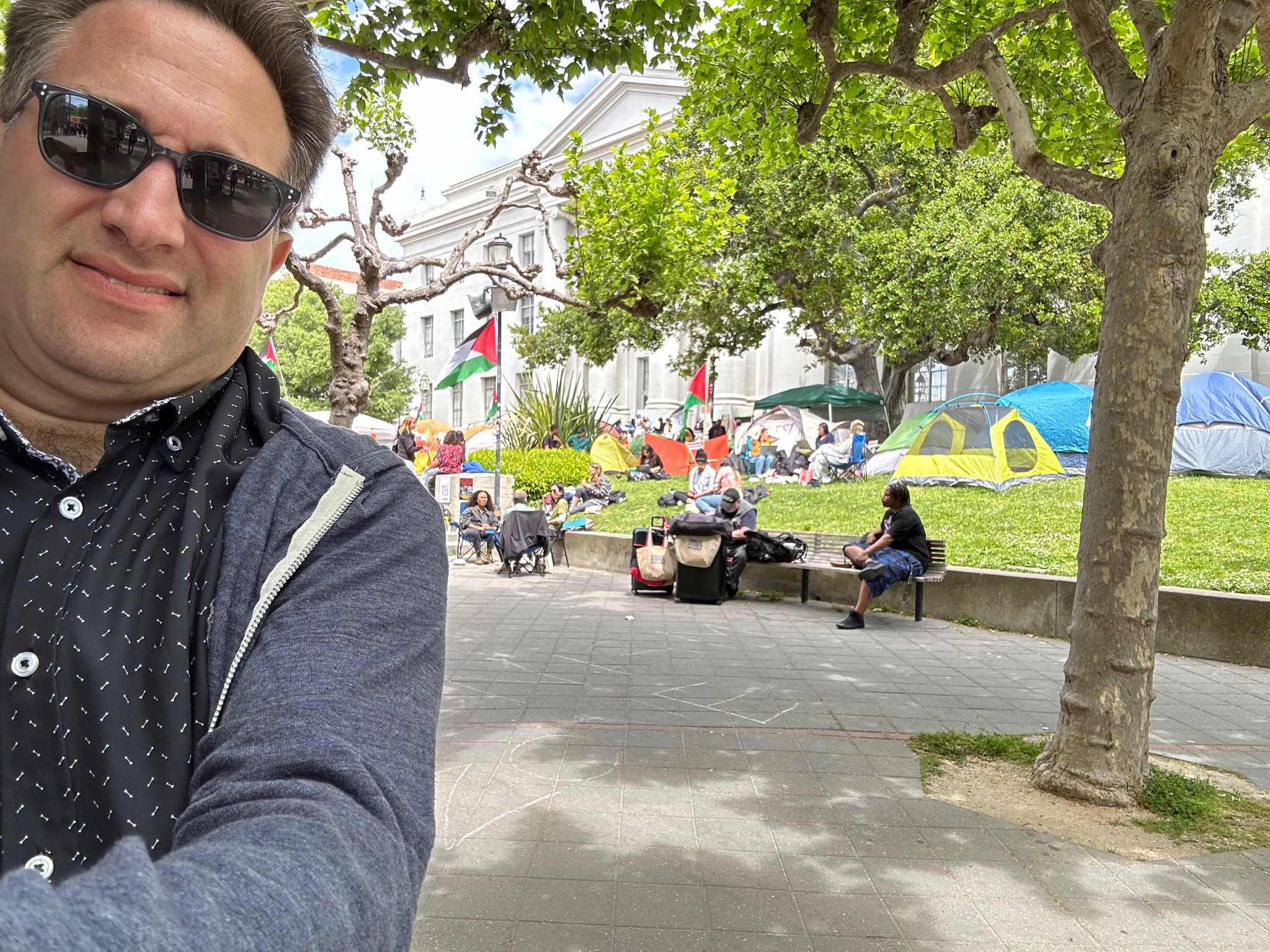
At Berkeley, many things were as I remembered them—my favorite Thai eatery, the bubble tea, the Campanile—but not everything was the same. Here I am in front of Berkeley’s Gaza encampment, a.k.a. its “Anti Zionism Zone” or what was formerly Sproul Plaza (zoom into the chalk):

I felt a need to walk through the Anti Zionism Zone day after day (albeit unassumingly, neither draped in an Israeli flag nor looking to start an argument with anyone), for more-or-less the same reasons why the US regularly sends aircraft carriers through the Strait of Taiwan.


Back in the more sheltered environment of the Simons Institute, it was great to be among friends, some of whom I hadn’t seen since before Covid. Andris Ambainis and I worked together for a bit on an open problem in quantum query complexity, for old times’ sake (we haven’t solved it yet).

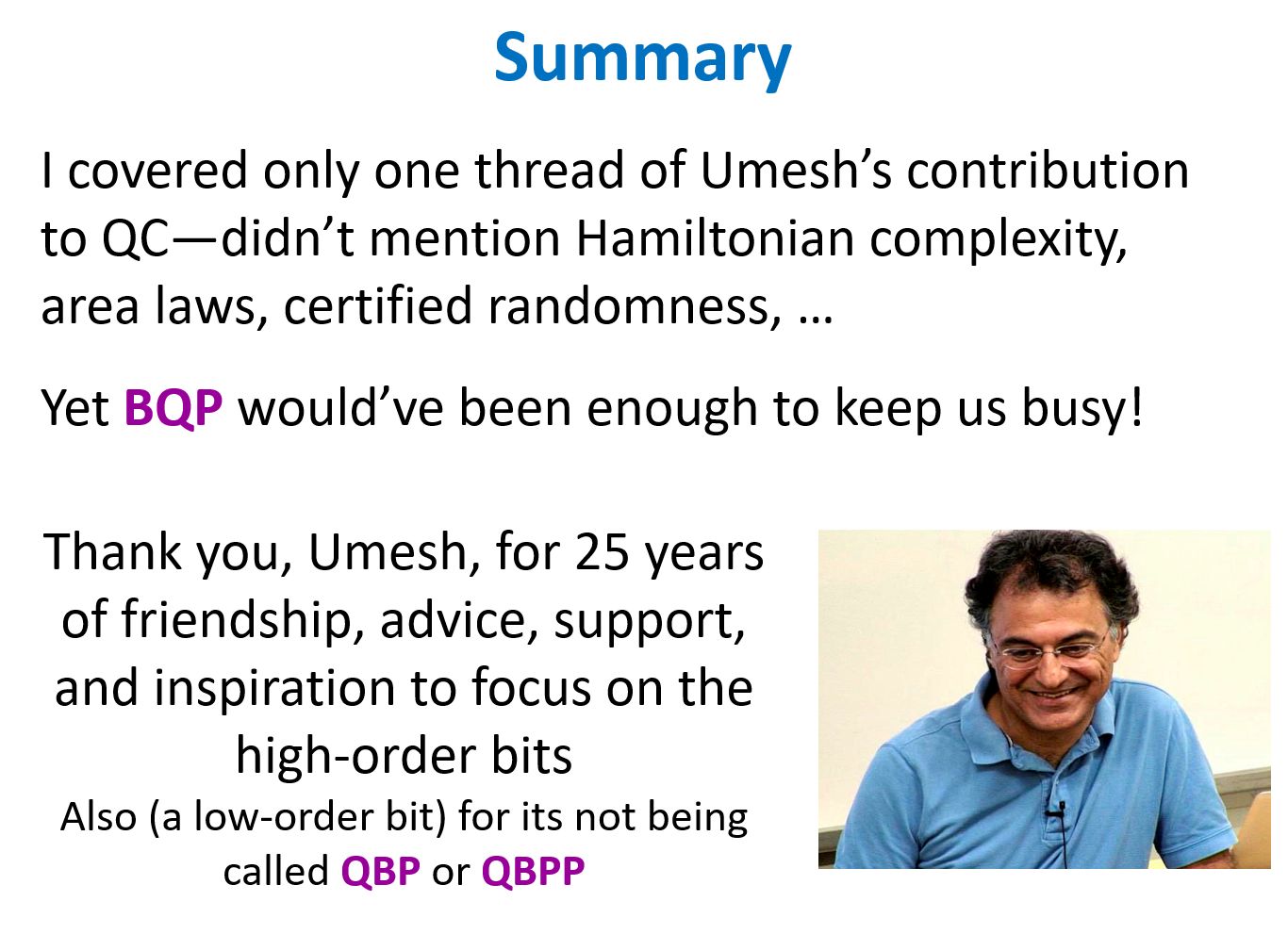
And then there were talks! I thought I’d share my own talk, which was entitled The Story of BQP (Bounded-Error Quantum Polynomial-Time). Here are the PowerPoint slides, but I’ll also share screen-grabs for those of you who constantly complain that you can’t open PPTX files.

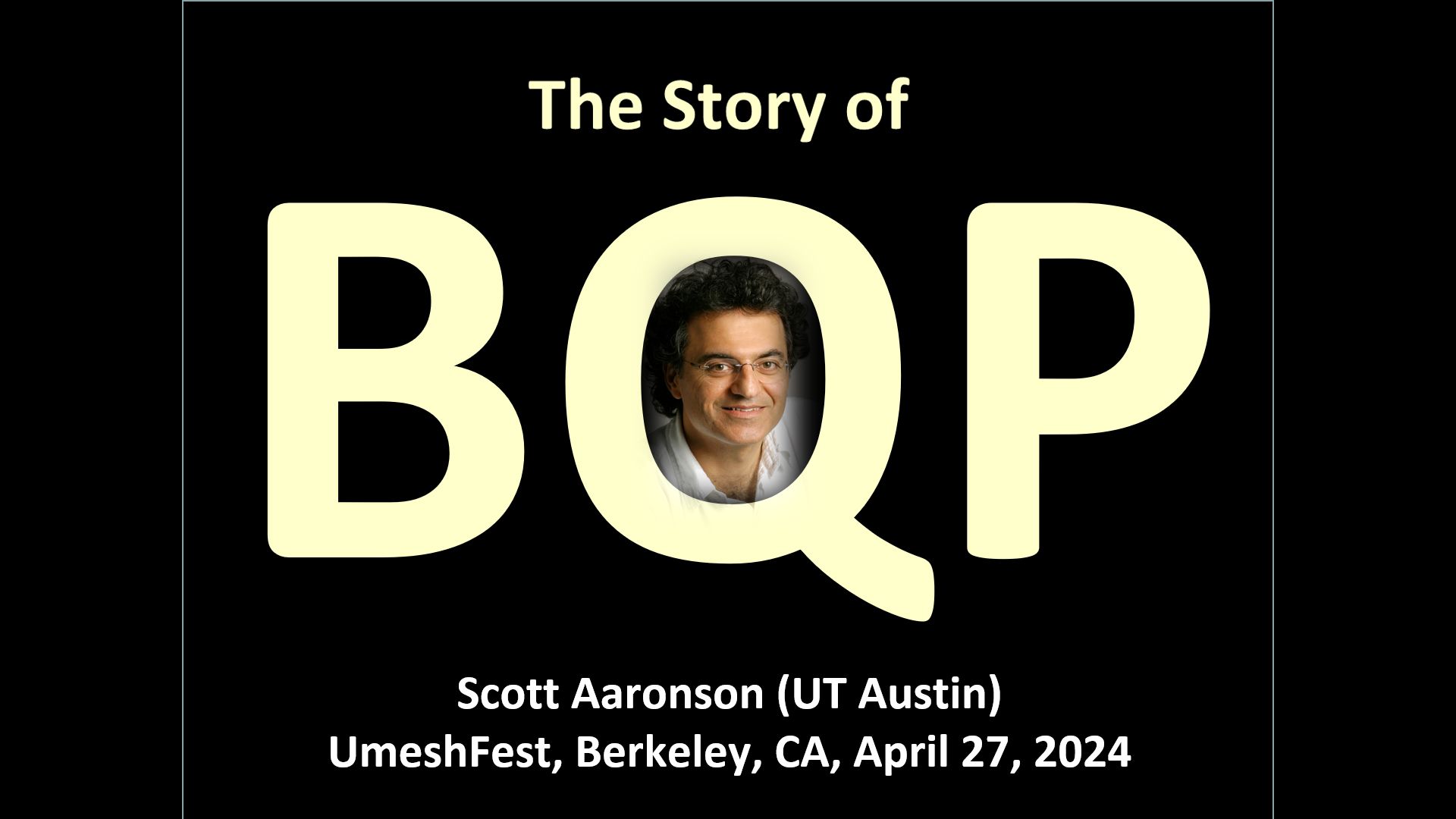
I was particularly proud of the design of my title slide:

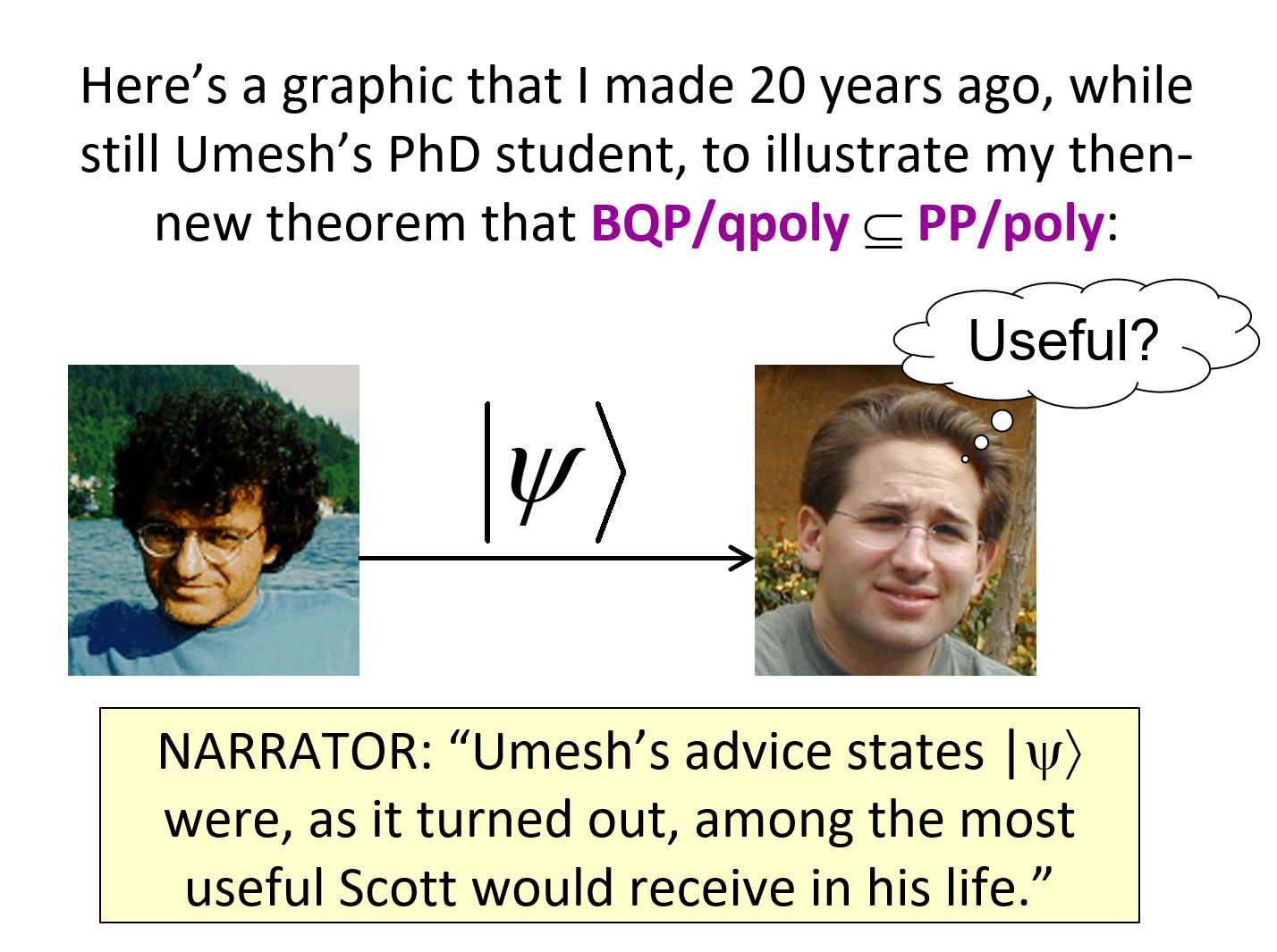
Moving on:

The class BQP/qpoly, I should explain, is all about an advisor who’s all-wise and perfectly benevolent, but who doesn’t have a lot of time to meet with his students, so he simply doles out the same generic advice to all of them, regardless of their thesis problem x.

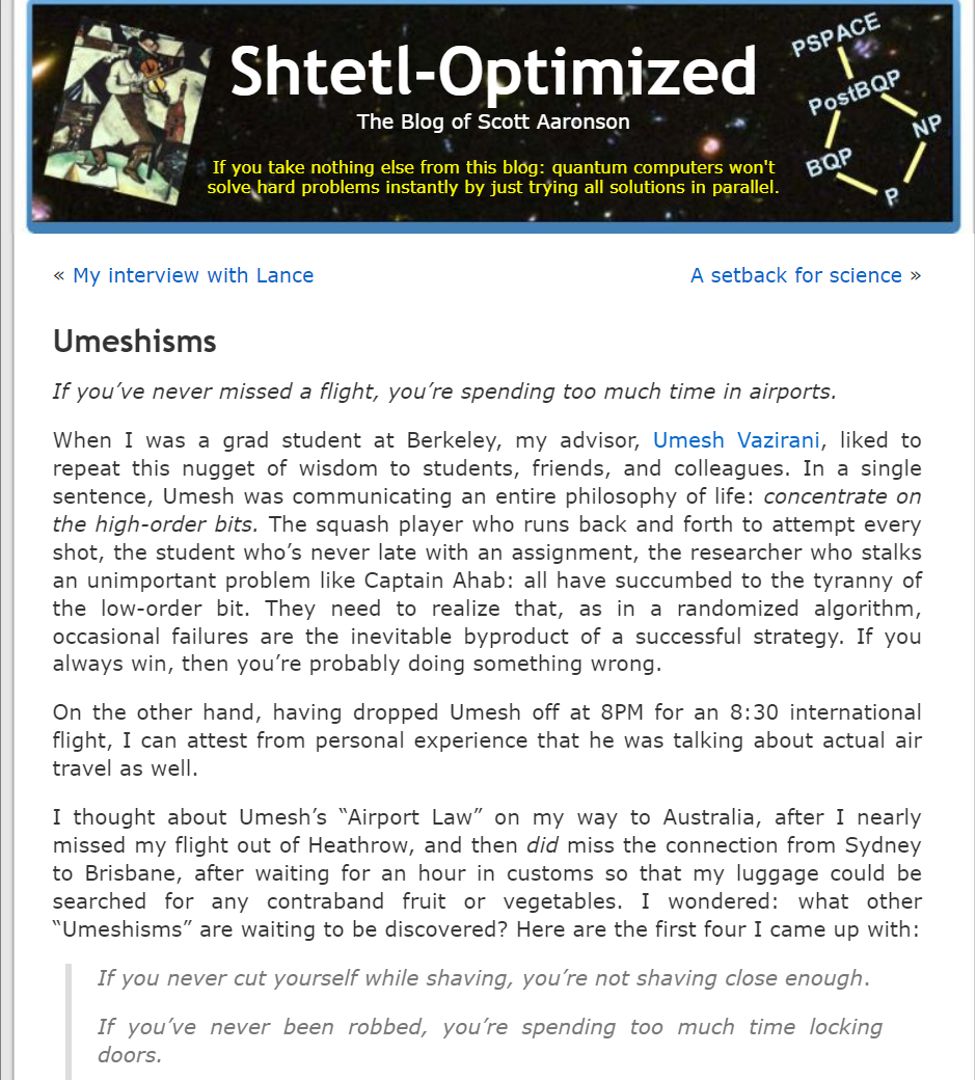
I then displayed my infamous “Umeshisms” blog post from 2005—one of the first posts in the history of this blog:

As I explained, now that I hang out with the rationalist and AI safety communities, which are also headquartered in Berkeley, I’ve learned that my “Umeshisms” post somehow took on a life of its own. Once, when dining at one of the rationalists’ polyamorous Berkeley group houses, I said this has been lovely but I’ll now need to leave, to visit my PhD former adviser Umesh Vazirani. “You mean the Umesh?!” the rationalists excitedly exclaimed. “Of Umeshisms? If you’ve never missed a flight?”

But moving on:

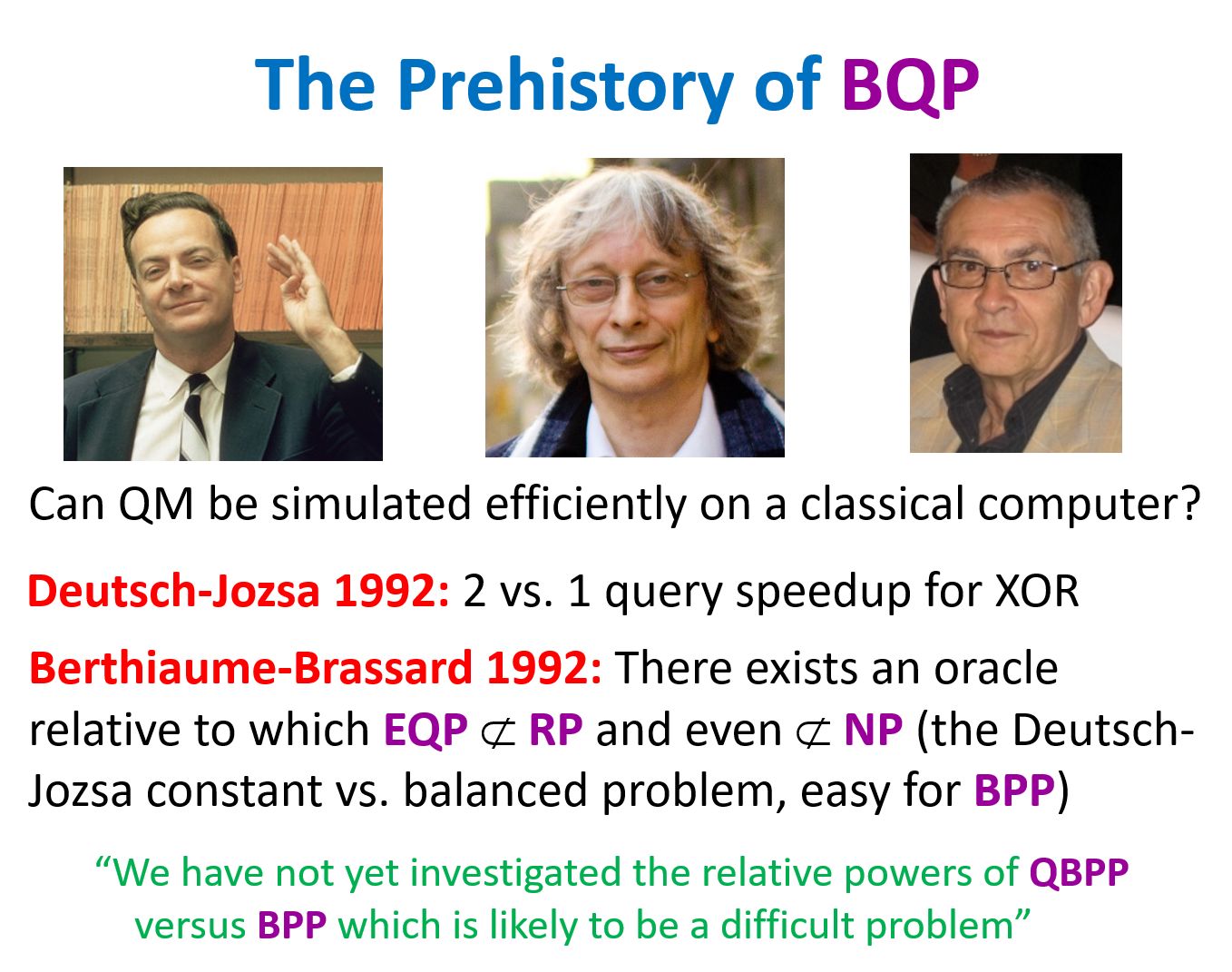
(Note that by “QBPP,” Bethiaume and Brassard meant what we now call BQP.)

Feynman and Deutsch asked exactly the right question—does simulating quantum mechanics on a classical computer inherently produce an exponential slowdown, or not?—but they lacked most of the tools to start formally investigating the question. A factor-of-two quantum speedup for the XOR function could be dismissed as unimpressive, while a much greater quantum speedup for the “constant vs. balanced” problem could be dismissed as a win against only deterministic classical algorithms, rather than randomized algorithms. Deutsch-Jozsa may have been the first time that an apparent quantum speedup faltered in an honest comparison against classical algorithms. It certainly wasn’t the last!

Ah, but this is where Bernstein and Vazirani enter the scene.

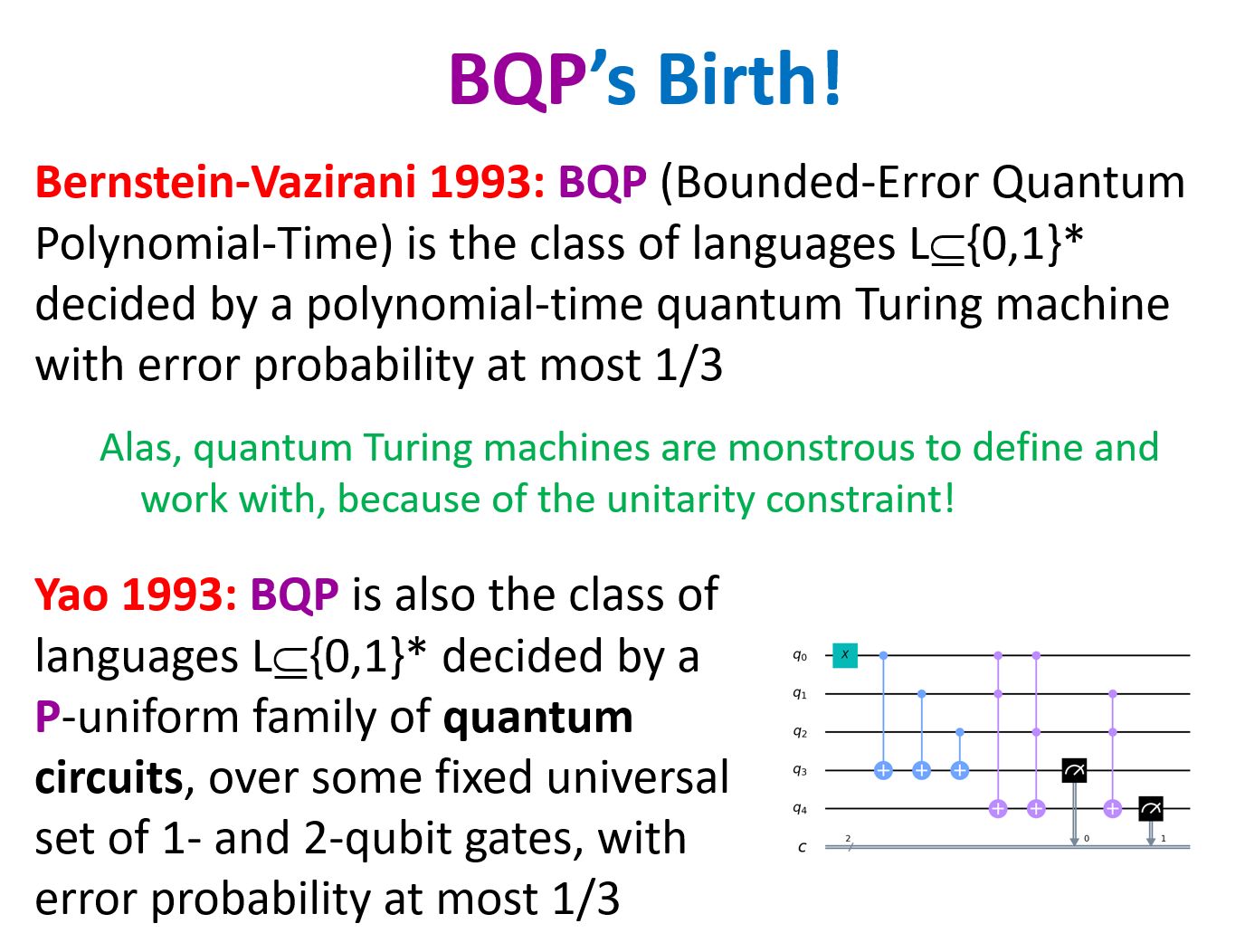
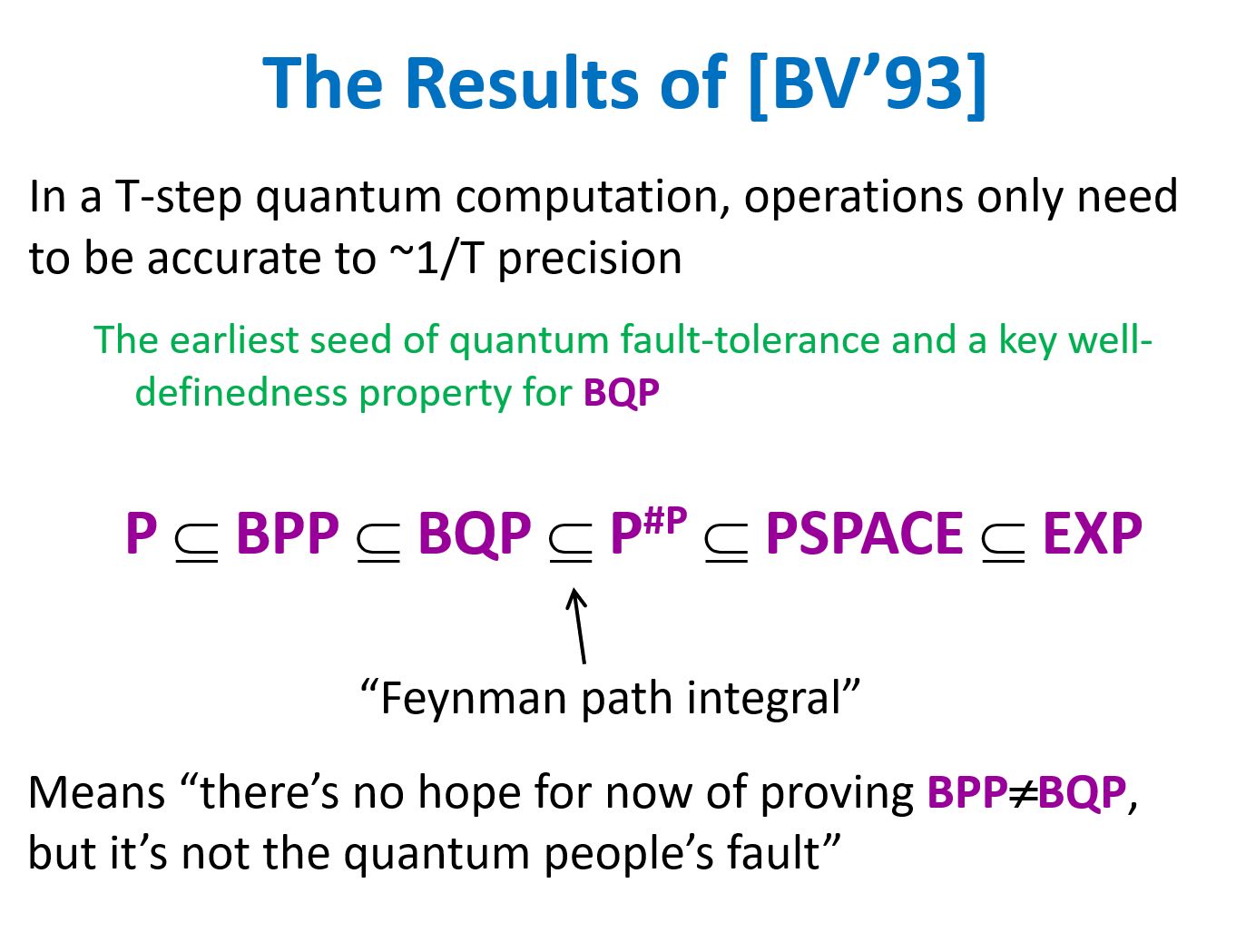
Bernstein and Vazirani didn’t merely define BQP, which remains the central object of study in quantum complexity theory. They also established its most basic properties:

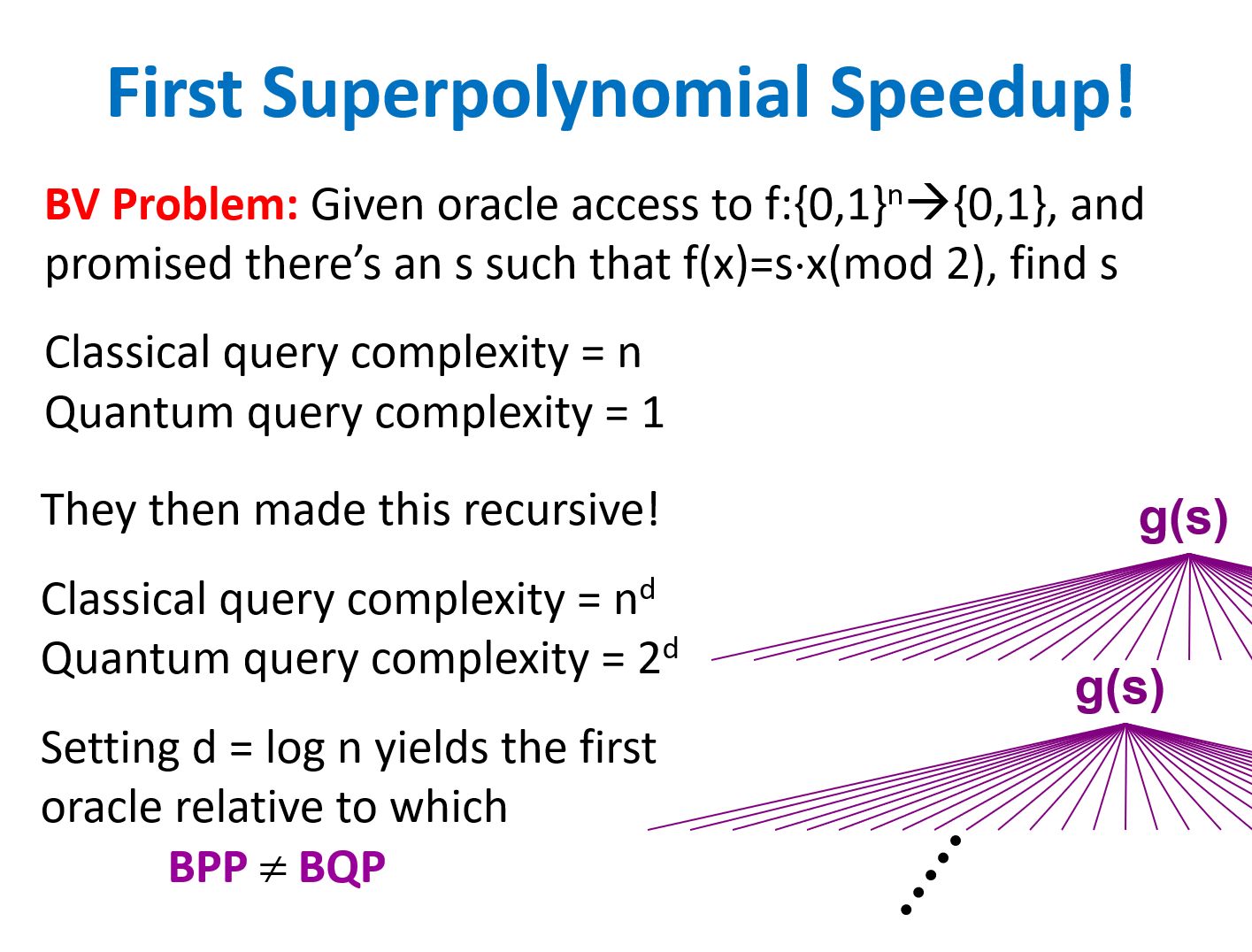
And, at least in the black-box model, Bernstein and Vazirani gave the first impressive quantum speedup for a classical problem that survived in a fair comparison against the best classical algorithm:

The Recursive Bernstein-Vazirani problem, also called Recursive Fourier Sampling, is constructed as a “tree” of instances of the Bernstein-Vazirani problem, where to query the Boolean function at any given level, you need to solve a Bernstein-Vazirani problem for a Boolean function at the level below it, and then run the secret string s through a fixed Boolean function g. For more, see my old paper Quantum Lower Bound for Recursive Fourier Sampling.

Each Bernstein-Vazirani instance has classical query complexity n and quantum query complexity 1. So, if the tree of instances has depth d, then overall the classical query complexity is nd, while the quantum query complexity is only 2d. Where did the 2 come from? From the need to uncompute the secret strings s at each level, to enable quantum interference at the next level up—thereby forcing us to run the algorithm twice. A key insight.

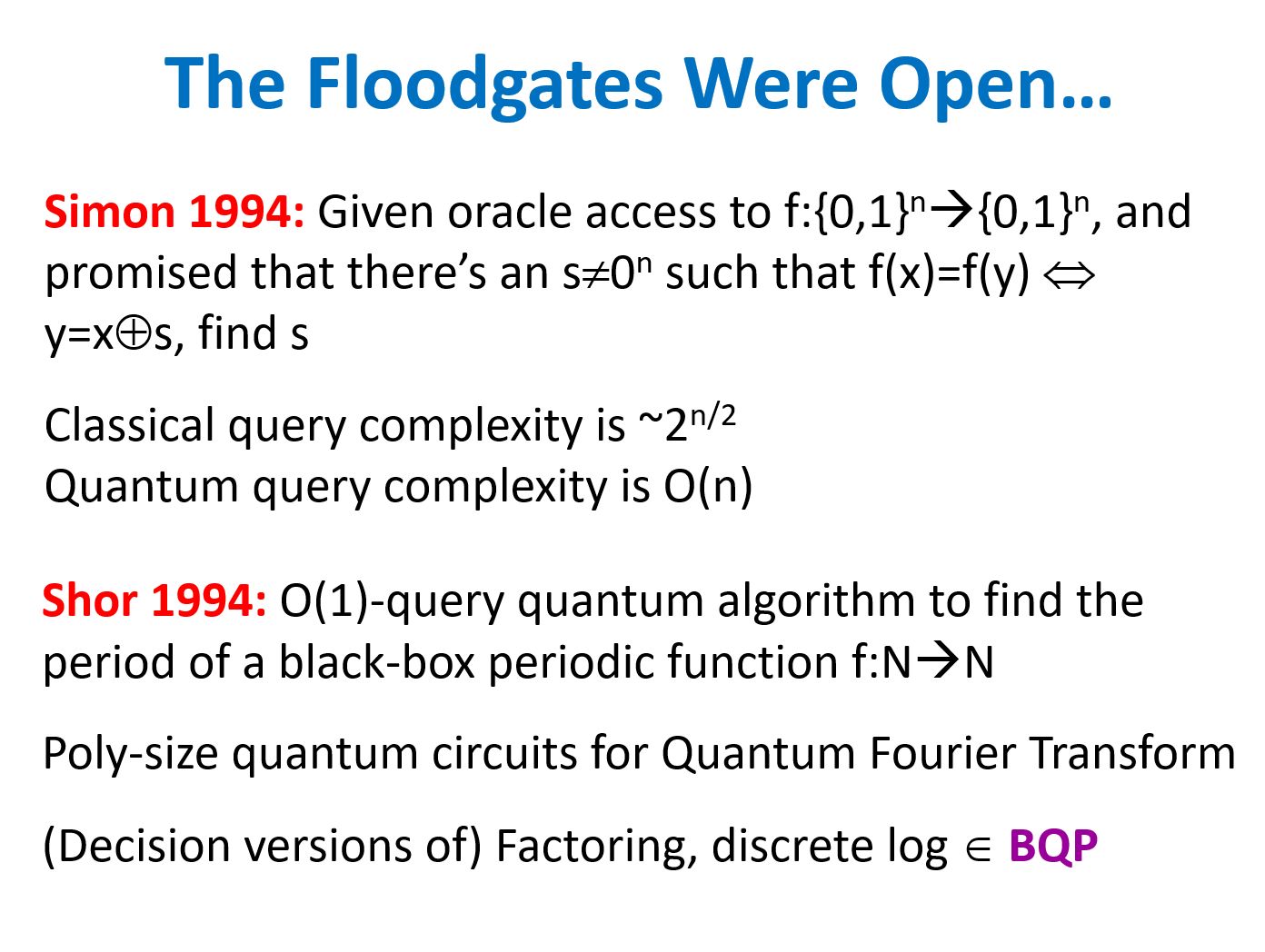
The Recursive Fourier Sampling separation set the stage for Simon’s algorithm, which gave a more impressive speedup in the black-box model, and thence for the famous Shor’s algorithm for factoring and discrete log:

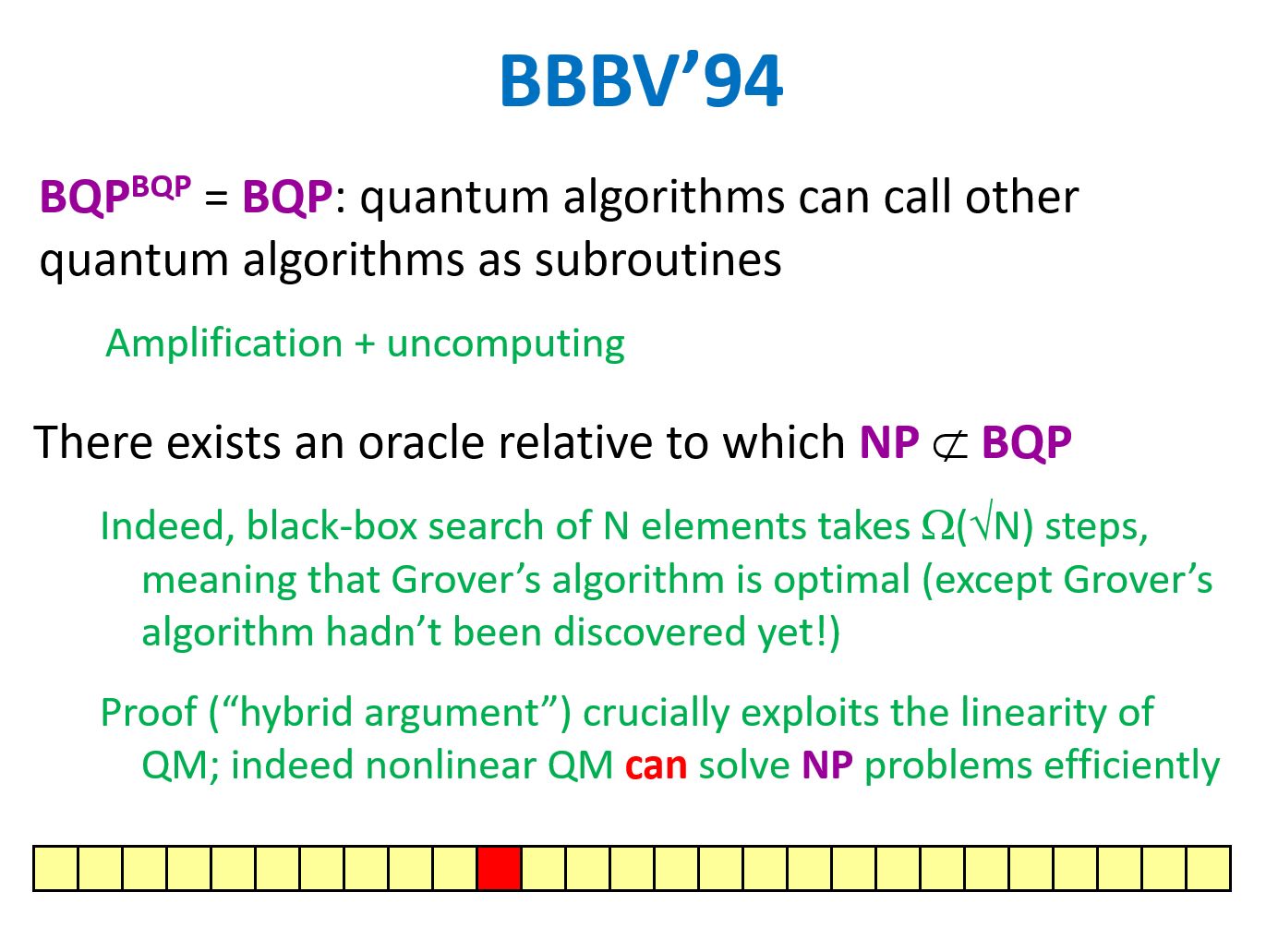
But Umesh wasn’t done establishing the most fundamental properties of BQP! There’s also the seminal 1994 paper by Bennett, Bernstein, Brassard, and Vazirani:

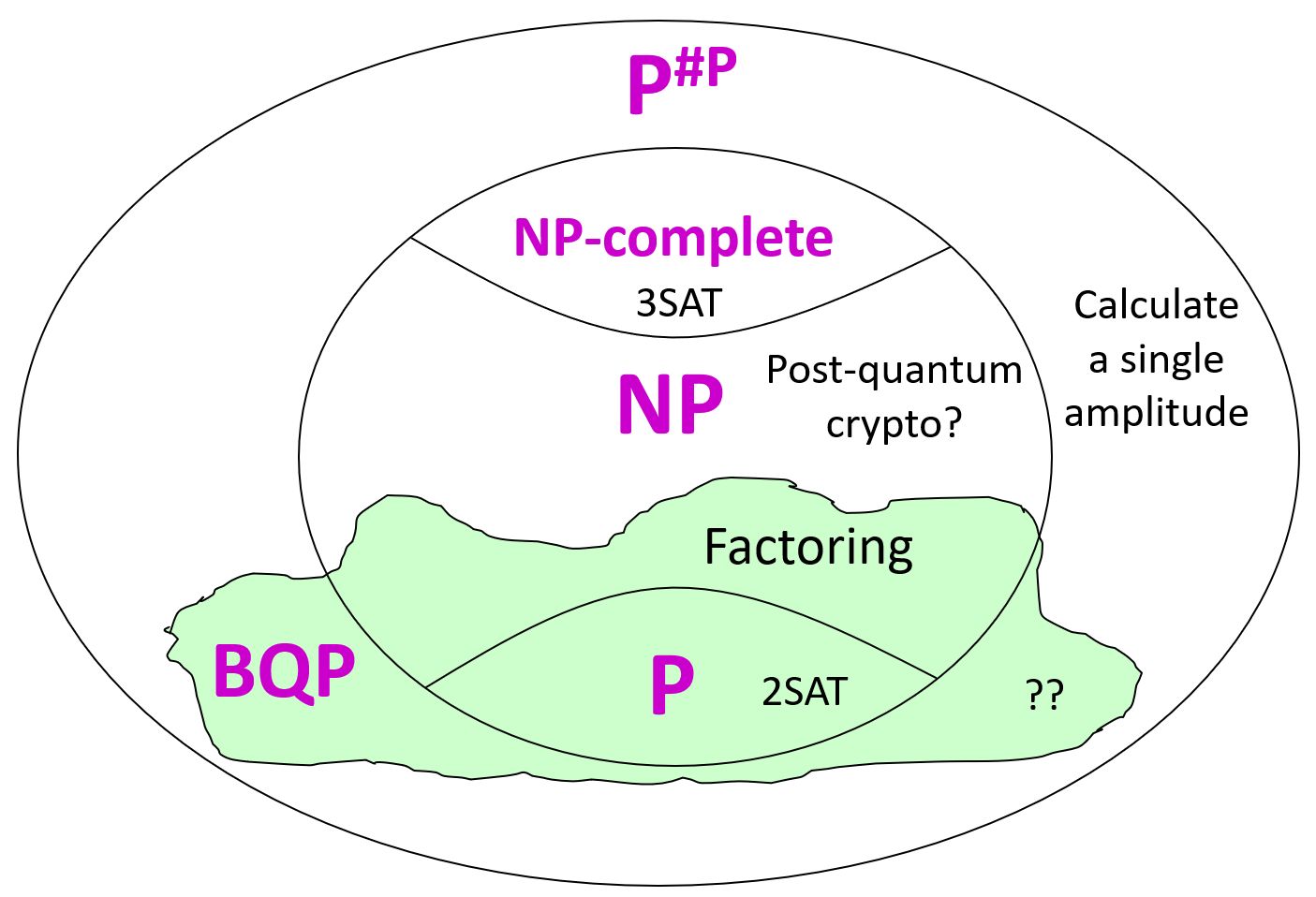
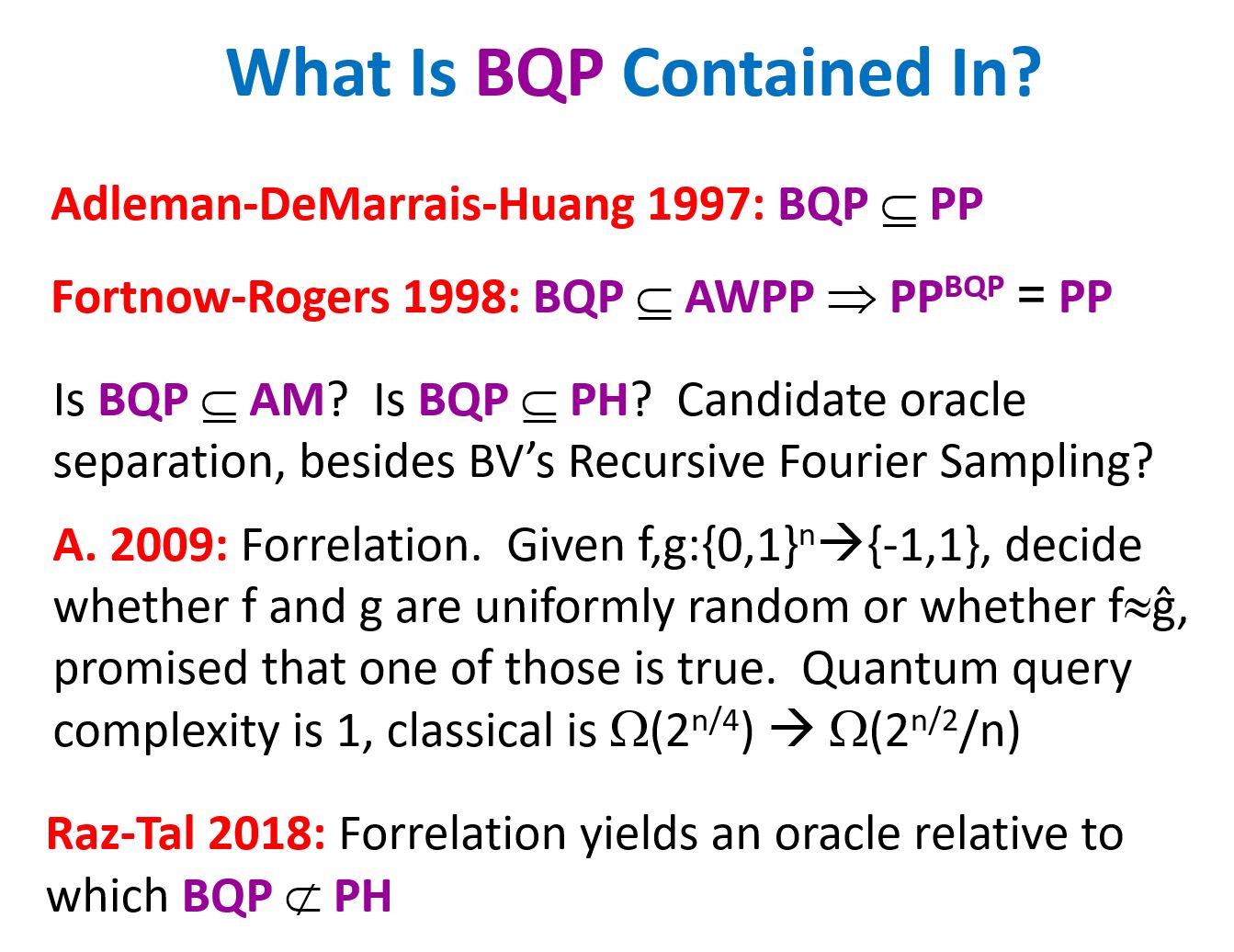
In light of the BV and BBBV papers, let’s see how BQP seems to fit with classical complexity classes—an understanding that’s remained largely stable for the past 30 years:

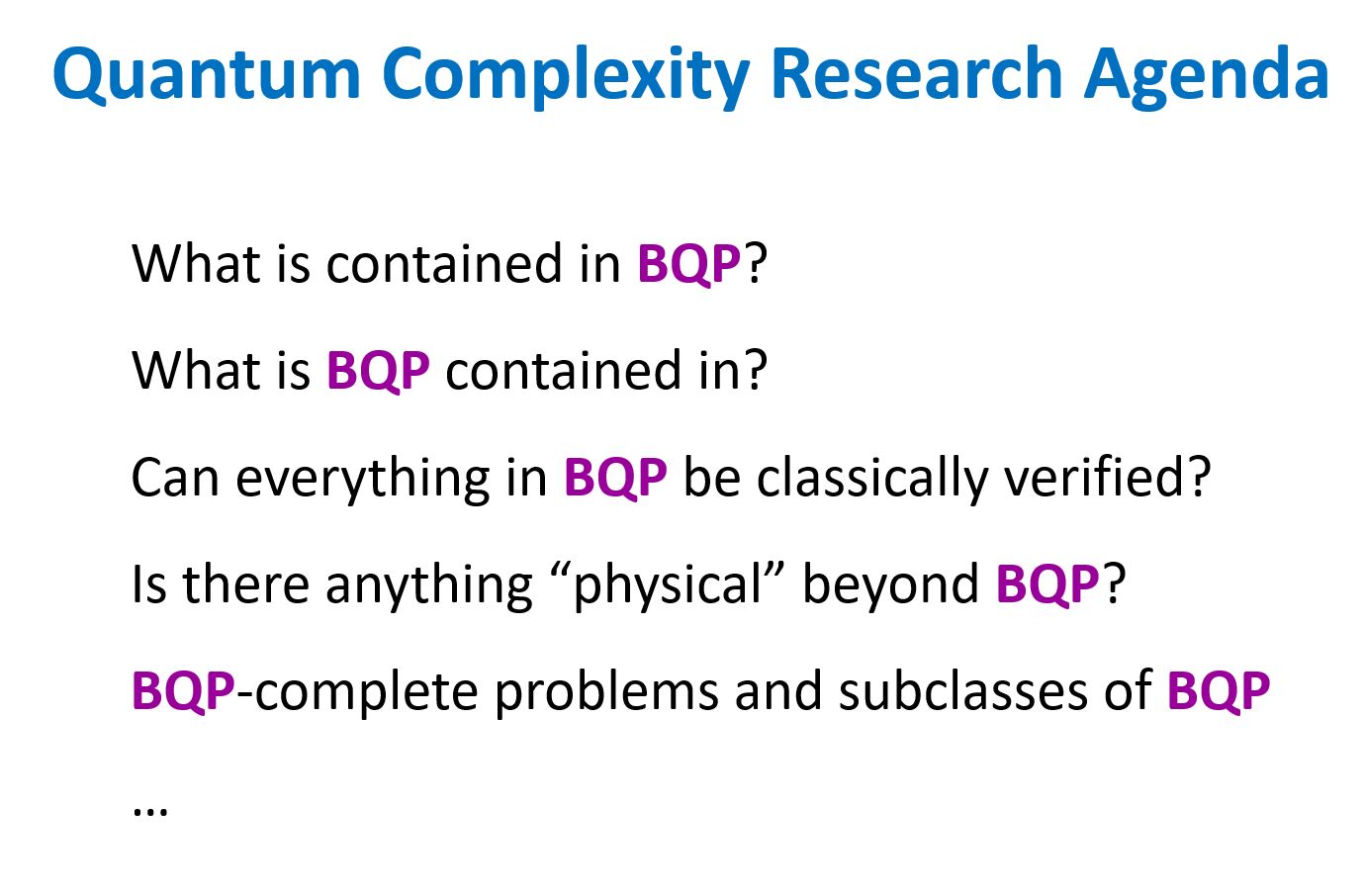
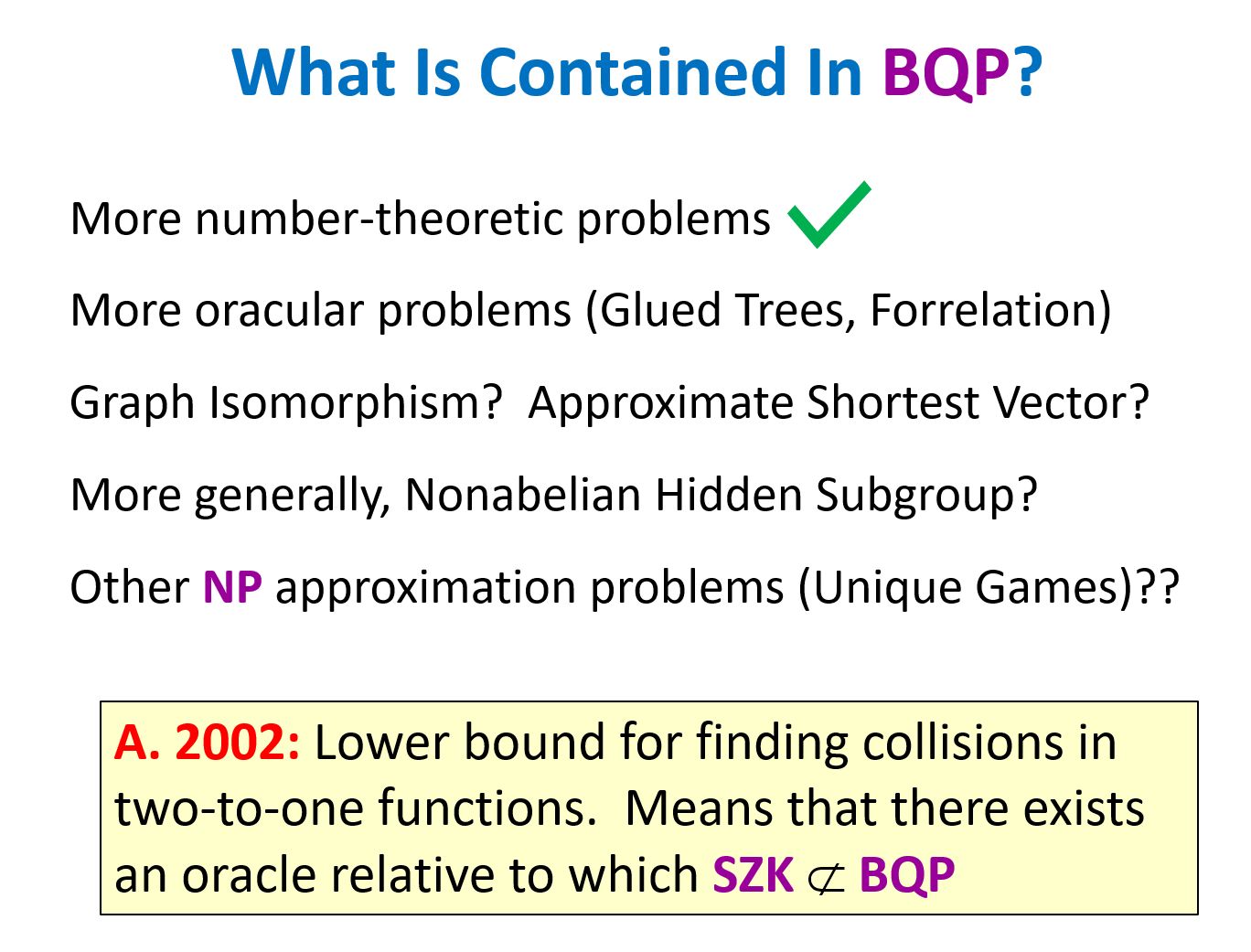
We can state a large fraction of the research agenda of the whole field, to this day, as questions about BQP:

I won’t have time to discuss all of these questions, but let me at least drill down on the first few.

Many people hoped the list of known problems in BQP would now be longer than it is. So it goes: we don’t decide the truth, we only discover it.

As a 17-year-old just learning about quantum computing in 1998 by reading the Bernstein-Vazirani paper, I was thrilled when I managed to improve their containment BQP ⊆ P#P to BQP ⊆ PP. I thought that would be my big debut in quantum complexity theory. I was then crushed when I learned that Adleman, DeMarrais, and Huang had proved the same thing a year prior. OK, but at least it wasn’t, like, 50 years prior! Maybe if I kept at it, I’d reach the frontier soon enough.

Umesh, from the very beginning, raised the profound question of BQP’s relation to the polynomial hierarchy. Could we at least construct an oracle relative to which BQP⊄PH—or, closely related, relative to which P=NP≠BQP? Recursive Fourier Sampling was a already candidate for such a separation. I spent months trying to prove that candidate wasn’t in PH, but failed. That led me eventually to propose a very different problem, Forrelation, which seemed like a stronger candidate, although I couldn’t prove that either. Finally, in 2018, after four years of effort, Ran Raz and Avishay Tal proved that my Forrelation problem was not in PH, thereby resolving Umesh’s question after a quarter century.

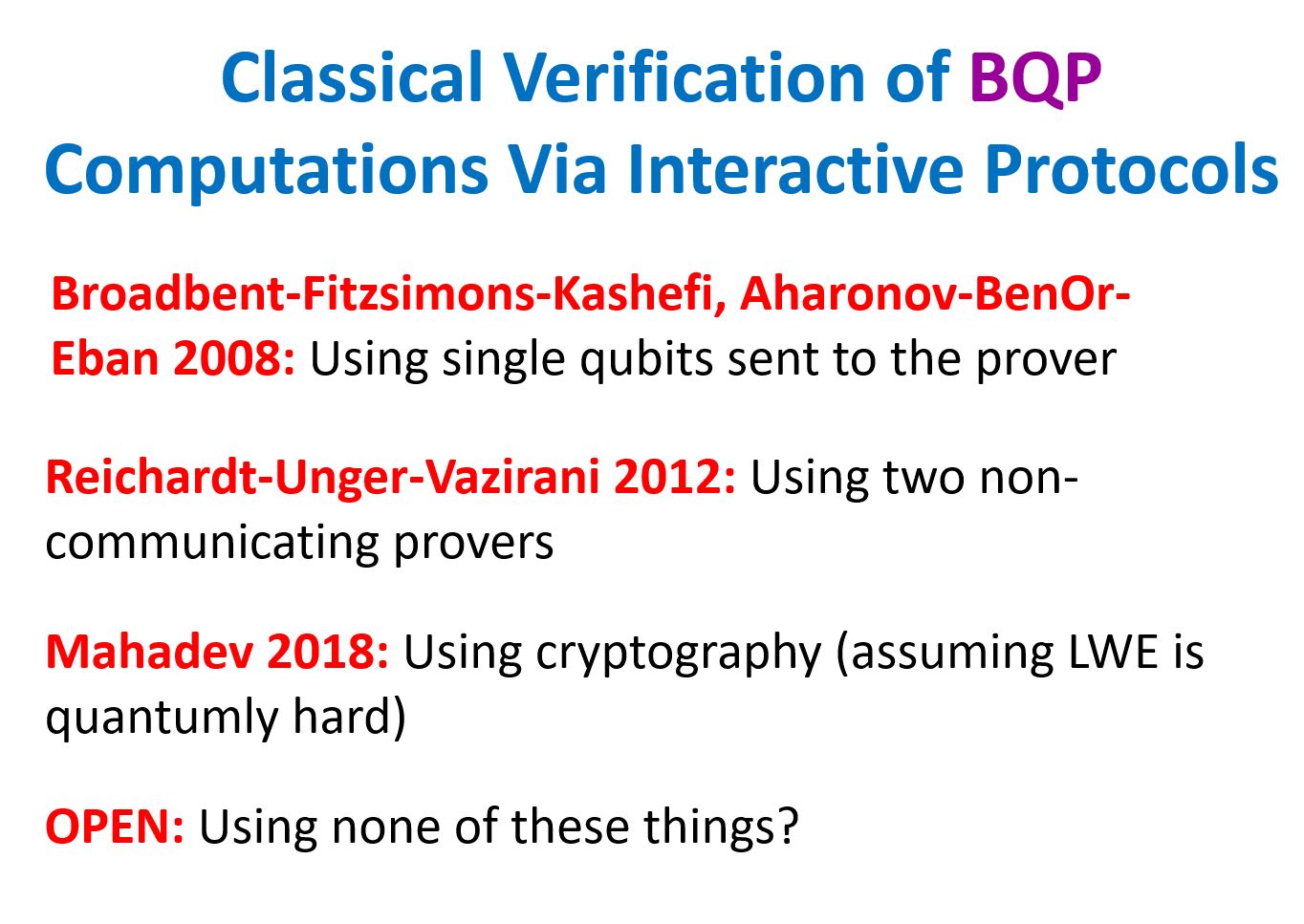
We now know three different ways by which a quantum computer can not merely solve any BQP problem efficiently, but prove its answer to a classical skeptic via an interactive protocol! Using quantum communication, using two entangled (but non-communicating) quantum computers, or using cryptography (this last a breakthrough of Umesh’s PhD student Urmila Mahadev). It remains a great open problem, first posed to my knowledge by Daniel Gottesman, whether one can do it with none of these things.

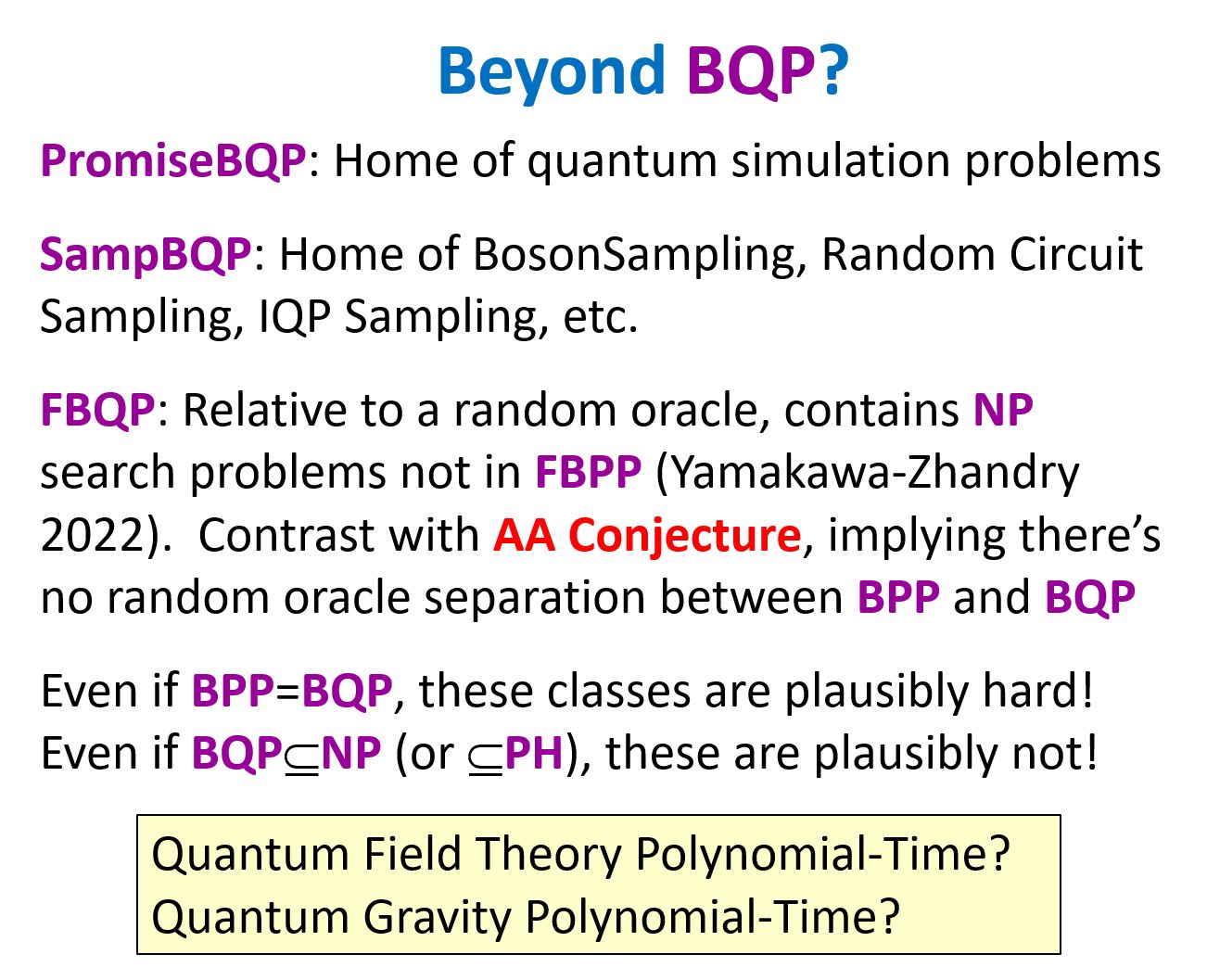
To see many of the advantages of quantum computation over classical, we’ve learned that we need to broaden our vision beyond BQP (which is a class of languages), to promise problems (like estimating the expectation values of observables), sampling problems (like BosonSampling and Random Circuit Sampling), and relational problems (like the Yamakawa-Zhandry problem, subject of a recent breakthrough). It’s conceivable that quantum advantage could remain for such problems even if it turned out that P=BQP.

A much broader question is whether BQP captures all languages that can be efficiently decided using “reasonable physical resources.” What about chiral quantum field theories, like the Standard Model of elementary particles? What about quantum theories of gravity? Good questions!

Since it was Passover during the talk, I literally said “Dayenu” to Umesh: “if you had only given us BQP, that would’ve been enough! but you didn’t, you gave us so much more!”

Happy birthday Umesh!! We look forward to celebrating again on all your subsequent power-of-2 birthdays.

That IACR preprint

Tuesday, April 16th, 2024

Update (April 19): Apparently a bug has been found, and the author has withdrawn the claim (see the comments).


For those who don’t yet know from their other social media: a week ago the cryptographer Yilei Chen posted a preprint, eprint.iacr.org/2024/555, claiming to give a polynomial-time quantum algorithm to solve lattice problems. For example, it claims to solve the GapSVP problem, which asks to approximate the length of the shortest nonzero vector in a given n-dimensional lattice, to within an approximation ratio of ~n4.5. The best approximation ratio previously known to be achievable in classical or quantum polynomial time was exponential in n.

If it’s correct, this is an extremely big deal. It doesn’t quite break the main lattice-based cryptosystems, but it would put those cryptosystems into a precarious position, vulnerable to a mere further polynomial improvement in the approximation factor. And, as we learned from the recent NIST competition, if the lattice-based and LWE-based systems were to fall, then we really don’t have many great candidates left for post-quantum public-key cryptography! On top of that, a full quantum break of LWE (which, again, Chen is not claiming) would lay waste (in a world with scalable QCs, of course) to a large fraction of the beautiful sandcastles that classical and quantum cryptographers have built up over the last couple decades—everything from Fully Homomorphic Encryption schemes, to Mahadev’s protocol for proving the output of any quantum computation to a classical skeptic.

So on the one hand, this would substantially enlarge the scope of exponential quantum speedups beyond what we knew a week ago: yet more reason to try to build scalable QCs! But on the other hand, it could also fuel an argument for coordinating to slow down the race to scalable fault-tolerant QCs, until the world can get its cryptographic house into better order. (Of course, as we’ve seen with the many proposals to slow down AI scaling, this might or might not be possible.)

So then, is the paper correct? I don’t know. It’s very obviously a serious effort by a serious researcher, a world away from the P=NP proofs that fill my inbox every day. But it might fail anyway. I’ve asked the world experts in quantum algorithms for lattice problems, and they’ve been looking at it, and none of them is ready yet to render a verdict. The central difficulty is that the algorithm is convoluted, and involves new tools that seem to come from left field, including complex Gaussian functions, the windowed quantum Fourier transform, and Karst waves (whatever those are). The algorithm has 9 phases by the author’s count. In my own perusal, I haven’t yet extracted even a high-level intuition—I can’t tell any little story like for Shor’s algorithm, e.g. “first you reduce factoring to period-finding, then you solve period-finding by applying a Fourier transform to a vector of amplitudes.”

So, the main purpose of this post is simply to throw things open to commenters! I’m happy to provide a public clearinghouse for questions and comments about the preprint, if those studying it would like that. You can even embed LaTeX in your comments, as will probably be needed to get anywhere.


Unrelated Update: Connor Tabarrok and his friends just put a podcast with me up on YouTube, in which they interview me in my office at UT Austin about watermarking of large language models and other AI safety measures.

Avi Wigderson wins Turing Award!

Wednesday, April 10th, 2024

Back in 2006, in the midst of an unusually stupid debate in the comment section of Lance Fortnow and Bill Gasarch’s blog, someone chimed in:

Since the point of theoretical computer science is solely to recognize who is the most badass theoretical computer scientist, I can only say:

GO HOME PUNKS!

WIGDERSON OWNS YOU!

Avi Wigderson: central unifying figure of theoretical computer science for decades; consummate generalist who’s contributed to pretty much every corner of the field; advocate and cheerleader for the field; postdoc adviser to a large fraction of all theoretical computer scientists, including both me and my wife Dana; derandomizer of BPP (provided E requires exponential-size circuits). Now, Avi not only “owns you,” he also owns a well-deserved Turing Award (on top of his well-deserved Nevanlinna, Abel, Gödel, and Knuth prizes). As Avi’s health has been a matter of concern to those close to him ever since his cancer treatment, which he blogged about a few years ago, I’m sure today’s news will do much to lift his spirits.

I first met Avi a quarter-century ago, when I was 19, at a PCMI summer school on computational complexity at the Institute for Advanced Study in Princeton. Then I was lucky enough to visit Avi in Israel when he was still a professor at the Hebrew University (and I was a grad student at Berkeley)—first briefly, but then Avi invited me back to spend a whole semester in Jerusalem, which ended up being one of my most productive semesters ever. Then Avi, having by then moved to the IAS in Princeton, hosted me for a one-year postdoc there, and later he and I collaborated closely on the algebrization paper. He’s had a greater influence on my career than all but a tiny number of people, and I’m far from the only one who can say that.

Summarizing Avi’s scientific contributions could easily fill a book, but Quanta and New Scientist and Lance’s blog can all get you started if you’re interested. Eight years ago, I took a stab at explaining one tiny little slice of Avi’s impact—namely, his decades-long obsession with “why the permanent is so much harder than the determinant”—in my IAS lecture Avi Wigderson’s “Permanent” Impact On Me, to which I refer you now (I can’t produce a new such lecture on one day’s notice!).

Huge congratulations to Avi.

Postdocs wanted!

Friday, December 22nd, 2023

David Soloveichik, my friend and colleague in UT Austin’s Electrical and Computer Engineering department, and I are looking to hire a joint postdoc in “Unconventional Computing,” broadly defined. Areas of interest include but are not limited to:

(1) quantum computation,
(2) thermodynamics of computation and reversible computation,
(3) analog computation, and
(4) chemical computation.

The ideal candidate would have broad multi-disciplinary interests in addition to prior experience and publications in at least one of these areas. The researcher will work closely with David and myself but is expected to be highly self-motivated. To apply, please send an email to david.soloveichik@utexas.edu and aaronson@cs.utexas.edu with the subject line “quantum postdoc application.” Please include a CV and links to three representative publications. Let’s set a deadline of January 20th. We’ll be back in touch if we need recommendation letters.


My wife Dana Moshkovitz Aaronson and my friend and colleague David Zuckerman are also looking for a joint postdoc at UT Austin, to work on pseudorandomness and related topics. They’re asking for applications by January 16th. Click here for more information.

Quantum miscellany

Tuesday, September 19th, 2023
  1. Tomorrow at 1:30pm US Central time, I’ll be doing an online Q&A with Collective[i] Forecast about quantum computing (probably there will also be questions about AI safety). It’s open to all. Hope to see some of you there!
  2. Toby Cubitt of University College London is visiting UT Austin. We’ve been discussing the question: can you produce a QMA witness state using a closed timelike curve? Since QMA⊆PSPACE, and since Fortnow, Watrous, and I proved that closed timelike curves (or anyway, Deutsch’s model of them) let you solve PSPACE problems, clearly a closed timelike curve lets you solve QMA decision problems, but that’s different from producing the actual witness state as the fixed-point of a polynomial-time superoperator. Toby has a neat recent result, which has as a corollary that you can produce the ground state of a local Hamiltonian using a CTC, if you have as auxiliary information the ground state energy as well as (a lower bound on) the spectral gap. But you do seem to need that extra information.

    Yesterday I realized there’s also a simpler construction: namely, take an n-qubit state from the CTC, and check whether it’s a valid QMA witness, having used Marriott-Watrous amplification to push the probability of error down to (say) exp(-n2). If the witness is valid, then send it back in time unmodified; otherwise replace it by the maximally mixed state. If valid witnesses exist, then you can check that this sets up a Markov chain whose stationary distribution is almost entirely concentrated on such witnesses. (If no valid witnesses exist, then the stationary distribution is just the maximally mixed state, or exponentially close to it.) One drawback of this construction is that it can only produce a Marriott-Watrous state, rather than the “original” QMA witness state.

    Is there a third approach, which overcomes the disadvantages of both mine and Toby’s? I’ll leave that question to my readers!
  3. On the theme of QMA plus weird physics, a wonderful question emerged from a recent group meeting: namely, what’s the power of QMA if we let the verifier make multiple non-collapsing measurements of the same state, as in the “PDQP” model defined by myself, Bouland, Fitzsimons, and Lee? I conjecture that this enhanced QMA goes all the way up to NEXP (Nondeterministic Exponential-Time), by a construction related to the one I used to show that PDQP/qpoly = ALL (i.e., non-collapsing measurements combined with quantum advice lets you decide literally all languages), and that also uses the PCP Theorem. I even have some candidate constructions, though I haven’t yet proven their soundness.

    In the past, I would’ve spent more time on such a problem before sharing it. But after giving some students a first crack, I now … just want to know the answer? Inspecting my feelings in my second year of leave at OpenAI, I realized that I still care enormously about quantum complexity theory, but only about getting answers to the questions, barely at all anymore about getting credit for them. Admittedly, it took me 25 years to reach this state of not caring.

Palate cleanser

Monday, August 21st, 2023
  1. Ben Brubaker wrote a long piece for Quanta magazine about meta-complexity. The first three-quarters are a giant refresher on the story of computability and complexity theory in the 20th century—including Turing, Gödel, Shannon, Cook, Karp, Levin, Baker-Gill-Solovay, Sipser, Razborov, Rudich, and more. But then the last quarter gets into actually new (well, within the last couple years) developments, including the NP-completeness of “Partial-MCSP” and other progress on the Minimum Circuit Size Problem, and progress toward basing cryptography on the sole assumption P≠NP, and ruling out Impagliazzo’s “Heuristica” and “Pessiland” worlds. I’m quoted (and helped proofread the piece) despite playing no role in the new developments. Worth a read if you don’t already know this stuff.
  2. Duane Rich created a Part II of his YouTube video series on the Busy Beaver function. It features some of the core ideas from my Busy Beaver survey, clearly narrated and beautifully animated. If reading my survey is too much for you, now you can just watch the movie!
  3. Aznaur Midov recorded a podcast with me about quantum computing and AI—just in case you haven’t got enough of either of those lately.
  4. Oded Regev put an exciting paper on the arXiv, showing how to factor an n-digit integer using quantum circuits of size ~O(n3/2) (multiple such circuits, whose results are combined classically), assuming a smoothness conjecture from number theory. This compares to ~O(n2) for Shor’s algorithm. Regev’s algorithm uses classical algorithms for lattice problems, thereby connecting that subject to quantum factoring. This might or might not bring nearer in time the day when we can break (say) 2048-bit RSA keys using a quantum computer—that mostly depends, apparently, on whether Regev’s algorithm can also be made highly efficient in its use of qubits.
  5. A team from IBM, consisting of Sergey Bravyi, Andrew Cross, Jay Gambetta, Dmitri Maslov, Ted Yoder, and my former student Patrick Rall, put another exciting paper on the arXiv, which reports an apparent breakthrough in quantum error-correction—building a quantum memory based on LDPC (Low Density Parity Check) codes rather than the Kitaev surface code, and which (they say) with an 0.1% physical error rate, can preserve 12 logical qubits for ten million syndrome cycles using 288 physical qubits, rather than more than 4000 physical qubits with the surface code. Anyone who understands in more detail is welcome to comment!
  6. Boaz Barak wrote a blog post about the history of the atomic bomb, and possible lessons for AI development today. I’d been planning to write a blog post about the history of the atomic bomb and possible lessons for AI development today. Maybe I’ll still write that blog post.
  7. Last week I attended the excellent Berkeley Simons Workshop on Large Language Models and Transformers, hosted by my former adviser Umesh Vazirani. While there, I gave a talk on watermarking of LLMs, which you can watch on YouTube (see also here for the PowerPoint slides). Shtetl-Optimized readers might also enjoy the talk by OpenAI cofounder Ilya Sutskever, An Observation on Generalization, as well as many other talks on all aspects of LLMs, from theoretical to empirical to philosophical to legal.
  8. Right now I’m excited to be at Crypto’2023 in Santa Barbara, learning a lot about post-quantum crypto and more, while dodging both earthquakes and hurricanes. On Wednesday, I’ll give an invited plenary talk about “Neurocryptography”: my vision for what cryptography can contribute to AI safety, including via watermarking and backdoors. Who better to enunciate such a vision than someone who’s neither a cryptographer nor an AI person? If you’re at Crypto and see me, feel free to come say hi.

On students as therapy

Friday, July 21st, 2023
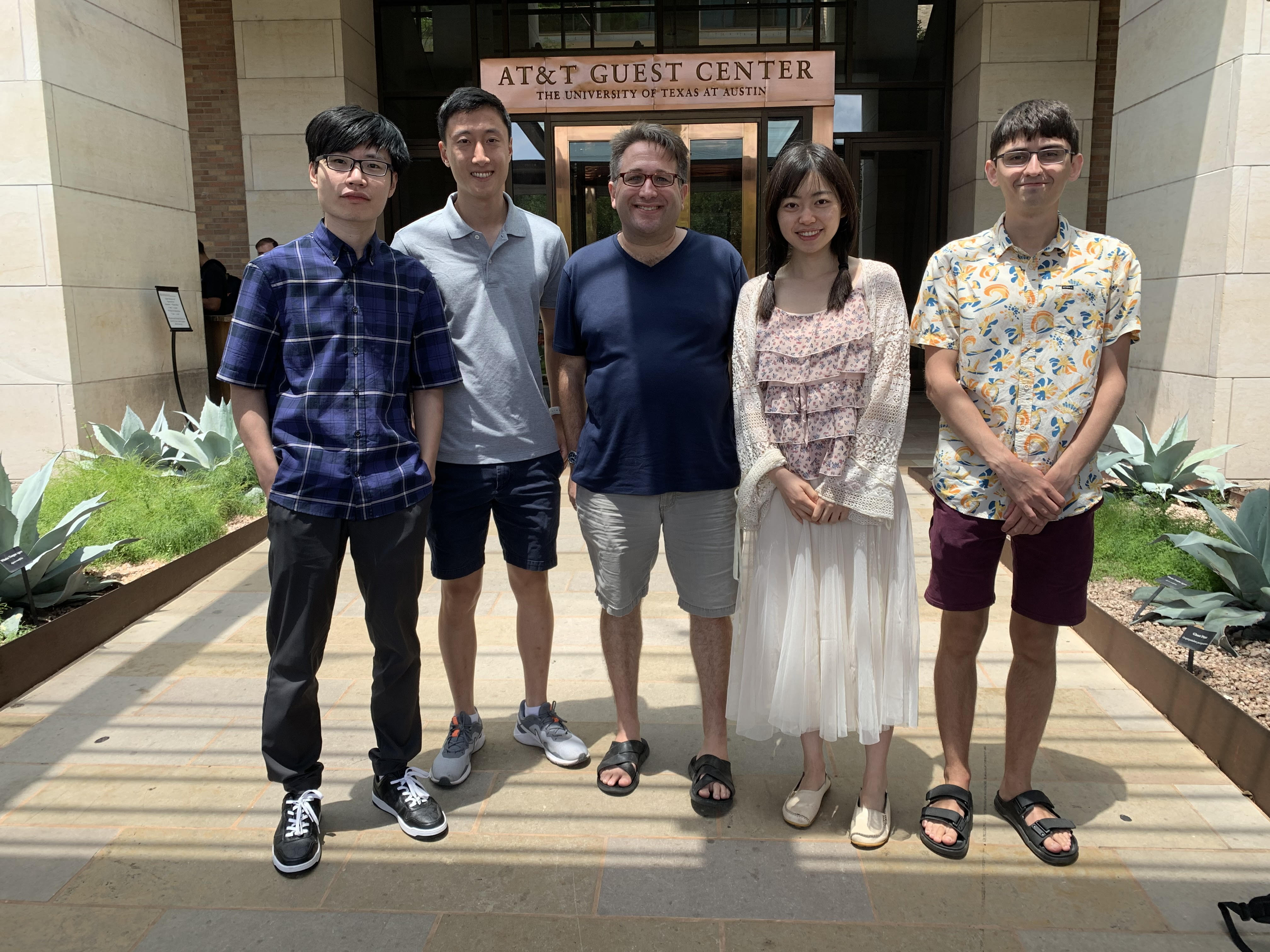
From left: Ruizhe, Daniel, me, Jiahui, William

This summer, I’m delighted to report, we’ve had four (!) students complete their PhDs in computer science through UT Austin’s Quantum Information Center:

  • Dr. Ruizhe Zhang, student of my wife Dana Moshkovitz, who’s worked on numerous topics in quantum algorithms, optimization, meta-complexity, and machine learning, and who’s continuing to a postdoc at the Simons Institute in Berkeley.
  • Dr. Daniel Liang, student of me, who’s worked on efficient learning of stabilizer and near-stabilizer states, and who’s continuing to a postdoc at Rice University.
  • Dr. Jiahui Liu, student of me, who’s worked on quantum copy-protection, quantum money, and other quantum cryptographic functionalities, and who’s continuing to a postdoc at MIT.
  • Dr. William Kretschmer, student of me, who’s worked on quantum query complexity, oracle separations between quantum complexity classes, pseudorandom quantum states, and much more, and who’s continuing to a postdoc at the Simons Institute in Berkeley.

A fifth, Dr. Yuxuan Zhang, completed his PhD in condensed-matter physics.

We also had two postdocs finish this summer:

All told, I’ve now supervised or co-supervised a total of 12 PhD students and 15 postdocs (see my homepage for the complete list). I’m ridiculously proud of all of them; along with my kids, they’re one of the central joys of my life.

While there are many reasons to want to celebrate this news, I confess that among them is thumbing my nose at haters. This past week, Shtetl-Optimized endured yet another sustained troll attack. One troll claimed that my use of the names “Alice” and “Bob,” in discussing communication protocols, was Eurocentric and offensive, and threatened to contact UT Austin’s DEI office about this matter and whip up dozens of students to protest outside my office. A second troll (or was it the same troll?) accused my Chinese students of being spies and called them a long litany of racial slurs. He also accused me of being paid off by the Chinese government, and of blogging skeptically about quantum speedup claims merely to hide the fact that China will soon build a quantum computer able to break US encryption. These trolls, and others, pursued me relentlessly by both blog comments and email—acting like I was the unreasonable one for ignoring them—until I finally broke down and engaged, calling upon the Shtetl-Optimized Committee of Guardians (who I thank profusely) for needed moral support.

The fact that there are people so far beyond the reach of reason bothers me much more than it reasonably should. But whenever the toxicity of the Internet gets me down, I try to take solace from the real world. Over the past seven years, I’m proud to have built a research group at UT Austin that’s welcomed students and postdocs and visitors from all over the world, and that’s treated them as individuals on a shared journey to understand reality. I intend to continue in that spirit for as long as I’m able.