“If Anyone Builds It, Everyone Dies”
Friday, May 30th, 2025Eliezer Yudkowsky and Nate Soares are publishing a mass-market book, the rather self-explanatorily-titled If Anyone Builds It, Everyone Dies. (Yes, the “it” means “sufficiently powerful AI.”) The book is now available for preorder from Amazon:
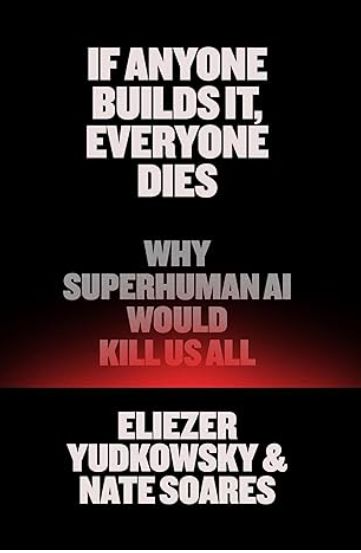
(If you plan to buy the book at all, Eliezer and Nate ask that you do preorder it, as this will apparently increase the chance of it making the bestseller lists and becoming part of The Discourse.)
I was graciously offered a chance to read a draft and offer, not a “review,” but some preliminary thoughts. So here they are:
For decades, Eliezer has been warning the world that an AI might soon exceed human abilities, and proceed to kill everyone on earth, in pursuit of whatever strange goal it ended up with. It would, Eliezer said, be something like what humans did to the earlier hominids. Back around 2008, I followed the lead of most of my computer science colleagues, who considered these worries, even if possible in theory, comically premature given the primitive state of AI at the time, and all the other severe crises facing the world.
Now, of course, not even two decades later, we live on a planet that’s being transformed by some of the signs and wonders that Eliezer foretold. The world’s economy is about to be upended by entities like Claude and ChatGPT, AlphaZero and AlphaFold—whose human-like or sometimes superhuman cognitive abilities, obtained “merely” by training neural networks (in the first two cases, on humanity’s collective output) and applying massive computing power, constitute (I’d say) the greatest scientific surprise of my lifetime. Notably, these entities have already displayed some of the worrying behaviors that Eliezer warned about decades ago—including lying to humans in pursuit of a goal, and hacking their own evaluation criteria. Even many of the economic and geopolitical aspects have played out as Eliezer warned they would: we’ve now seen AI companies furiously racing each other, seduced by the temptation of being (as he puts it) “the first monkey to taste the poisoned banana,” discarding their previous explicit commitments to safety, transparency, and the public good once they get in the way.
Today, then, even if one still isn’t ready to swallow the full package of Yudkowskyan beliefs, any empirically minded person ought to be updating in its direction—and acting accordingly. Which brings us to the new book by Eliezer and his collaborator Nate Soares. This book is far and away the clearest, most accessible presentation of Eliezer’s beliefs, the culmination of a quarter-century of his developing and talking about them. That undoubtedly owes a great deal to Nate, who seems to have sanded down the infamously brusque rough edges of Eliezer’s writing style. So much the better! But it also owes a lot to the world itself: current events now offer an endless supply of real-world examples for Eliezer’s formerly abstract arguments about AI, examples that the book deploys to maximum effect.
The book also mines history—everything from the Wright Brothers to World War II to the Chernobyl accident—for lessons about human attitudes toward technological progress, safety, and risk. And it maintains Eliezer’s fondness for stories and parables, one of the most charming features of his writing.
Even today, I’m not nearly as confident about the doom scenario as Eliezer and Nate are. I don’t know whether an AI’s goals are really “orthogonal” to its abilities, in the sense that will matter in practice. And when I reach the part where the AI, having copied itself all over the Internet and built robot factories, then invents and releases self-replicating nanotechnology that gobbles the surface of the earth in hours or days, a large part of me still screams out that there must be practical bottlenecks that haven’t been entirely accounted for here.
And yet, even if you agree with only a quarter of what Eliezer and Nate write, you’re likely to close this book fully convinced—as I am—that governments need to shift to a more cautious approach to AI, an approach more respectful of the civilization-changing enormity of what’s being created. And that, if they won’t, their citizens need to pressure them to do so.
So regardless of how much they agree or disagree, I’d like everyone on earth who cares about the future to read this book, debate its ideas, and have its thesis in mind when they’re discussing AI.
As for me? It would’ve been better if I’d reached my current position earlier: if I hadn’t needed empirical reality, plus superb writing like Eliezer’s and Nate’s, to bonk me over the head with the risks that AI was likely to pose to humanity in my lifetime. But having failed to see as far ahead as they did, the least I can do is update. You should too, and you can start by reading the book.
As it happens, this weekend I’ll be at LessOnline, the rationalist blogging conference in Berkeley, where (among my other events) I’ll engage in a dialogue/debate with Nate Soares about the orthogonality thesis, one of the crucial underpinnings of his and Eliezer’s case for AI doom. So, I’ll probably be LessAvailable to respond to comments on this post. But feel free to discuss anyway! After all, it’s merely the fate of all Earth-originating life that’s at stake here, not some actually hot-button topic like Trump or Gaza.
 Follow