Archive for the ‘Adventures in Meatspace’ Category

By popular demand

Monday, January 23rd, 2006

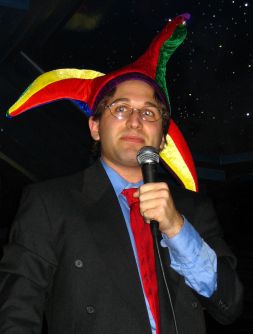
“How To Be A Serious Researcher,” my infamous after-dinner speech at QIP’2006, is now available as an mp3 (5MB, 21 minutes). If you want to tar-and-feather me for this, don’t forget Ben Toner (who made the recording) or Julia Kempe (who sent the photo).

The quantum jester

Tuesday, January 17th, 2006

I’ve been told that “the world is awaiting” my report about the QIP’2006 conference. So here it is. I’m in Paris, near the Pantheon. The buildings are beautiful, but the weather is crummy. The food is tasty, expensive, and fattening. Everyone here has been friendly, which is surprising — considering that I’m conspicuously American, and that my French consists almost entirely of the following phrases:

Bonjour!
Merci!
Oui!
Je ne comprends pas!
Monsieur
Madame
École Polytechnique
Croissant
Baguette
Ravioli (no, wait — that’s Italian)

(I’m in a talk right now, using the wireless Internet, and Harry Buhrman is reading this over my shoulder and laughing. Stop that, Harry!)

Oh, right: there have also been talks here. Maybe I’ll blog about them in a later post, but then again, maybe not. I’m not giving a talk, but I am giving the after-dinner speech on Thursday, the quantum computing community having relegated me to the role of jester. Which reminds me that I should write the speech.

I should also apply for jobs for next year. Actually, would anyone like to offer me a tenure-track faculty position right now? Most of the deadlines have passed, and I haven’t even written my research statement — so if that sort of thing doesn’t bother you, your chances of getting me are excellent.

Portugal: “Non-Catholics Once Again Welcome”

Wednesday, January 11th, 2006

I arrived yesterday morning in Lisbon. I’m here to give a talk at the Instituto Superior Técnico, which is working to build up a quantum information group. On Saturday I leave for QIP’2006 in Paris, then for New York City, before returning to Waterloo. Academia is not an easy life, but I try to bear it like a soldier.

Lisbon is beautiful: sort of like San Francisco, except more so. Yesterday I hiked up to the Castelo de São Jorge, a 100% genuine castle (with turrets, a moat, etc.) that overlooks the city from a hilltop. I took lots of photos, but then lost the cable with which to upload them to my computer. Sorry!

As my host, Yasser Omar, explained to me, Portugal “missed half of the 20th century”: specifically the years 1932-1974, when it was run by a backwards dictatorship. Even today, a tradition of bureaucratic incompetence lingers on. Yasser said that when he was looking for a tenure-track physics job, he could find only one opening in the whole country — and that one was only for “geophysics or the history of physics”! (He now works in a math department.) He and like-minded academics are now doing their best to help Portugal make up for the lost time.

PS. For those Shtetl-Optimized readers who don’t know a shtetl from schmaltz (and it’s come to my attention that such exist): King Manuel I of Portugal expelled the Jews in 1497, five years after Ferdinand and Isabella expelled them from Spain. Apparently, King Manuel realized that this would devastate Portugal’s economy, so he only signed the order reluctantly, after Princess Isabel of Spain demanded he do it as a precondition of marriage (!). Portugal started readmitting Jews in the 1800’s, and eventually became a transit point for over 100,000 refugees from the Nazis. You can read more here.

That’s not a proof, mate — that’s a proof

Tuesday, December 13th, 2005

I arrived Friday morning in an exotic, faraway “Backwards-Land,” where mammals have pouches, vegemite is considered edible, toilets should in principle flush the wrong way, and Christmas trees adorn a tropical summer landscape.

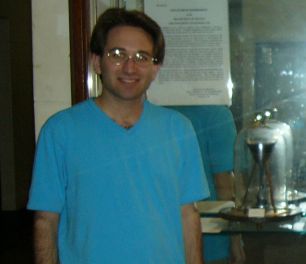
I’m here to visit the University of Queensland physics department, which is probably best known as the home of the world’s longest-running experiment: a glob of congealed black tar that’s been dripping through a funnel since 1927, at the rate of about one drop per decade. This important experiment recently won an Ig Nobel Prize in Physics, causing my colleague the Quantum Pontiff to regret not taking a photo of it while he had the chance. In perhaps the greatest advance in Catholic-Jewish relations since John Paul II prayed at the Western Wall, today Shtetl-Optimized proudly presents His Quantum Holiness with the following token of goodwill.

But there’s more to Australia than funnels of congealed black tar. There are also strange and wonderful birds with that wander around the campus eating people’s garbage. Birdwatching is not a pastime I’ve ever wished on anyone, but I think this one is an Australian White Ibis:

Finally, Australia is also home to terrible race riots, which erupted yesterday after a Lebanese gang apparently attacked two white lifeguards. I don’t have anything amusing to say about that.

Get off that shoulder — it’s my giant!

Tuesday, December 6th, 2005

Yesterday I visited the Wren Library, which houses many of Newton’s old books. Notably, they have a first edition of Principia Mathematica, with Newton’s handwritten corrections for the second edition. So what did Ike see fit to correct? Well, the title page of the first edition listed him as a Fellow of the Royal Society. Sir Isaac crossed that out: he was now the President of the Royal Society! As Jonathan Oppenheim pointed out to me, it’s weirdly reassuring to see a guy at the vertiginous top of the academic ladder, grasping in vain for the nonexistent rung above.

The Bloggour hath returneth

Monday, December 5th, 2005

Picture this: it’s my first visit to Cambridge — Ground Zero of the scientific revolution, a place that’s probably contributed more to human knowledge than any other on Earth. Within walking distance are the original manuscripts of Newton’s Principia; the halls where Darwin, Maxwell, and Russell dined as undergraduates; the Cavendish Laboratory where Rutherford bombarded nuclei and Crick and Watson unravelled nucleic acids; and architecture dating back to the 1200’s, much of it among the finest in Europe. I ought to be taking in the splendor (sorry, “splendour”) by day, and blogging about it by night.

So where have I been? Hunkered in an office, trying to finish a paper with Greg Kuperberg about QMA versus QCMA in time for the Complexity’06 submission deadline. Happily, by Saturday it had become obvious that, try though we might, we weren’t gonna make it. So I put it off till the next conference, and contented myself with submitting two papers to this year’s Complexity conference instead of three. As Douglas Adams, another Cambridge alum, put it: “I love deadlines. I like the whooshing sound they make as they fly by.”

So what can I tell you about Cambridge? First of all, when people refer to the various “colleges” — King’s, Trinity, and so on — they’re not just being eccentric and British. These colleges actually exist. Each one is basically a walled-off compound, with a few grand-looking entrances that get locked at night, thereby making Cambridge even harder to navigate than the average campus. (It doesn’t help that the streets change names constantly: St. John’s becomes Trinity becomes King’s Parade becomes Trumpington Street within a couple of blocks.)

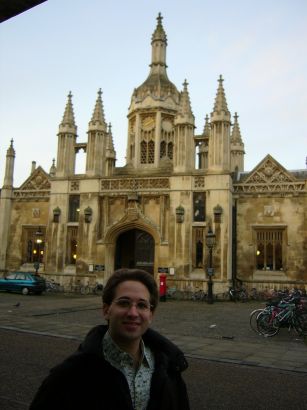
I’m staying at King’s, pictured below:

Last week my host at King’s, Artur Ekert, invited me to High Table. For you non-Oxbridge doofuses, “High Table” is a fancy dinner at which people still wear robes, non-ironically as far as I could tell. Or rather, Fellows must wear robes when dining at their own college, though not when dining at a different college. (Makes sense, huh?) Afterwards, the Fellows and their guests retire to another room for wine, cheese, and academic gossip.

All these dining rooms are lined with portraits of illustrious King’s alumni from centuries past — but amazingly, there’s still no portrait of the greatest King’s man of all time. Who was it? Let me give you a few hints. He proved the unsolvability of the Entscheidungsproblem. He was “queer” in more than one way. He had a Machine and a Test named after him. He may have played a bigger role than Churchill in winning the Second World War.

To his great credit, Artur told me that he almost threatened to resign his Fellowship if no portrait of Alan Mathison Turing F.R.S. was hung in the halls. The relevant authorities have promised to rectify the situation, though they haven’t done so yet. (Admittedly, the computer help center at King’s is called the “Turing Centre.” One imagines Turing’s ghost managing the DHCP servers, so that the real scholars can get on with their work.)

To my mind, the central question is this: did Cambridge become the world’s scientific superpower for 300 years in spite of all this idiosyncratic formality, or because of it? I have mixed feelings. On the one hand, the amount of red tape here, and the importance attached to one’s status, is like something out of Victorian England (oh, wait…). Fellows and their guests are allowed to walk on the grass; all others are not. Even though there’s an ethernet jack right in my room, I wasn’t allowed to use it, being merely a visitor. (After I complained, Artur was kind enough to give me his IP address.)

On the other hand, I like High Table and similar traditions. I like how they acknowledge and celebrate something that’s always been obvious to me: that being an academic isn’t a job like other jobs, but a way of life. This doesn’t necessarily mean that academics have no lives; what it means is that they don’t distinguish between work and life the way most people do.

Have you ever been to one of those roadside diners where you can pick an entree plus two sides, but a few of the entrees are marked “complete,” meaning you don’t get any sides with them? Well, at Cambridge they’ve understood for centuries that academia is one of life’s complete entrees. Not that a Cambridge man would know anything about roadside diners.
Home of the thirsty and brave

Thursday, November 24th, 2005

Happy Thanksgiving to my American readers! I arrived last night at my parents’ place in Pennsylvania. After I’ve digested enough to walk again, I’m off to Cambridge (the England one), then Brisbane, Australia, then back to America before Christmas Eve (which I do celebrate, with Alex Halderman’s family).

For all the academic traveling I’ve done, this will be my first time circumnavigating the globe. I can’t wait to find out whether it’s really round, or whether thar’ be dragons at the end.

Yet wherever I go, I’ll always be an American. In Toronto’s Pearson airport, I came across a Maclean’s (roughly, Canada’s Time or Newsweek), whose cover depicted a smirking Bush holding a glass of water. The headline (which I’m not making up):

America is thirsty
Let’s sell them our water before they take it

Sure, we might be chipping away at that “land of the free” part, but we’re still the home of the brave.

First we assume a circular CD

Wednesday, November 16th, 2005

Over at Freedom to Tinker, Alex Halderman and his adviser Ed Felten have been causing headaches for SunnComm, the makers of broken technology designed to prevent the copying of music CD’s. Alex is the Princeton graduate student who enjoyed worldwide media attention two years ago, when he showed that SunnComm’s “MediaMax” anti-copying software could be disabled by holding down the “Shift” key while inserting a CD into your computer. Alex’s paper about this was downloaded over a hundred thousand times, and caused SunnComm’s stock to lose $10,000,000 in a week. By comparison, my paper Quantum Lower Bound for Recursive Fourier Sampling has (I think) been downloaded at least twice, and would have driven Recursive Fourier Sampling In 2o(h) Queries Incorporated out of business, had it existed.

Now Alex and Ed are reporting that SunnComm has continued to “innovate.” It seems that the latest version of MediaMax, which is included with several Sony/BMG music CD’s,

  1. secretly installs itself even before you accept the End User License Agreement,
  2. remains installed even if you decline the agreement, and
  3. secretly “phones home” to SunnComm with information about your activities, despite assurances to the contrary.

Alex and I met in seventh grade at Newtown Junior High School. I had just transferred from a parochial school, and was so low in the social hierarchy that, when kids beat me up, I was grateful for the attention. My one consolation was that, out of all the kids in the school, I — and I alone — knew that dx3/dx=3x2 and that t’=t/√(1-(v/c)2). Most importantly, I alone knew how to program in GW-BASIC.

So you can imagine the existential shock when I heard there was another kid in seventh grade who was already writing Windows applications and marketing them as shareware. Clearly I had to meet this guy, see if he was for real. After I found out that he was — and repaired the gaping holes in my ego — Alex and I became best friends. We remain so twelve years later.

Even in junior high, Alex was obsessed with security issues: his bestselling program, if I remember correctly, was an encryption utility. At the same time, he was obviously a “white hat.” Rather than getting himself into trouble by hacking the school computers, he’d simply make the teachers utterly reliant on his expertise, then ask them for administrator privileges.

One day in the cafeteria, Alex excitedly brought me a book he was reading, which described a bizarre-sounding encryption system called “RSA.” Supposedly, with this system you could send someone secret messages without ever having met them to agree on a key.

“But that’s obviously impossible,” I explained. I was proud that, for once, I could use my superior mathematical knowledge to set Alex straight.

Eventually Alex and I both ended up in academic computer science, albeit on opposite sides of it. Perhaps the difference between us is best summarized as follows. For Alex, the impossibility of making digital information copy-proof is a central truth of our age: something to be explained, and then re-explained, to judges, reporters, and businesspeople, in amicus curiae briefs and interviews on NPR. For me, it follows from the fact that the set of n-bit strings constitutes an orthogonal basis for Hilbert space.

Cold logic

Monday, November 7th, 2005

Everyone knows that if you have a cold, the most important thing (besides chicken soup) is to get plenty of sleep. Sleep is when your white blood cells stop reading The Onion and watching Simpsons reruns, and start snacking on viruses.

But what if your cold is so severe that you can’t sleep, not even for an hour or two? What do you do then? Not knowing the answer — but knowing readers of your blog will be getting increasingly antsy — you go see a doctor. The doctor says to take NyQuil to sleep.

The problem is that NyQuil tastes worse than Vegemite, and (another Catch-22) you can barely force a drop of it down your swollen throat. So you mix a Coke and NyQuil, on the rocks. But this merely converts a small disgusting green beverage into a large disgusting greenish-brown one.

So you go back to the drugstore, where you’re relieved to learn that NyQuil is also sold in capsule form. You take two capsules. Hours later, you’re still not asleep. So you take a third. An hour later you’re still not asleep, and your throat is in indescribable pain. So you take two Advils. The pain doesn’t go away, so you take a third Advil.

At this point you start hallucinating and feeling dizzy. Your skin is pale, your pupils are dilated, and you’re sweating profusely. Uh-oh. What was in those pills, anyway? In each NyQuil: Dextromethorphan HBr 15mg, Pseudoephedrine HCl 30mg, Acetaminophen 325mg, Doxylamine succinate 6.25mg. In each Advil Cold & Sinus: Ibuprofen 200mg, Pseudoephedrine HCl 30mg. So, you’ve now ingested 180mg of Pseudoephedrine HCl, whatever the hell that is.

“In case of accidental overdose contact a physician or poison control centre immediately, even if there are no symptoms.”

Staggering over to your computer, you read that overdosing on antihistamines and decongestants can be fatal, and that indeed, the proper thing to do would be to get your stomach pumped as soon as possible. But it’s 4AM, and for better or worse, you decide to leave the 9-1-1 operator alone, and trust that three billion years of Darwinian natural selection weren’t for bleaaaarrrrrgghhhhhhhhh…

The Moral: Never assume that, just because a single dose of a drug doesn’t help you, a double or triple dose isn’t going to kill you.

It actually gets even more nauseating, but I’ll cut to the end: after more than a week, I can eat again. I can blog again. I can lower-bound again. I can even talk again, though I won’t be playing female leads in Broadway musicals anytime soon.

It’s good to be back.

Can’t… blog… too much… pain…

Monday, October 31st, 2005

I’m bedridden with a sore throat, and on enough painkillers to knock out an elephant (well, a very small elephant). I assume the String Theory God is punishing me. I’ve been repenting to all five of His manifestations — Type I, Type IIA, Type IIB, Heterotic SO(32), and Heterotic E8xE8 — and hopefully I’ll be back in a couple days. Happy Halloween.