aaronson@mit

June 13th, 2007

They rejected me for undergrad. They rejected me for grad school. And for reasons best known to them, in July they’re going to let me loose on their campus as an Assistant Professor of Electrical Engineering and Computer Science.

This decision was one of the hardest I’ve ever made. I was lucky to have a half-dozen fantastic offers (apparently, larding your job talk with jokes actually works). I asked myself: can I really see myself as an “MIT person”? Can I deal with the pressure, the competitiveness, the non-rectangular Stata Center offices, the winters said to be even worse than Waterloo’s? Wouldn’t I prefer (for example) to return to my alma mater, and bask in the familiar sunshine of the People’s Republic of Berkeley — a place whose politics make Cambridge, Massachusetts look like Oklahoma City?

In the end, though, MIT simply refused to cooperate in giving me a good reason to turn it down. Among the considerations that tilted me toward Cambridge, the most important by far was the high caliber of ice cream available there. Other factors included the chance to get in some quality arguing time with Ed Farhi; students who solve your open problems before you’ve even finished stating them; the urge to spread the Gospel of Vazirani I imbibed at Berkeley in relatively virgin territory; and MIT’s role as a publicly-visible platform from which to pursue my central ambition in life, fighting doofosity wherever and whenever I find it. And, of course, a strong desire to be closer to Luboš Motl.

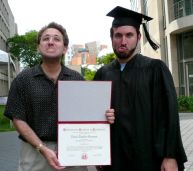
But just as I was getting ready to sign the contract, a sticking point emerged that threatened to derail the entire decision. My brother, David, had already taken the address aaronson@mit.edu. Luckily for me, though, David graduated just last week with a bachelor’s in math, and Srini Devadas, MIT’s Associate Head for Computer Science, has assured me in writing that I can have David’s address as soon as it lapses. As a new faculty member, I was even formally able to present David’s degree to him:

Let me end this post with a plea to any superstar undergrads who (when you’re not procrastinating by reading this blog) are considering applying to grad school in theoretical computer science. Sure, your decision might seem like an obvious one, but please give the “unBerkeley” a chance. If you do decide come to Cambridge, MA, there will now be someone around who you can work with — I mean, y’know, besides Demaine, Goemans, Goldwasser, Indyk, Karger, Kelner, Kleitman, Leighton, Lynch, Micali, Mitzenmacher, Rivest, Rubinfeld, Shor, Sipser, Sudan, Vadhan, Valiant, …

In support of an academic boycott

June 10th, 2007

Today’s topic is one I was hoping I could avoid, since I know that my stance will alienate many of my own supporters. But after I read the comments on this post by Bill Gasarch, and reflected on all the men, women, and children who were dispossessed of their land while the world did nothing, I realized I could no longer remain silent.

Most of you will know what I’m talking about, but for those who don’t: I urge the readers of this blog to join me in severing all academic ties with the settler state of New Zealand, until that state makes complete restitution for its historic crimes against the Maori people. That means no more giving seminars at the University of Auckland. No more reading papers with “ac.nz” in the author’s email address. Indeed, no more involvement with any physics or climate research in Antarctica, the flights to which leave from Christchurch.

Some will say my proposed boycott smacks of anti-Kiwi prejudice. But in reality, some of my best friends are Kiwis. Furthermore, I hope and expect that those Kiwis who care about justice will embrace my proposal, for the chance it affords their rogue state to confront the lies and denial upon which it was founded.

Others will ask: if we’re going to boycott Kiwi scientists over the dispossession of the Maori, then why not boycott Australian scientists over the aboriginals, Chinese scientists over the Tibetans, or American scientists over the Native Americans, Iraqis, Vietnamese, or Guatemalans? I trust, however, that sensible people will recognize this question for the Kiwi diversionary tactic that it is. For what could Australia, China, or the US possibly have to do with New Zealand? Until the Kiwis acknowledge that the issue is them and only them, there is no hope for progress.

Even in a world rife with violence and despair, I can think of no single issue with a greater claim upon our conscience. And that is why I ask again: who will join me in severing all academic ties with New Zealand?

Bluehost sucks

June 6th, 2007

I apologize for my website being down all morning. Back in the heyday of Bell Labs, they used to engineer telecommunications systems for “five-nines availability” (that is, 99.999% uptime). In our vastly more sophisticated Internet age, I’d gladly settle for two and a half nines.

So, can anyone recommend a webhosting service that doesn’t suck? If such a service exists, I’ll dump Bluehost and encourage others to do the same.

The groupies of science

June 5th, 2007

A friend sent me this Stanford Daily article about the strange tale of Elizabeth Okazaki, who

[f]or the last four years … has attended graduate physics seminars, used the offices reserved for doctoral and post-doctoral physics students and for all intents and purposes made the Varian Physics Lab her home. The only problem is that Okazaki appears to have no affiliation with Stanford and, according to physics professors and students, no real reason to be there.

The article quotes two people I know: Lenny Susskind (“as far as I can tell, she has a very limited knowledge of physics itself”) and Alessandro Tomasiello (“I feel really bad for her … I don’t want to have a conversation with her that will actually hurt her”). From both the article and the many impassioned comments, it’s clear that opinions in the physics department were mixed. Of course, by now Stanford has predictably reacted by banning Okazaki from campus.

Here’s the thing: while Okazaki is admittedly an extreme case, she reminds me of people I’ve known throughout my academic career. These are the groupies of science: those non-scientists who, for one reason or another, choose to build their whole social lives around science and scientists. When asked about their “research,” such people usually mention some vague interdisciplinary project that never seems to come to fruition.

After long deliberation, I’ve reached the following conclusion: generally speaking, SCIENCE NEEDS MORE GROUPIES, NOT LESS.

And no, not just for the obvious reason. At their best, groupies perform a vital role in the socially-impoverished scientific ecosystem, by serving as the conveyors of gossip, the organizers of parties, the dispensers of advice, and the matchmakers of lonely nerds with eligible humanists.

Furthermore, science needs a freewheeling culture to function, a point that seems lost on many of the Stanford Daily commenters. There we find enraged alumni wondering how anyone could possibly get away with this, and declaring that they certainly won’t be sending their kids to any school that tolerates such inanity. We find bigots comparing Okazaki to the Virginia Tech shooter Cho Seung-Hui (the common thread being, apparently, that both of them are Asian). And we find people asking rhetorically whether any corporation or government agency would tolerate a freeloader hanging around its offices for years. (My answer: probably not, and that’s one reason why I’m happy not to work at such places!)

On the other hand, we also find commenters denouncing the spoiled bourgeoisie capitalists at Stanford, who would deny a poor homeless woman the right to sleep in their physics building. Unless the critics are Mother Teresas themselves, that doesn’t seem fair to me either.

I have no desire to pass judgment on someone I’ve never met; any decision on Okazaki ought to rest with the people who actually work in Varian and know the specifics of her case. But I’d like to offer a general suggestion to any department that finds itself in a similar situation in the future: unless the groupie is insane or incompetent, find her some low-paying job as a lab assistant or “social programming director” or something like that. When we discover a stowaway on the great Ship of Science, why throw her overboard when we could make her swab the decks?

Update (6/6): Peter Woit now has his own post on this affair, with several entertaining comments. I’m skeptical of the idea that Okazaki had no real interest in science or scientists and only wanted free digs. Even in the insane housing market of Palo Alto, surely there must be ways to get a roof over your head that don’t require sitting in on theoretical physics seminars?

I also found the following comment priceless:

I think Scott Aaronson’s opinion is quite shallow … Scott wants groupies, and he wants to hire them to “swab the decks”. Only someone who thinks he is so special he should have serfs to serve him would think that way. College Professors already have a bunch of poorly paid workers(graduate students) who write papers for them. Do these aristocrats need an additional class of poorly paid servants

It always amuses me when those looking for an “elite” to rail against pick people who strive for a decade against staggering odds to have ideas that no one in the history of the world ever had before, in order that they might possibly qualify for a stressful, ~90-hour-a-week job offering the same money, power, and prestige that would accrue automatically to a mid-level insurance salesman.

Wanna bet?

June 3rd, 2007

A commenter on my previous post writes:

What all these scientists who are crying about the teaching of evolution should do is propose bets to creationists based on the outcomes of experiments … You think that these D-wave guys won’t be able to do something they’re claiming to be able to do? It might be a good exercise to make that statement precise … If someone has a conjecture of the form “There should exist a theory that explains X”, people roll their eyes, essentially because there’s no way of deciding the implicit bet.

Alright, imagine the following conversation:

Layperson: I just heard on the radio about this new Yood d’Shnood Theory of the Universe. What do you think the odds are that it’ll turn out to be true?

Scientist: Well, so far I haven’t seen any good evidence that…

Layperson: Sure, but what’s your prediction?

Scientist: As I said, the evidence seems to be explained a lot more easily by…

Layperson: But what if you had to bet?

Scientist: Well, there are two ways to think about this. What the Yood d’Shnood proponents argue is that…

Layperson: No, don’t give me a dissertation, just give me a number!

Here’s the thing: when my PhD diploma arrived in the mail, it didn’t imbue me with some sort of supernatural power to predict the outcomes of future quantum computing experiments, unmediated by the evidence and arguments of the temporal world. (This despite the fact that my diploma was signed by a time-travelling cyborg, in his official capacity as Governor of California and Regent of the UC system.)

Of course, the reason scientists worry about evidence is that ultimately, we want our theories to cohere with reality and our predictions to come out right. The experience of the last four centuries suggests this hope is far from futile. The trouble is that, once you’ve decided to adopt the evidence-centric strategy that’s worked so well in the past, you have to forget temporarily about betting odds. For the mindset of the scientist toying with rival explanations, and that of the Bayesian handicapping horses in a race, are (at least in my experience) simply too incompatible to inhabit the same brain at the same time.

If you’ll forgive the metaphor, asking for gambling odds on every scientific question is like asking a woman to sleep with you on the first date. Of course it’s in the back of your mind (and possibly not only yours), but it tends to be counterproductive even to bring it up. If you’re ever going to reach the summit, then you have to act like all that really matters to you is the climb, and the only reliable way to act like it is to remake yourself into the sort of person for whom it’s true. Such is the paradox of science and of life.

So, did D-Wave succeed in using the quantum adiabatic algorithm to solve Sudoku puzzles in fewer steps than those same puzzles would be solved with classical simulated annealing? I don’t know. To repeat, I don’t know. What I know is that I haven’t seen the evidence, and that the burden of providing such evidence rests with the people making the claim.

The Myth of the Ivory Tower

May 30th, 2007

I know I promised no more posts about D-Wave and its “commercial” “quantum” computer for a while. But will you look at the bait that D-Wave founder Geordie Rose has been dangling in front of me on his blog?

People tend to approach problems and form opinions through the lens of their expertise. This happens all the time when disciplines are close … but it also happens in wierder [sic] situations, where the area of expertise is entirely disjoint from the situation being analyzed — like when theoretical computer scientists have opinions about real computers for example.

In Geordie’s comments section, the message is clearer still. One commenter writes that “the Professors didn’t get there first and they are angry; all truth must first come from them.” Another imagines “the Aaronsons of the world” fervently hoping that “their fragile self-created self-contained ecosystem can be re-built just the way they like it.”

For commenters like these, it would seem that the issue has nothing to do with decoherence rates or scalability, or with what the evidence is that D-Wave is actually harnessing quantum effects to obtain a computational speedup. So in this post, I want to step back and try to understand what the real issue is.

I propose that more than a few technology enthusiasts — not just the D-Wave supporters quoted above — are in the thrall of The Myth of the Ivory Tower. According to this Myth, the basic function of academic scientists is to sit around in their armchairs, pompously declaring to be impossible what plucky inventors like Thomas Edison or the Wright Brothers then roll up their sleeves and do. Now, I might be an academic myself, but I’m also a proud American (currently residing in the 51st state), and I won’t deny that this most American of myths has a certain resonance even for me. In the end, though, I believe that the Myth tells us more about our Zeitgeist, or our collective psyche, or something like that, than it does about the actual history of technology.

The “evidence” for the Myth (when such is offered) usually consists of famous last words from distinguished scientific authorities. You know the sort of thing I’m talking about:

Heavier-than-air flying machines are impossible.
Radio has no future.
X-rays will prove to be a hoax.
-William Thomson (Lord Kelvin)

I think there is a world market for maybe five computers.
-Thomas Watson

There is no reason anyone would want a computer in their home.
-Ken Olsen

(Watson and Olsen were of course CEO’s, but for the purposes of the Myth they stand in here as “academics.”)

However, as soon as we think about these predictions and what they’re supposed to demonstrate, we notice some glaring problems. The first one is confirmation bias. No one compiles lists of pessimistic technological forecasts made by experts that turned out to be right — where would you even start?

The second problem is that many of the juiciest predictions come from a single individual: Lord Kelvin. Furthermore, they come from the twilight of his career, when he was considered to have lost his vortices even by most of his colleagues. Seeking to better understand this great physicist of the 19th century who was so wrong about the technologies of the 20th, I just read an excellent biography called Degrees Kelvin. One thing I learned is that, if the selective historians chose to focus on the first half of Kelvin’s career rather than the second, they could find equally exquisite anecdotes illustrating the reliability of academic opinions.

In the laying of the first transatlantic telegraph cable in the 1850’s, there were two colorful personalities: Kelvin and Wildman Whitehouse. Whitehouse, the “practical” man, detested any math or physics he couldn’t understand, and insisted that a transatlantic cable would just be a longer version of existing cables. Kelvin, the “theorist,” said that while a transatlantic cable was certainly possible, it would need thicker insulation, a different kind of receiver, etc. than previous cables to work reliably, and that more testing and research was needed. As it happened, after laying a cable that was every bit as unreliable as Kelvin said it would be, Whitehouse (1) had to use Kelvin’s receiver to get any signal through at all, (2) faked the transcripts to make it look like he used his own receiver, (3) fatally damaged the cable by sending 2,000 volts through it in a desperate attempt to get it to work properly, and then (4) insisted the cable was still fine after it had permanently gone silent. Eventually the cable companies learned their lesson.

Despite this and other successes (e.g., the Second Law of Thermodynamics), Kelvin’s doofus predictions in later life do illustrate two important points. The first is that, if you’re going to make skeptical pronouncements, you’d better distinguish clearly between the provably impossible, the presumably impossible, and the merely difficult and not yet achieved. The second is that, if you’re going to claim something’s impossible, you’d better have an argument, and you’d better understand what assumptions it rests on.

Alright, so let’s move on to Watson and Olsen’s predictions about the computer industry. The funny thing is, these predictions weren’t nearly as stupid as they sound! Why? Because there’s nothing inevitable about the concept of a personal computer. Instead of billions of home PC’s, we could just as easily imagine most of the world’s computing power concentrated in a few servers, accessible remotely to anyone who wanted it. In this alternate universe, your desktop PC would be little more than a glorified information portal — a “browser,” if you will — while most of the actual application software (email, calendars, maps, etc.) ran elsewhere. I admit that this is just a fanciful, hypothetical scenario, but what does that matter to a theorist like me?

Speaking of which, the Internet was of course the child of DARPA and NSF, raised to adolescence in university CS departments. (DARPA has since reoriented itself toward projects with shorter-term payoff, its previous funding model having failed so disastrously.) The Web was created by Tim Berners-Lee at CERN, and the first popular web browser by Marc Andreessen at the University of Illinois. (And yes, Al Gore had a nontrivial role in funding this work.) R, S, and A were all at MIT. If you’re going to argue for the irrelevance of academic research, the Internet is not the place to start.

But what about some of the other spectacular inventions of the last fifty years: the laser, the transistor, the fiber-optic cable, the communications satellite? Didn’t those come from the private sector? As it happens, they came from Bell Labs, which is interesting as the sort of mammoth exception that proves the rule. Because of AT&T’s government-sanctioned monopoly, for much of the 20th century Bell Labs was able to function like the world’s largest university, devoting billions of dollars to “irrelevant” research. So in the 1980’s, when Congress decided to deregulate the phone system, many people predicted that Bell Labs would die a slow, agonizing death — a prediction that’s been borne out over the last 25 years.

But surely other companies must have picked up the slack? No, not really. While Microsoft, IBM, NEC, Xerox, and a few others all provide welcome support for basic research, none of them do so on the old Ma Bell’s scale. From a CEO’s perspective, the problem with basic research is obvious: a rising tide lifts all boats, your competitors’ as well as yours. (The famous cautionary example here is Xerox PARC, which made the “mistake” of giving the world the windowing system, the mouse, and the laser printer.)

For those who adhere to the religion of capitalism, have the Arrow-Debreu Theorem tattoed across their chests, etc., it might be difficult to understand how a system based on peer review rather than the free market could lead so consistently to technological breakthroughs. I mean, all those ivory-tower academics growing fat off government grants: what incentive could they possibly have to get the right answers? Without picky customers or venture capitalists breathing down their necks, what’s the penalty for being wrong?

I’m lucky enough to be friends with Robin Hanson, a brilliant economist and futurist who starts where Ayn Rand would’ve suffered a loss of nerve and keeps going from there. Robin has long argued that the scientific peer review process is broken, and ought to be supplanted by a futures market that would reward scientists for making correct predictions. As he writes:

The pace of scientific progress may be hindered by the tendency of our academic institutions to reward being popular, rather than being right … Academia is still largely a medieval guild, with a few powerful elites, many slave-like apprentices, and members who hold a monopoly on the research patronage of princes and the teaching of their sons …

Imagine that academics are expected to “put up or shut up” and accompany claims with at least token bets, and that statistics are collected on how well people do. Imagine that funding agencies subsidize pools on questions of interest to them, and that research labs pay for much of their research with winnings from previous pools. And imagine that anyone could play, either to take a stand on an important issue, or to insure against technological risk.

Personally, I hope that Robin’s science futures market gets tried on a significant scale, and I can’t wait to see the results. (Naturally, even the marketplace of ideas has to compete in the marketplace of ideas!) I agree with Robin that academic science is often tradition-bound to the point of absurdity, and that its institutions ought to be as open to scrutiny and replacement as its theories. But I don’t go as far as he apparently does in the direction of the Myth of the Ivory Tower. For me, the interesting thing about science is not that it’s broken, but rather that it’s about the least broken enterprise in the whole sorry history of our species.
A Woitian links, links, links post (slightly stale but still edible)

May 20th, 2007

Razborov and Rudich won the Gödel Prize for “Natural Proofs”, which probably did as much as any single paper to elucidate the nature of the P vs. NP problem. (More from the Bearded One and the Pontiff.) Loosely speaking, R&R showed that any circuit lower bound satisfying certain extremely broad criteria would “bite its own tail,” and lead to efficient algorithms to distinguish random from pseudorandom functions — the very sort of thing that we wanted to prove was hard. This doesn’t by any means imply that a P≠NP proof is impossible, but it does show how the problem has a strange, self-referential character that’s not quite like anything previously encountered in mathematics, including in the work of Gödel and Turing. Technically simple but conceptually profound, the paper is also a masterpiece of clear, forceful exposition. When I first came across it as an undergrad at Cornell, I knew complexity was my subject.

Following on the heels of the New Yorker, the New York Times ran its own epic on the Large Hadron Collider. So science writers can do a decent job when they feel like it. Why can’t they write about P vs. NP the same way? Oh, right … them big machines …

Andy Drucker poses the following problem: suppose there are n blog posts, and for each post bi, you’re told only that it was posted during the time interval [ti,ui]. Is there an efficient algorithm to count how many orderings of the blog posts are compatible with that information? Alternatively, is the problem #P-complete? Let me stress that Andy doesn’t know the answer to this question, and neither do I.

A certain MIT undergrad of my acquaintance sent the following letter to MIT’s DMCA enforcement office.

Dear MIT DMCA Agent,

After viewing Scoop and receiving your notice, I was more than happy to comply with NBC’s request to destroy it. Rest assured that I will no longer be downloading or sharing any post-Manhattan Woody Allen films.

Religion’s rules of inference

May 12th, 2007

Besides defending quantum computing day and night, having drinks with Cosmic Variance‘s Sean Carroll, and being taken out to dinner at lots of restaurants with tablecloths, the other highlight of my job interview tour was meeting a friendly, interesting, articulate divinity student on the flight from San Francisco to Philadelphia, who tried to save my soul from damnation.

Here’s how it happened: the student (call him Kurt) was reading a Christian theological tract, while I, sitting next to him, was reading Russell on Religion. (This is true.) I sheepishly covered the spine of my book, trying to delay the inevitable conversation — but it finally happened, when Kurt asked me how I was liking ole’ Bert. I said I was liking him just fine, thank you very much.

Kurt then made some comment about the inadequacy of a materialistic worldview, and how, without God as the basis of morality, the whole planet would degenerate into what we saw at Virginia Tech. I replied that the prevention of suffering seemed like a pretty good basis for morality to me.

“Oh!” said Kurt. “So then suffering is bad. How do you know it’s bad?”

“How do you know it’s bad?”

“Because I believe the word of God.”

“So if God said that suffering was good, that would make it good?”

I can’t remember Kurt’s response, but I’m sure it was eloquent and well-practiced — nothing I said really tripped him up, nor did I expect it to. Wanting to change the subject, I asked him about his family, his studies, his job, what he’d been doing in the vipers’ den of San Francisco, etc. I told him a little about quantum computing and my job search. I mused that, different though we were, we both valued something in life more than money, and that alone probably set us apart from most people on the plane. Kurt said it was fitting that I’d gone to grad school at Berkeley. I replied that, as a mere Democrat, I was one of the most conservative people there.

Finally I blurted out the question I really wanted to ask. In his gentle, compassionate, way, Kurt made it clear to me that yes, I was going to roast in hell, and yes, I’d still roast in hell even if I returned to the religion of my ancestors (that, of course, being at best a beta version of the true religion). In response, I told Kurt that when I read Dante’s Inferno in freshman English, I decided that the place in the afterlife I really wanted to go was the topmost layer of hell: the place where Dante put the “righteous unbaptized” such as Euclid, Plato, and Aristotle. There, these pre-Christian luminaries could carry on an eternal intellectual conversation — cut off from God’s love to be sure, but also safe from the flames and pitchforks. How could angels and harps possibly compete with infinite tenure at Righteous Unbaptized University? If God wanted to lure me away from that, He’d probably have to throw in the Islamic martyr package.

San Francisco to Philadelphia is a five-hour flight, and the conversation ranged over everything you might expect: the age of the earth (Kurt was undecided but leaning toward 6,000 years), whether the universe needs a reason for its existence external to itself, etc. With every issue, I resolved not to use the strongest arguments at my disposal, since I was more interested in understanding my adversary’s reasoning process — and ideally, in getting him to notice inconsistencies within his own frame of reference. Alas, in that I was to be mostly disappointed.

Here’s an example. I got Kurt to admit that certain Bible passages — in particular, the ones about whipping your slaves — reflected a faulty, limited understanding of God’s will, and could only be understood in the historical context in which they were written. I then asked him how he knew that other passages — for example, the ones condemning homosexuality — didn’t also reflect a limited understanding of God’s will. He replied that, in the case of homosexuality, he didn’t need the Bible to tell him it was immoral: he knew it was immoral because it contradicted human beings’ biological nature, gay couples being unable to procreate. I then asked whether he thought that infertile straight couples should similarly be banned from getting married. Of course not, he replied, since marriage is about more than procreation — it’s also about love, bonding, and so on. I then pointed out that gay and lesbian couples also experience love and bonding. Kurt agreed that this was true, but then said the reason homosexuality was wrong went back to the Bible.

What fascinated me was that, with every single issue we discussed, we went around in a similar circle — and Kurt didn’t seem to see any problem with this, just so long as the number of 2SAT clauses that he had to resolve to get a contradiction was large enough.

In the study of rationality, there’s a well-known party game: the one where everyone throws a number from 0 to 100 into a hat, and that player wins whose number was closest to two-thirds of the average of everyone’s numbers. It’s easy to see that the only Nash equilibrium of this game — that is, the only possible outcome if everyone is rational, knows that everyone is rational, knows everyone knows everyone is rational, etc. — is for everyone to throw in 0. Why? For simplicity, consider the case of two people: one can show that I should throw in 1/2 of what I think your number will be, which is 1/2 of what you think my number will be, and so on ad infinitum until we reason ourselves down to 0.

On the other hand, how should you play if you actually want to win this game? The answer, apparently, is that you should throw in about 20. Most people, when faced with a long chain of logical inferences, will follow the chain for one or two steps and then stop. And, here as elsewhere in life, “being rational” is just a question of adjusting yourself to everyone else’s irrationalities. “Two-thirds of 50 is 33, and two-thirds of that is 22, and … OK, good enough for me!”

I’ve heard it said that the creationists are actually perfectly rational Bayesians; they just have prior probabilities that the scientifically-minded see as perverse. Inspired by conversations with Kurt and others, I hereby wish to propose a different theory of fundamentalist psychology. My theory is this: fundamentalists use a system of logical inference wherein you only have to apply the inference rules two or three times before you stop. (The exact number of inferences can vary, depending on how much you like the conclusion.) Furthermore, this system of “bounded inference” is actually the natural one from an evolutionary standpoint. It’s we — the scientists, mathematicians, and other nerdly folk — who insist on a bizzarre, unnatural system of inference, one where you have to keep turning the modus ponens crank whether you like where it’s taking you or not.

Kurt, who looked only slightly older than I am, is already married with two kids, and presumably more on the way. In strict Darwinian terms, he’s clearly been more successful than I’ve been. Are those of us who can live with A→B or B→C or C→not(A) but not all of them at once simply evolutionary oddities, like people who have twelve fingers or can’t stand sunlight?

Five reasons why I was in a good mood yesterday

May 8th, 2007
  1. I went on my first hot-air balloon ride (click here for photos). We landed in a Mennonite farm a half hour’s drive from Waterloo. Seven kids came out of the farmhouse to greet us, wearing caps and bonnets. These were the best-behaved kids I had ever seen in my life: they literally walked in formation, and only the oldest one spoke to us, the other six remaining silent. Having a balloon land on their farm was not at all a new experience for them.
  2. I saw this xkcd cartoon, which succinctly captures a point that I’ve been trying to make for the last fifteen years, in arguments against conspiracy-mongers and other associated doofiati.
  3. I read Elizabeth Kolbert’s New Yorker article about the Large Hadron Collider and the future of particle physics. I hereby nominate her for a Pulitzer; this is one of the best popular science articles I’ve ever read.
  4. I saw Spider-Man 3, a profound philosophical drama that spoke to me on numerous levels. It is indeed true that with great power comes great responsibility; that we all have the capacity for good; and that, if we wish to vanquish the evil without, then we must first confront the arrogance within. My one complaint is that the Sandman was not a particularly effective villain. Let’s face it: sand just isn’t scary.
  5. I got a job offer from MIT.

[Note: To clear up any confusion, I’m now lucky enough to have several great offers, and have not yet decided where I’m going, even unofficially.]

Two Sunday-morning breakfast links

May 6th, 2007

On Thursday NEC put out a press release announcing the “world’s first controllably coupled qubits.” See here for the abstract of the accompanying Science paper by Niskanen et al. (unfortunately the full text requires a subscription). NEC’s announcement led to the usual fluffified popular articles; see here, here, and here for example. But to satisfy Geordie Rose’s curiosity, my hype-o-meter has not yet reached D-Wave levels, for three reasons.

  1. These claims haven’t garnered nearly as much ‘quonfusion’ as D-Wave’s in the popular press.
  2. In this case there is a peer-reviewed paper.
  3. There’s no claim here about solving NP-complete problems, or indeed about asymptotic complexity at all. The sole claim to originality has to do with “tunable two-qubit couplings,” and I’m not at all well-placed to evaluate it.

Anyway, I thought I should at least mention this work, in the hope that commenters more knowledgeable than I am will weigh in on its significance. Eternal vigilance is the price of quantum computing research.

OK, on to the second breakfast link. Bill Gasarch has reviewed my blog for SIGACT News (scroll down to page 15), together with Lance Fortnow’s and Luca Trevisan’s. Favorite quotes:

Lance is Walter Cronkite. Scott is Stephen Colbert.

The name of the blog, ‘Shtetl-Optimized’ does not really say what it is about. With this in mind one can never say Scott has gone ‘off topic’ since its [sic] not clear what the topic should be.

Incidentally, an uncharitable person might suspect a slight conflict of interest in Bill reviewing Lance’s blog, seeing as Bill now writes Lance’s blog. But Bill assures us that he reviewed the blog before taking it over.