Intellectual funnel cake
Thursday, September 14th, 2006It’s the Science Blog Carnival! Come see me hawking my wares, alongside Peter Woit, Dave Bacon, and dozens of other clowns.
It’s the Science Blog Carnival! Come see me hawking my wares, alongside Peter Woit, Dave Bacon, and dozens of other clowns.
I woke up at my normal time — probably around 2PM — in my room at Berkeley’s International House, to find an avalanche of email: from a fellow grad student, urging everyone to check the news; from Christos Papadimitriou, reminding us that we have a community here, and communities can comfort; from Luca Trevisan, announcing that the class that he taught and I TA’ed would be canceled, since on a day like this it was impossible to think about algorithms. I then clicked over to news sites to find out what had happened.
After confirming that my friends and family were safe, I walked over to my office in Soda Hall, mostly to find people to talk to. Technically I had office hours for the algorithms class that afternoon, but I didn’t expect students actually to come. Yet come they did: begging for hints on the problem set, asking what would and wouldn’t be on the test, pointing to passages in the CLRS textbook that they didn’t understand. I pored over their textbook, shaking my head in disbelief, glancing up every minute or so at the picture of the burning buildings on the computer screen.
That night there was a big memorial service in Sproul Plaza. When I arrived, a woman offered me a candle, which I took, and a man standing next to her offered me a flyer, which I also took. The flyer, which turned out to be from a socialist organization, sought to place the events of that morning in “context,” describing the World Trade Center victims as “mostly white-collar executives and those who tried to save them.”
After a few songs and eulogies, a woman got up to explain that, on this terrible day, what was really important was that we try to understand the root causes of violence — namely poverty and despair — and not use this tragedy as a pretext to start another war. The crowd thunderously applauded.
While the speeches continued, I got up and wandered off by myself in the direction of Bancroft Way. Much as I did the year before, when the area around Telegraph was festooned with Nader for President posters, I felt palpably that I wasn’t living in an outcomes-based region of reality. The People’s Republic of Berkeley was proving to be a staunch ally of the Oilmen’s Oligarchy of Crawford, undermining the only sorts of opposition to it that had any possibility of succeeding.
I decided to forget about politics for a while and concentrate exclusively on research. I can’t say I succeeded at this. But I did pass my prelim exam three days later (on September 14), and a few weeks afterward proved the quantum lower bound for the collision problem.
Note: Feel free to post your own retrospective in the comments section. Andris Ambainis has already done so.
So, it seems the arXiv is now so popular that even Leonhard Euler has contributed 25 papers, despite being dead since 1783. (Thanks to Ars Mathematica for this important news item, as well as for the hours of procrastination on my part that led to its rediscovery.) Since I’d long been curious about the mathematical research interests of the nonliving, I decided to check out Leonhard’s most recent preprint, math.HO/0608467 (“Theorems on residues obtained by the division of powers”). The paper starts out slow: explaining in detail why, if a mod p is nonzero, then a2 mod p, a3 mod p, and so on are also nonzero. By the end, though, it’s worked out most of the basics of modular arithmetic, enough (for example) to analyze RSA. Furthermore, the exposition, while “retro” in style, is sufficiently elegant that I might even recommend acceptance at a minor theory conference, even though the basic results have of course been known for like 200 years.
Oh — you say that Mr. E’s papers were as difficult and abstract for their time as Wiles and Perelman’s papers are for our own time? BULLSHIT. Reading the old master brings home the truth: that, for better and worse, math has gotten harder. Much, much harder. And we haven’t gotten any smarter.
At Greg Kuperberg’s request, I’ve decided to follow my Ten Reasons To Believe P!=NP with…
Thirteen Reasons Why I’d Be Surprised If Quantum Computing Were Fundamentally Impossible
So that there’s no question about exactly where I stand, I’ll start out by repeating, for the ten billionth time, the Official Scott Aaronson Quantum Computing Position Statement.
I now offer thirteen arguments to support the above views.
A reader named Lewis K. wrote in to ask for a “brief list of required reading for someone with a normal CS degree under his belt who wants to be taken to the research front in quantum complexity.” Alright then:
[Deutsch] [Bernstein-Vazirani] [BBBV] [Simon] [Shor] [Grover] [BBHT] [BBCMW] [Ambainis] [Watrous] [ANTV] [Fortnow-Rogers] [Abrams-Lloyd] [Childs et al.] [DMV] [EHK] [BJK] [Gottesman] [KKR] [Marriott-Watrous]
(Sprinkle in some textbooks, survey articles, and course lecture notes to taste.)
Commenters will boil me alive for leaving out huge swaths of the field, and they’ll be right. I’ve merely listed some papers that had a definite impact on how I, personally, attack problems. But hey, I’m the one you asked. So print ’em out, take ’em to the toilet, and sit there for a long time. When you’re finished, you won’t be at the “research front” — for that you obviously have to read my papers — but hopefully you’ll have seen enough to visit the big bad arXiv on your own. Happy Hadamards!
More often than I can remember, I’ve been asked some form of the following question: “If you computer scientists can’t prove P=NP or P!=NP, then why aren’t we justified in believing whichever one we want? And why is the ‘consensus’ that P!=NP anything more than a shared prejudice — something you repeat to each other so your work won’t seem irrelevant?”
It’s time to assume the mantle of Defender of the Faith. I’m going to give you ten arguments for believing P!=NP: arguments that are pretty much obvious to those who have thought seriously about the question, but that (with few exceptions) seem never to be laid out explicitly for those who haven’t. You’re welcome to believe P=NP if you choose. My job is to make you understand the conceptual price you have to pay for that belief.
Without further ado:
There are several questions that the above arguments don’t pretend to address: first, why is P versus NP a reasonable question? Second, even if P!=NP, why should we expect there to be a proof in ZF set theory? Third, even if there is a proof, why should we expect it to be within reach of the human intellect? I’m really not cut out for this C. S. Lewis role, but look for further installments of Mere Complexity as the need arises…
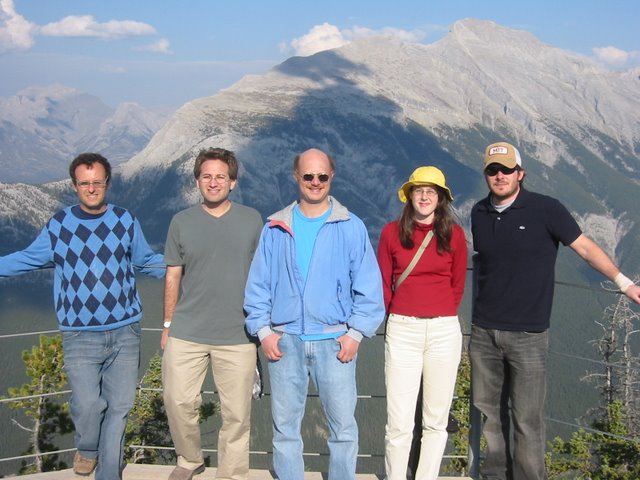
From left: Amnon Ta-Shma, your humble blogger, David Zuckerman, Adi Akavia, Adam Klivans. Behind us: the majestic mountains of Banff, Canada, site of yet another complexity workshop, which I just returned from a couple days ago, after which I immediately had to move out of my apartment, which explains the delay in updating the blog. Thanks to Oded Regev for the photo.
A few highlights from the workshop:
Overwhelming everything else, alas, was a memorial session for Misha Alekhnovich. Misha, who loved extreme sports, went on a whitewater kayaking trip in Russia a month ago. At a dangerous bend in the river, his three companions apparently made it to shore safely, while Misha did not. He was 28, and was to get married a few days from now.
Misha and I overlapped as postdocs at IAS, and I wish I’d gotten to know him better then. From the conversations we did have, it was clear that Misha missed Russia and wanted to go back as soon as possible. The truth, though, is that I knew Misha less on a personal level than through his groundbreaking work, and particularly his beautiful paper with Razborov, where they show that the Resolution proof system is not automatizable unless FPT = W[P]. I still find it incredible that they were able to prove such a thing.
Lance has already discussed the memorial session, in which Eli Ben-Sasson and Sasha Razborov offered their personal remembrances, while Toni Pitassi and Russell Impagliazzo gave talks about Misha’s work, emphasizing how the P versus NP question always lay just beneath the surface. It occurred to me that an outsider might find these talks odd, or even off-putting. Here we were, at a memorial for a dead colleague, talking in detail about the definition of automatizability and the the performance of the DPLL algorithm on satisfiable CNF instances. Personally, I found it moving. At a funeral for a brilliant musician, would one discuss his “passion for music” in the abstract without playing any of his songs?
The tragic loss of Misha has reinforced a view I’ve long held: that if challenge is what you seek, then the thing to do is to tackle difficult open problems in math and computer science (or possibly physics). Unlike the skydiver, the kayaker, or the mountain-climber, the theorem-prover makes a permanent contribution in the best case, and is down a few months and a few hundred cups of coffee in the worst case. As for physical challenges, walking around heavily-populated tourist areas with slanty rocks has always presented more than enough of them for me.

You are currently browsing the Shtetl-Optimized weblog archives for September, 2006.
 Follow