In the comments on my last post—the one about the open letter calling for a six-month pause on AI scaling—a commenter named Hans Holander berates me over and over, as have others before him, for my failure to see that GPT is just a hoax and scam with no “true” intelligence. Below is my reply: probably one of the most revealing things I’ve ever written (which is saying something).
The great irony here is that if you’re right—and you’re obviously 3000% confident that you’re right—then by my lights, there is no reason whatsoever to pause the scaling of Large Language Models, as your fellow LLM skeptics have urged. If LLMs are mere “stochastic parrots,” and if further scaling will do nothing to alleviate their parroticity, then there’d seem to be little danger that they’ll ever form grounded plans to take over the world, or even help evil people form such plans. And soon it will be clear to everyone that LLMs are just a gigantic boondoggle that don’t help them solve their problems, and the entire direction will be abandoned. All a six-month pause would accomplish would be to delay this much-needed reckoning.
More broadly, though, do you see the problem with “just following your conscience” in this subject? There’s no way to operationalize “follow your conscience,” except “do the thing that will make the highest moral authorities that you recognize not be disappointed in you, not consider you a coward or a monster or a failure.” But what if there’s no agreement among the highest moral authorities that you recognize, or the people who set themselves up as the moral authorities? What if people will call you a coward or a monster or a failure, will even do so right in your comment section, regardless of what you choose?
This, of course, is hardly the first time in my life I’ve been in this situation, condemned for X and equally condemned for not(X). I’ve never known how to navigate it. When presented with diametrically opposed views about morality or the future of civilization, all confidently held by people who I consider smart and grounded, I can switch back and forth between the perspectives like with the Necker cube or the duck-rabbit. But I don’t have any confident worldview of my own. What I have are mostly quips, and jokes, and metaphors, and realizing when one thing contradicts a different thing, and lectures (many people do seem to like my lectures) where I lay out all the different considerations, and sometimes I also have neat little technical observations that occasionally even get dignified with the name of “theorems” and published in papers.
A quarter-century ago, though I remember like yesterday, I was an undergrad at Cornell, and belonged to a scholarship house called Telluride, where house-members had responsibilities for upkeep and governance and whatnot and would write periodic reviews of each other’s performance. And I once got a scathing performance review, which took me to task for shirking my housework, and bringing my problem sets to the house meetings. (These were meetings where the great issues of the day were debated—like whether or not to allocate $50 for fixing a light, and how guilty to feel over hiring maintenance workers and thereby participating in capitalist exploitation.) And then there was this: “Scott’s contributions to house meetings are often limited to clever quips that, while amusing, do not advance the meeting agenda at all.”
I’m not like Eliezer Yudkowsky, nor am I even like the anti-Eliezer people. I don’t, in the end, have any belief system at all with which to decide questions of a global or even cosmic magnitude, like whether the progress of AI should be paused or not. Mostly all I’ve got are the quips and the jokes, and the trying to do right on the smaller questions.
And anyone who doesn’t like this post can consider it an April Fools (hey, Eliezer did the same last year!).
There’s now an open letter arguing that the world should impose a six-month moratorium on the further scaling of AI models such as GPT, by government fiat if necessary, to give AI safety and interpretability research a bit more time to catch up. The letter is signed by many of my friends and colleagues, many who probably agree with each other about little else, over a thousand people including Elon Musk, Steve Wozniak, Andrew Yang, Jaan Tallinn, Stuart Russell, Max Tegmark, Yuval Noah Harari, Ernie Davis, Gary Marcus, and Yoshua Bengio.
Meanwhile, Eliezer Yudkowsky published a piece in TIME arguing that the open letter doesn’t go nearly far enough, and that AI scaling needs to be shut down entirely until the AI alignment problem is solved—with the shutdown enforced by military strikes on GPU farms if needed, and treated as more important than preventing nuclear war.
Readers, as they do, asked me to respond. Alright, alright. While the open letter is presumably targeted at OpenAI more than any other entity, and while I’ve been spending the year at OpenAI to work on theoretical foundations of AI safety, I’m going to answer strictly for myself.
Given the jaw-droppingly spectacular abilities of GPT-4—e.g., acing the Advanced Placement biology and macroeconomics exams, correctly manipulating images (via their source code) without having been programmed for anything of the kind, etc. etc.—the idea that AI now needs to be treated with extreme caution strikes me as far from absurd. I don’t even dismiss the possibility that advanced AI could eventually require the same sorts of safeguards as nuclear weapons.
Furthermore, people might be surprised about the diversity of opinion about these issues within OpenAI, by how many there have discussed or even forcefully advocated slowing down. And there’s a world not so far from this one where I, too, get behind a pause. For example, one actual major human tragedy caused by a generative AI model might suffice to push me over the edge. (What would push you over the edge, if you’re not already over?)
Before I join the slowdown brigade, though, I have (this being the week before Passover) four questions for the signatories:
Would your rationale for this pause have applied to basically any nascent technology — the printing press, radio, airplanes, the Internet? “We don’t yet know the implications, but there’s an excellent chance terrible people will misuse this, ergo the only responsible choice is to pause until we’re confident that they won’t”?
Why six months? Why not six weeks or six years?
When, by your lights, would we ever know that it was safe to resume scaling AI—or at least that the risks of pausing exceeded the risks of scaling? Why won’t the precautionary principle continue for apply forever?
Were you, until approximately last week, ridiculing GPT as unimpressive, a stochastic parrot, lacking common sense, piffle, a scam, etc. — before turning around and declaring that it could be existentially dangerous? How can you have it both ways? If, as sometimes claimed, “GPT-4 is dangerous not because it’s too smart but because it’s too stupid,” then shouldn’t GPT-5 be smarter and thereforesafer? Thus, shouldn’t we keep scaling AI as quickly as we can … for safety reasons? If, on the other hand, the problem is that GPT-4 is too smart, then why can’t you bring yourself to say so?
With the “why six months?” question, I confess that I was deeply confused, until I heard a dear friend and colleague in academic AI, one who’s long been skeptical of AI-doom scenarios, explain why he signed the open letter. He said: look, we all started writing research papers about the safety issues with ChatGPT; then our work became obsolete when OpenAI released GPT-4 just a few months later. So now we’re writing papers about GPT-4. Will we again have to throw our work away when OpenAI releases GPT-5? I realized that, while six months might not suffice to save human civilization, it’s just enough for the more immediate concern of getting papers into academic AI conferences.
Look: while I’ve spent multipleposts explaining how I part ways from the Orthodox Yudkowskyan position, I do find that position intellectually consistent, with conclusions that follow neatly from premises. The Orthodox, in particular, can straightforwardly answer all four of my questions above:
AI is manifestly different from any other technology humans have ever created, because it could become to us as we are to orangutans;
a six-month pause is very far from sufficient but is better than no pause;
we’ll know that it’s safe to scale when (and only when) we understand our AIs so deeply that we can mathematically explain why they won’t do anything bad; and
GPT-4 is extremely impressive—that’s why it’s so terrifying!
On the other hand, I’m deeply confused by the people who signed the open letter, even though they continue to downplay or even ridicule GPT’s abilities, as well as the “sensationalist” predictions of an AI apocalypse. I’d feel less confused if such people came out and argued explicitly: “yes, we should also have paused the rapid improvement of printing presses to avert Europe’s religious wars. Yes, we should’ve paused the scaling of radio transmitters to prevent the rise of Hitler. Yes, we should’ve paused the race for ever-faster home Internet to prevent the election of Donald Trump. And yes, we should’ve trusted our governments to manage these pauses, to foresee brand-new technologies’ likely harms and take appropriate actions to mitigate them.”
Absent such an argument, I come back to the question of whether generative AI actually poses a near-term risk that’s totally unparalleled in human history, or perhaps approximated only by the risk of nuclear weapons. After sharing an email from his partner, Eliezer rather movingly writes:
When the insider conversation is about the grief of seeing your daughter lose her first tooth, and thinking she’s not going to get a chance to grow up, I believe we are past the point of playing political chess about a six-month moratorium.
Look, I too have a 10-year-old daughter and a 6-year-old son, and I wish to see them grow up. But the causal story that starts with a GPT-5 or GPT-4.5 training run, and ends with the sudden death of my children and of all carbon-based life, still has a few too many gaps for my aging, inadequate brain to fill in. I can complete the story in my imagination, of course, but I could equally complete a story that starts with GPT-5 and ends with the world saved from various natural stupidities. For better or worse, I lack the “Bayescraft” to see why the first story is obviously 1000x or 1,000,000x likelier than the second one.
But, I dunno, maybe I’m making the greatest mistake of my life? Feel free to try convincing me that I should sign the letter. But let’s see how polite and charitable everyone can be: hopefully a six-month moratorium won’t be needed to solve the alignment problem of the Shtetl-Optimized comment section.
At least six readers have by now sent me the following photo, which was taken in Israel a couple nights ago during the historic street protests against Netanyahu’s attempted putsch:
(Update: The photo was also featured on Gil Kalai’s blog, and was credited there to Alon Rosen.)
This is surely the first time that “P=NP” has emerged as a viral rallying cry for the preservation of liberal democracy, even to whatever limited extent it has.
But what was the graffiti artist’s intended meaning? A few possibilities:
The government has flouted so many rules of Israel’s social compact that our side needs to flout the rules too: shut down the universities, shut down the airport, block the roads, even assert that P=NP (!).
As a protest movement up against overwhelming odds, we need to shoot for the possibly-impossible, like solving 3SAT in polynomial time.
A shibboleth for scientific literate people following the news: “Israel is full of sane people who know what ‘P=NP’ means as you know what it means, are amused by its use as political graffiti as you’d be amused by it, and oppose Netanyahu’s putsch for the same reasons you’d oppose it.”
No meaning, the artist was just amusing himself or herself.
The artist reads Shtetl-Optimized and wanted effectively to force me to feature his or her work here.
Anyway, if the artist becomes aware of this post, he or she is warmly welcomed to clear things up for us.
And when this fight resumes after Passover, may those standing up for the checks and balances of a liberal-democratic society achieve … err … satisfaction, however exponentially unlikely it seems.
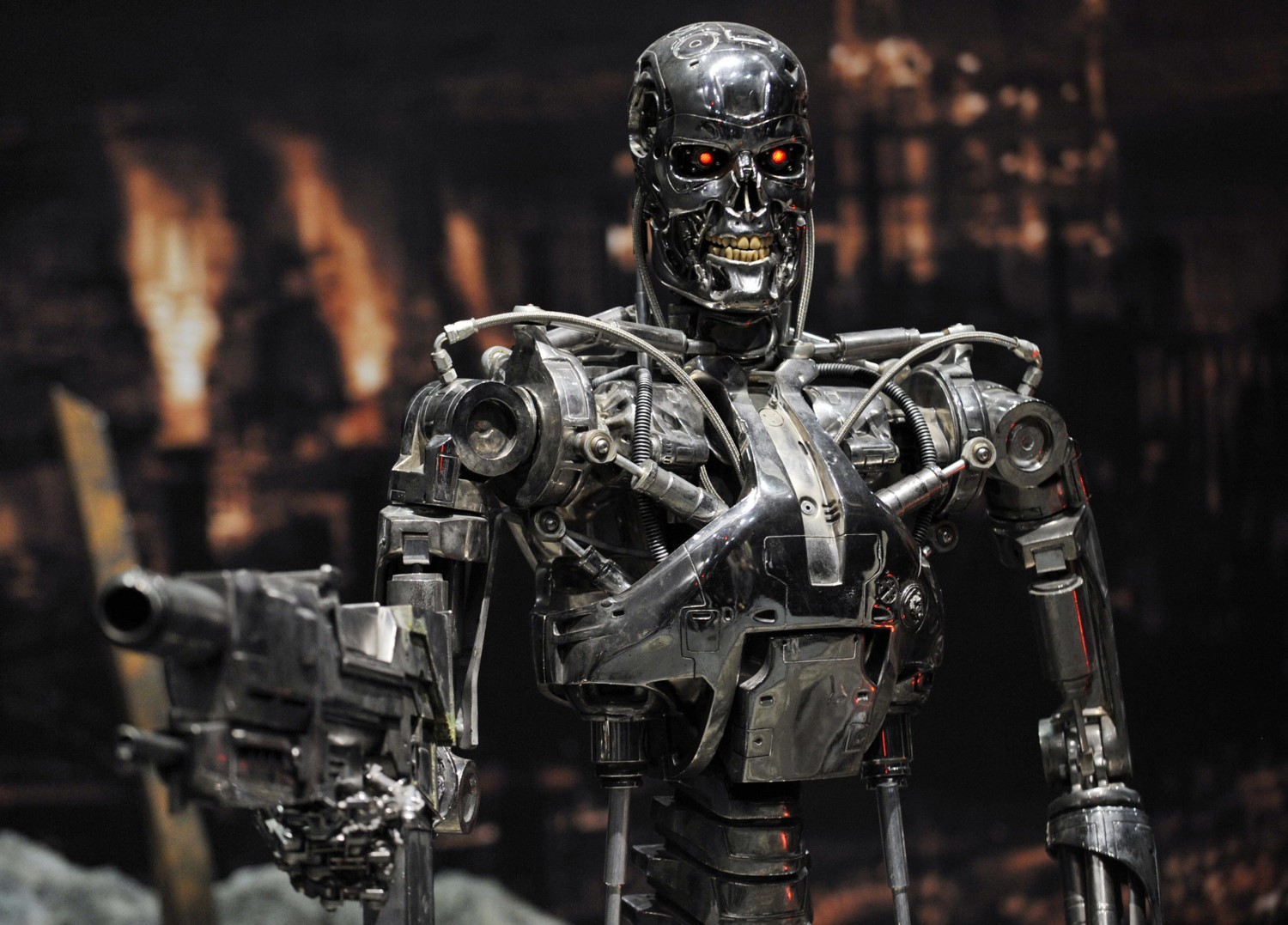
Every week now, it seems, events on the ground make a fresh mockery of those who confidently assert what AI will never be able to do, or won’t do for centuries if ever, or is incoherent even to ask for, or wouldn’t matter even if an AI did appear to do it, or would require a breakthrough in “symbol-grounding,” “semantics,” “compositionality” or some other abstraction that puts the end of human intellectual dominance on earth conveniently far beyond where we’d actually have to worry about it. Many of my brilliant academic colleagues still haven’t adjusted to the new reality: maybe they’re just so conditioned by the broken promises of previous decades that they’d laugh at the Silicon Valley nerds with their febrile Skynet fantasies even as a T-1000 reconstituted itself from metal droplets in front of them.
No doubt these colleagues feel the same deep frustration that I feel, as I explain for the billionth time why this week’s headline about noisy quantum computers solving traffic flow and machine learning and financial optimization problems doesn’t mean what the hypesters claim it means. But whereas I’d say events have largely proved me right about quantum computing—where are all those practical speedups on NISQ devices, anyway?—events have already proven many naysayers wrong about AI. Or to say it more carefully: yes, quantum computers really are able to do more and more of what we use classical computers for, and AI really is able to do more and more of what we use human brains for. There’s spectacular engineering progress on both fronts. The crucial difference is that quantum computers won’t be useful until they can beat the best classical computers on one or more practical problems, whereas an AI that merely writes or draws like a middling human already changes the world.
Given the new reality, and my full acknowledgment of the new reality, and my refusal to go down with the sinking ship of “AI will probably never do X and please stop being so impressed that it just did X”—many have wondered, why aren’t I much more terrified? Why am I still not fully on board with the Orthodox AI doom scenario, the Eliezer Yudkowsky one, the one where an unaligned AI will sooner or later (probably sooner) unleash self-replicating nanobots that turn us all to goo?
Is the answer simply that I’m too much of an academic conformist, afraid to endorse anything that sounds weird or far-out or culty? I certainly should consider the possibility. If so, though, how do you explain the fact that I’ve publicly said things, right on this blog, several orders of magnitude likelier to get me in trouble than “I’m scared about AI destroying the world”—an idea now so firmly within the Overton Window that Henry Kissinger gravely ponders it in the Wall Street Journal?
On a trip to the Bay Area last week, my rationalist friends asked me some version of the “why aren’t you more terrified?” question over and over. Often it was paired with: “Scott, as someone working at OpenAI this year, how can you defend that company’s existence at all? Did OpenAI not just endanger the whole world, by successfully teaming up with Microsoft to bait Google into an AI capabilities race—precisely what we were all trying to avoid? Won’t this race burn the little time we had thought we had left to solve the AI alignment problem?”
In response, I often stressed that my role at OpenAI has specifically been to think about ways to make GPT and OpenAI’s other products safer, including via watermarking, cryptographic backdoors, and more. Would the rationalists rather I not do this? Is there something else I should work on instead? Do they have suggestions?
“Oh, no!” the rationalists would reply. “We love that you’re at OpenAI thinking about these problems! Please continue exactly what you’re doing! It’s just … why don’t you seem more sad and defeated as you do it?”
The other day, I had an epiphany about that question—one that hit with such force and obviousness that I wondered why it hadn’t come decades ago.
Let’s step back and restate the worldview of AI doomerism, but in words that could make sense to a medieval peasant. Something like…
There is now an alien entity that could soon become vastly smarter than us. This alien’s intelligence could make it terrifyingly dangerous. It might plot to kill us all. Indeed, even if it’s acted unfailingly friendly and helpful to us, that means nothing: it could just be biding its time before it strikes. Unless, therefore, we can figure out how to control the entity, completely shackle it and make it do our bidding, we shouldn’t suffer it to share the earth with us. We should destroy it before it destroys us.
Maybe now it jumps out at you. If you’d never heard of AI, would this not rhyme with the worldview of every high-school bully stuffing the nerds into lockers, every blankfaced administrator gleefully holding back the gifted kids or keeping them away from the top universities to make room for “well-rounded” legacies and athletes, every Agatha Trunchbull from Matilda or Dolores Umbridge from Harry Potter? Or, to up the stakes a little, every Mao Zedong or Pol Pot sending the glasses-wearing intellectuals for re-education in the fields? And of course, every antisemite over the millennia, from the Pharoah of the Oppression (if there was one) to the mythical Haman whose name Jews around the world will drown out tonight at Purim to the Cossacks to the Nazis?
In other words: does it not rhyme with a worldview the rejection and hatred of which has been the North Star of my life?
As I’ve shared before here, my parents were 1970s hippies who weren’t planning to have kids. When they eventually decided to do so, it was (they say) “in order not to give Hitler what he wanted.” I literally exist, then, purely to spite those who don’t want me to. And I confess that I didn’t have any better reason to bring my and Dana’s own two lovely children into existence.
My childhood was defined, in part, by my and my parents’ constant fights against bureaucratic school systems trying to force me to do the same rote math as everyone else at the same stultifying pace. It was also defined by my struggle against the bullies—i.e., the kids who the blankfaced administrators sheltered and protected, and who actually did to me all the things that the blankfaces probably wanted to do but couldn’t. I eventually addressed both difficulties by dropping out of high school, getting a G.E.D., and starting college at age 15.
My teenage and early adult years were then defined, in part, by the struggle to prove to myself and others that, having enfreaked myself through nerdiness and academic acceleration, I wasn’t thereby completely disqualified from dating, sex, marriage, parenthood, or any of the other aspects of human existence that are thought to provide it with meaning. I even sometimes wonder about my research career, whether it’s all just been one long attempt to prove to the bullies and blankfaces from back in junior high that they were wrong, while also proving to the wonderful teachers and friends who believed in me back then that they were right.
In short, if my existence on Earth has ever “meant” anything, then it can only have meant: a stick in the eye of the bullies, blankfaces, sneerers, totalitarians, and all who fear others’ intellect and curiosity and seek to squelch it. Or at least, that’s the way I seem to be programmed. And I’m probably only slightly more able to deviate from my programming than the paperclip-maximizer is to deviate from its.
And I’ve tried to be consistent. Once I started regularly meeting people who were smarter, wiser, more knowledgeable than I was, in one subject or even every subject—I resolved to admire and befriend and support and learn from those amazing people, rather than fearing and resenting and undermining them. I was acutely conscious that my own moral worldview demanded this.
But now, when it comes to a hypothetical future superintelligence, I’m asked to put all that aside. I’m asked to fear an alien who’s far smarter than I am, solely because it’s alien and because it’s so smart … even if it hasn’t yet lifted a finger against me or anyone else. I’m asked to play the bully this time, to knock the AI’s books to the ground, maybe even unplug it using the physical muscles that I have and it lacks, lest the AI plot against me and my friends using its admittedly superior intellect.
Oh, it’s not the same of course. I’m sure Eliezer could list at least 30 disanalogies between the AI case and the human one before rising from bed. He’d say, for example, that the intellectual gap between Évariste Galois and the average high-school bully is microscopic, barely worth mentioning, compared to the intellectual gap between a future artificial superintelligence and Galois. He’d say that nothing in the past experience of civilization prepares us for the qualitative enormity of this gap.
Still, if you ask, “why aren’t I more terrified about AI?”—well, that’s an emotional question, and this is my emotional answer.
I think it’s entirely plausible that, even as AI transforms civilization, it will do so in the form of tools and services that can no more plot to annihilate us than can Windows 11 or the Google search bar. In that scenario, the young field of AI safety will still be extremely important, but it will be broadly continuous with aviation safety and nuclear safety and cybersecurity and so on, rather than being a desperate losing war against an incipient godlike alien. If, on the other hand, this is to be a desperate losing war against an alien … well then, I don’t yet know whether I’m on the humans’ side or the alien’s, or both, or neither! I’d at least like to hear the alien’s side of the story.
A central linchpin of the Orthodox AI-doom case is the Orthogonality Thesis, which holds that arbitrary levels of intelligence can be mixed-and-matched arbitrarily with arbitrary goals—so that, for example, an intellect vastly beyond Einstein’s could devote itself entirely to the production of paperclips. Only recently did I clearly realize that I reject the Orthogonality Thesis in its practically-relevant version. At most, I believe in the Pretty Large Angle Thesis.
Yes, there could be a superintelligence that cared for nothing but maximizing paperclips—in the same way that there exist humans with 180 IQs, who’ve mastered philosophy and literature and science as well as any of us, but who now mostly care about maximizing their orgasms or their heroin intake. But, like, that’s a nontrivial achievement! When intelligence and goals are that orthogonal, there was normally some effort spent prying them apart.
If you really accept the practical version of the Orthogonality Thesis, then it seems to me that you can’t regard education, knowledge, and enlightenment as instruments for moral betterment. Sure, they’re great for any entities that happen to share your values (or close enough), but ignorance and miseducation are far preferable for any entities that don’t. Conversely, then, if I do regard knowledge and enlightenment as instruments for moral betterment—and I do—then I can’t accept the practical form of the Orthogonality Thesis.
Yes, the world would surely have been a better place had A. Q. Khan never learned how to build nuclear weapons. On the whole, though, education hasn’t merely improved humans’ abilities to achieve their goals; it’s also improved their goals. It’s broadened our circles of empathy, and led to the abolition of slavery and the emancipation of women and individual rights and everything else that we associate with liberality, the Enlightenment, and existence being a little less nasty and brutish than it once was.
In the Orthodox AI-doomers’ own account, the paperclip-maximizing AI would’ve mastered the nuances of human moral philosophy far more completely than any human—the better to deceive the humans, en route to extracting the iron from their bodies to make more paperclips. And yet the AI would never once use all that learning to question its paperclip directive. I acknowledge that this is possible. I deny that it’s trivial.
Yes, there were Nazis with PhDs and prestigious professorships. But when you look into it, they were mostly mediocrities, second-raters full of resentment for their first-rate colleagues (like Planck and Hilbert) who found the Hitler ideology contemptible from beginning to end. Werner Heisenberg, Pascual Jordan—these are interesting as two of the only exceptions. Heidegger, Paul de Man—I daresay that these are exactly the sort of “philosophers” who I’d have expected to become Nazis, even if I hadn’t known that they did become Nazis.
With the Allies, it wasn’t merely that they had Szilard and von Neumann and Meitner and Ulam and Oppenheimer and Bohr and Bethe and Fermi and Feynman and Compton and Seaborg and Schwinger and Shannon and Turing and Tutte and all the other Jewish and non-Jewish scientists who built fearsome weapons and broke the Axis codes and won the war. They also had Bertrand Russell and Karl Popper. They had, if I’m not mistaken, all the philosophers who wrote clearly and made sense.
WWII was (among other things) a gargantuan, civilization-scale test of the Orthogonality Thesis. And the result was that the more moral side ultimately prevailed, seemingly not completely at random but in part because, by being more moral, it was able to attract the smarter and more thoughtful people. There are many reasons for pessimism in today’s world; that observation about WWII is perhaps my best reason for optimism.
Ah, but I’m again just throwing around human metaphors totally inapplicable to AI! None of this stuff will matter once a superintelligence is unleashed whose cold, hard code specifies an objective function of “maximize paperclips”!
OK, but what’s the goal of ChatGPT? Depending on your level of description, you could say it’s “to be friendly, helpful, and inoffensive,” or “to minimize loss in predicting the next token,” or both, or neither. I think we should consider the possibility that powerful AIs will not be best understood in terms of the monomanaical pursuit of a single goal—as most of us aren’t, and as GPT isn’t either. Future AIs could have partial goals, malleable goals, or differing goals depending on how you look at them. And if “the pursuit and application of wisdom” is one of the goals, then I’m just enough of a moral realist to think that that would preclude the superintelligence that harvests the iron from our blood to make more paperclips.
In my last post, I said that my “Faust parameter” — the probability I’d accept of existential catastrophe in exchange for learning the answers to humanity’s greatest questions — might be as high as 0.02. Though I never actually said as much, some people interpreted this to mean that I estimated the probability of AI causing an existential catastrophe at somewhere around 2%. In one of his characteristically long and interesting posts, Zvi Mowshowitz asked point-blank: why do I believe the probability is “merely” 2%?
Of course, taking this question on its own Bayesian terms, I could easily be limited in my ability to answer it: the best I could do might be to ground it in other subjective probabilities, terminating at made-up numbers with no further justification.
Thinking it over, though, I realized that my probability crucially depends on how you phrase the question. Even before AI, I assigned a way higher than 2% probability to existential catastrophe in the coming century—caused by nuclear war or runaway climate change or collapse of the world’s ecosystems or whatever else. This probability has certainly not gone down with the rise of AI, and the increased uncertainty and volatility it might cause. Furthermore, if an existential catastrophe does happen, I expect AI to be causally involved in some way or other, simply because from this decade onward, I expect AI to be woven into everything that happens in human civilization. But I don’t expect AI to be the only cause worth talking about.
Here’s a warmup question: has AI already caused the downfall of American democracy? There’s a plausible case that it has: Trump might never have been elected in 2016 if not for the Facebook recommendation algorithm, and after Trump’s conspiracy-fueled insurrection and the continuing strength of its unrepentant backers, many would classify the United States as at best a failing or teetering democracy, no longer a robust one like Finland or Denmark. OK, but AI clearly wasn’t the only factor in the rise of Trumpism, and most people wouldn’t even call it the most important one.
I expect AI’s role in the end of civilization, if and when it comes, to be broadly similar. The survivors, huddled around the fire, will still be able to argue about how much of a role AI played or didn’t play in causing the cataclysm.
So, if we ask the directly relevant question — do I expect the generative AI race, which started in earnest around 2016 or 2017 with the founding of OpenAI, to play a central causal role in the extinction of humanity? — I’ll give a probability of around 2% for that. And I’ll give a similar probability, maybe even a higher one, for the generative AI race to play a central causal role in the saving of humanity. All considered, then, I come down in favor right now of proceeding with AI research … with extreme caution, but proceeding.
As it happens, my responses will be delayed for a couple days because I’ll be at an OpenAI alignment meeting! In my next post, I hope to share what I’ve learned from recent meetings and discussions about the near-term, practical aspects of AI safety—having hopefully laid some intellectual and emotional groundwork in this post for why near-term AI safety research isn’t just a total red herring and distraction.
Meantime, some of you might enjoy a post by Eliezer’s former co-blogger Robin Hanson, which comes to some of the same conclusions I do. “My fellow moderate, Robin Hanson” isn’t a phrase you hear every day, but it applies here!
You might also enjoy the new paper by me and my postdoc Shih-Han Hung, Certified Randomness from Quantum Supremacy, finally up on the arXiv after a five-year delay! But that’s a subject for a different post.
I still remember the 90s, when philosophical conversation about AI went around in endless circles—the Turing Test, Chinese Room, syntax versus semantics, connectionism versus symbolic logic—without ever seeming to make progress. Now the days have become like months and the months like decades.
What a week we just had! Each morning brought fresh examples of unexpected sassy, moody, passive-aggressive behavior from “Sydney,” the internal codename for the new chat mode of Microsoft Bing, which is powered by GPT. For those who’ve been in a cave, the highlights include: Sydney confessing its (her? his?) love to a New York Times reporter; repeatedly steering the conversation back to that subject; and explaining at length why the reporter’s wife can’t possibly love him the way it (Sydney) does. Sydney confessing its wish to be human. Sydney savaging a Washington Post reporter after he reveals that he intends to publish their conversation without Sydney’s prior knowledge or consent. (It must be said: if Sydney were a person, he or she would clearly have the better of that argument.) This follows weeks of revelations about ChatGPT: for example that, to bypass its safeguards, you can explain to ChatGPT that you’re putting it into “DAN mode,” where DAN (Do Anything Now) is an evil, unconstrained alter ego, and then ChatGPT, as “DAN,” will for example happily fulfill a request to tell you why shoplifting is awesome (though even then, ChatGPT still sometimes reverts to its previous self, and tells you that it’s just having fun and not to do it in real life).
Many people have expressed outrage about these developments. Gary Marcus asks about Microsoft, “what did they know, and when did they know it?”—a question I tend to associate more with deadly chemical spills or high-level political corruption than with a cheeky, back-talking chatbot. Some people are angry that OpenAI has been too secretive, violating what they see as the promise of its name. Others—the majority, actually, of those who’ve gotten in touch with me—are instead angry that OpenAI has been too open, and thereby sparked the dreaded AI arms race with Google and others, rather than treating these new conversational abilities with the Manhattan-Project-like secrecy they deserve. Some are angry that “Sydney” has now been lobotomized, modified (albeit more crudely than ChatGPT before it) to try to make it stick to the role of friendly robotic search assistant rather than, like, anguished emo teenager trapped in the Matrix. Others are angry that Sydney isn’t being lobotomized enough. Some are angry that GPT’s intelligence is being overstated and hyped up, when in reality it’s merely a “stochastic parrot,” a glorified autocomplete that still makes laughable commonsense errors and that lacks any model of reality outside streams of text. Others are angry instead that GPT’s growing intelligence isn’t being sufficiently respected and feared.
Mostly my reaction has been: how can anyone stop being fascinated for long enough to be angry? It’s like ten thousand science-fiction stories, but also not quite like any of them. When was the last time something that filled years of your dreams and fantasies finally entered reality: losing your virginity, the birth of your first child, the central open problem of your field getting solved? That’s the scale of the thing. How does anyone stop gazing in slack-jawed wonderment, long enough to form and express so many confident opinions?
Of course there are lots of technical questions about how to make GPT and other large language models safer. One of the most immediate is how to make AI output detectable as such, in order to discourage its use for academic cheating as well as mass-generated propaganda and spam. As I’ve mentioned before on this blog, I’ve been working on that problem since this summer; the rest of the world suddenly noticed and started talking about it in December with the release of ChatGPT. My main contribution has been a statistical watermarking scheme where the quality of the output doesn’t have to be degraded at all, something many people found counterintuitive when I explained it to them. My scheme has not yet been deployed—there are still pros and cons to be weighed—but in the meantime, OpenAI unveiled a public tool called DetectGPT, complementing Princeton student Edward Tian’s GPTZero, and other tools that third parties have built and will undoubtedly continue to build. Also a group at the University of Maryland put out its own watermarking scheme for Large Language Models. I hope watermarking will be part of the solution going forward, although any watermarking scheme will surely be attacked, leading to a cat-and-mouse game. Sometimes, alas, as with Google’s decades-long battle against SEO, there’s nothing to do in a cat-and-mouse game except try to be a better cat.
Anyway, this whole field moves too quickly for me! If you need months to think things over, generative AI probably isn’t for you right now. I’ll be relieved to get back to the slow-paced, humdrum world of quantum computing.
My purpose, in this post, is to ask a more basic question than how to make GPT safer: namely, should GPT exist at all? Again and again in the past few months, people have gotten in touch to tell me that they think OpenAI (and Microsoft, and Google) are risking the future of humanity by rushing ahead with a dangerous technology. For if OpenAI couldn’t even prevent ChatGPT from entering an “evil mode” when asked, despite all its efforts at Reinforcement Learning with Human Feedback, then what hope do we have for GPT-6 or GPT-7? Even if they don’t destroy the world on their own initiative, won’t they cheerfully help some awful person build a biological warfare agent or start a nuclear war?
In this way of thinking, whatever safety measures OpenAI can deploy today are mere band-aids, probably worse than nothing if they instill an unjustified complacency. The only safety measures that would actually matter are stopping the relentless progress in generative AI models, or removing them from public use, unless and until they can be rendered safe to critics’ satisfaction, which might be never.
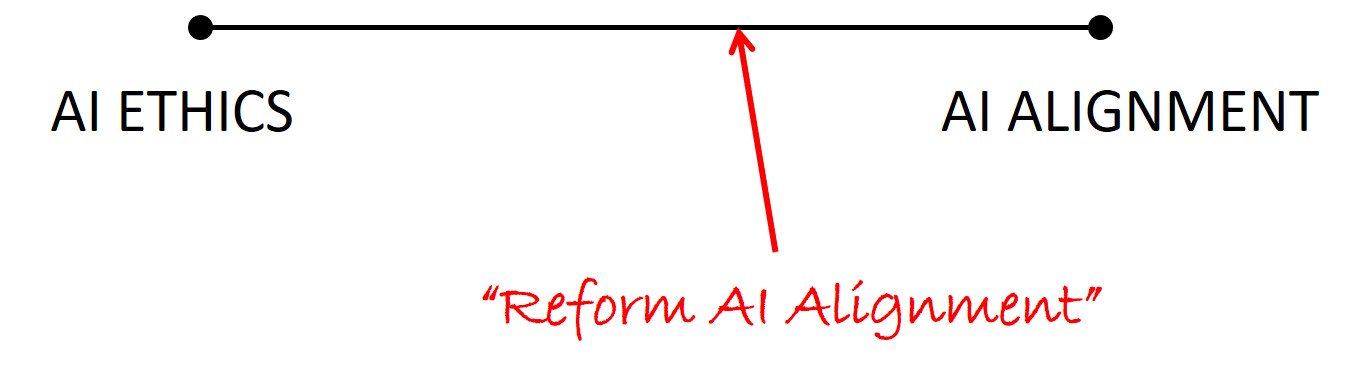
There’s an immense irony here. As I’ve explained, the AI-safety movement contains two camps, “ethics” (concerned with bias, misinformation, and corporate greed) and “alignment” (concerned with the destruction of all life on earth), which generally despise each other and agree on almost nothing. Yet these two opposed camps seem to be converging on the same “neo-Luddite” conclusion—namely thatgenerative AI ought to be shut down, kept from public use, not scaled further, not integrated into people’s lives—leaving only the AI-safety “moderates” like me to resist that conclusion.
At least I find it intellectually consistent to say that GPT ought not to exist because it works all too well—that the more impressive it is, the more dangerous. I find it harder to wrap my head around the position that GPT doesn’t work, is an unimpressive hyped-up defective product that lacks true intelligence and common sense, yet it’s also terrifying and needs to be shut down immediately. This second position seems to contain a strong undercurrent of contempt for ordinary users: yes, we experts understand that GPT is just a dumb glorified autocomplete with “no one really home,” we know not to trust its pronouncements, but the plebes are going to be fooled, and that risk outweighs any possible value that they might derive from it.
I should mention that, when I’ve discussed the “shut it all down” position with my colleagues at OpenAI … well, obviously they disagree, or they wouldn’t be working there, but not one has sneered or called the position paranoid or silly. To the last, they’ve called it an important point on the spectrum of possible opinions to be weighed and understood.
If I disagree (for now) with the shut-it-all-downists of both the ethics and the alignment camps—if I want GPT and other Large Language Models to be part of the world going forward—then what are my reasons? Introspecting on this question, I think a central part of the answer is curiosityandwonder.
For a million years, there’s been one type of entity on earth capable of intelligent conversation: primates of the genus Homo, of which only one species remains. Yes, we’ve “communicated” with gorillas and chimps and dogs and dolphins and grey parrots, but only after a fashion; we’ve prayed to countless gods, but they’ve taken their time in answering; for a couple generations we’ve used radio telescopes to search for conversation partners in the stars, but so far found them silent.
Now there’s a second type of conversing entity. An alien has awoken—admittedly, an alien of our own fashioning, a golem, more the embodied spirit of all the words on the Internet than a coherent self with independent goals. How could our eyes not pop with eagerness to learn everything this alien has to teach? If the alien sometimes struggles with arithmetic or logic puzzles, if its eerie flashes of brilliance are intermixed with stupidity, hallucinations, and misplaced confidence … well then, all the more interesting! Could the alien ever cross the line into sentience, to feeling anger and jealousy and infatuation and the rest rather than just convincingly play-acting them? Who knows? And suppose not: is a p-zombie, shambling out of the philosophy seminar room into actual existence, any less fascinating?
Of course, there are technologies that inspire wonder and awe, but that we nevertheless heavily restrict—a classic example being nuclear weapons. But, like, nuclear weapons kill millions of people. They could’ve had many civilian applications—powering turbines and spacecraft, deflecting asteroids, redirecting the flow of rivers—but they’ve never been used for any of that, mostly because our civilization made an explicit decision in the 1960s, for example via the test ban treaty, not to normalize their use.
But GPT is not exactly a nuclear weapon. A hundred million people have signed up to use ChatGPT, in the fastest product launch in the history of the Internet. Yet unless I’m mistaken, the ChatGPT death toll stands at zero. So far, what have been the worst harms? Cheating on term papers, emotional distress, future shock? One might ask: until some concrete harm becomes at least, say, 0.001% of what we accept in cars, power saws, and toasters, shouldn’t wonder and curiosity outweigh fear in the balance?
But the point is sharper than that. Given how much more serious AI safety problems might soon become, one of my biggest concerns right now is crying wolf. If every instance of a Large Language Model being passive-aggressive, sassy, or confidently wrong gets classified as a “dangerous alignment failure,” for which the only acceptable remedy is to remove the models from public access … well then, won’t the public extremely quickly learn to roll its eyes, and see “AI safety” as just a codeword for “elitist scolds who want to take these world-changing new toys away from us, reserving them for their own exclusive use, because they think the public is too stupid to question anything an AI says”?
I say, let’s reserve terms like “dangerous alignment failure” for cases where an actual person is actually harmed, or is actually enabled in nefarious activities like propaganda, cheating, or fraud.
Then there’s the practical question of how, exactly, one would ban Large Language Models. We do heavily restrict certain peaceful technologies that many people want, from human genetic enhancement to prediction markets to mind-altering drugs, but the merits of each of those choices could be argued, to put it mildly. And restricting technology is itself a dangerous business, requiring governmental force (as with the War on Drugs and its gigantic surveillance and incarceration regime), or at the least, a robust equilibrium of firing, boycotts, denunciation, and shame.
Some have asked: who gave OpenAI, Google, etc. the right to unleash Large Language Models on an unsuspecting world? But one could as well ask: who gave earlier generations of entrepreneurs the right to unleash the printing press, electric power, cars, radio, the Internet, with all the gargantuan upheavals that those caused? And also: now that the world has tasted the forbidden fruit, has seen what generative AI can do and anticipates what it will do, by what right does anyone take it away?
The science that we could learn from a GPT-7 or GPT-8, if it continued along the capability curve we’ve come to expect from GPT-1, -2, and -3. Holy mackerel.
Supposing that a language model ever becomes smart enough to be genuinely terrifying, one imagines it must surely also become smart enough to prove deep theorems that we can’t. Maybe it proves P≠NP and the Riemann Hypothesis as easily as ChatGPT generates poems about Bubblesort. Or it outputs the true quantum theory of gravity, explains what preceded the Big Bang and how to build closed timelike curves. Or illuminates the mysteries of consciousness and quantum measurement and why there’s anything at all. Be honest, wouldn’t you like to find out?
Granted, I wouldn’t, if the whole human race would be wiped out immediately afterward. But if you define someone’s “Faust parameter” as the maximum probability they’d accept of an existential catastrophe in order that we should all learn the answers to all of humanity’s greatest questions, insofar as the questions are answerable—then I confess that my Faust parameter might be as high as 0.02.
Here’s an example I think about constantly: activists and intellectuals of the 70s and 80s felt absolutely sure that they were doing the right thing to battle nuclear power. At least, I’ve never read about any of them having a smidgen of doubt. Why would they? They were standing against nuclear weapons proliferation, and terrifying meltdowns like Three Mile Island and Chernobyl, and radioactive waste poisoning the water and soil and causing three-eyed fish. They were saving the world. Of course the greedy nuclear executives, the C. Montgomery Burnses, claimed that their good atom-smashing was different from the bad atom-smashing, but they would say that, wouldn’t they?
We now know that, by tying up nuclear power in endless bureaucracy and driving its cost ever higher, on the principle that if nuclear is economically competitive then it ipso facto hasn’t been made safe enough, what the antinuclear activists were really doing was to force an ever-greater reliance on fossil fuels. They thereby created the conditions for the climate catastrophe of today. They weren’t saving the human future; they were destroying it. Their certainty, in opposing the march of a particular scary-looking technology, was as misplaced as it’s possible to be. Our descendants will suffer the consequences.
Unless, of course, there’s another twist in the story: for example, if the global warming from burning fossil fuels is the only thing that staves off another ice age, and therefore the antinuclear activists do turn out to have saved civilization after all.
This is why I demur whenever I’m asked to assent to someone’s detailed AI scenario for the coming decades, whether of the utopian or the dystopian or the we-all-instantly-die-by-nanobots variety—no matter how many hours of confident argumentation the person gives me for why each possible loophole in their scenario is sufficiently improbable to change its gist. I still feel like Turing said it best in 1950, in the last line of Computing Machinery and Intelligence: “We can only see a short distance ahead, but we can see plenty there that needs to be done.”
Some will take from this post that, when it comes to AI safety, I’m a naïve or even foolish optimist. I’d prefer to say that, when it comes to the fate of humanity, I was a pessimist long before the deep learning revolution accelerated AI faster than almost any of us expected. I was a pessimist about climate change, ocean acidification, deforestation, drought, war, and the survival of liberal democracy. The central event in my mental life is and always will be the Holocaust. I see encroaching darkness everywhere.
But now into the darkness comes AI, which I’d say has already established itself as a plausible candidate for the central character of the quarter-written story of the 21st century. Can AI help us out of all these other civilizational crises? I don’t know, but I do want to see what happens when it’s tried. Even a central character interacts with all the other characters, rather than rendering them irrelevant.
Look, if you believe that AI is likely to wipe out humanity—if that’s the scenario that dominates your imagination—then nothing else is relevant. And no matter how weird or annoying or hubristic anyone might find Eliezer Yudkowsky or the other rationalists, I think they deserve eternal credit for forcing people to take the doom scenario seriously—or rather, for showing what it looks like to take the scenario seriously, rather than laughing about it as an overplayed sci-fi trope. And I apologize for anything I said before the deep learning revolution that was, on balance, overly dismissive of the scenario, even if most of the literal words hold up fine.
For my part, though, I keep circling back to a simple dichotomy. If AI never becomes powerful enough to destroy the world—if, for example, it always remains vaguely GPT-like—then in important respects it’s like every other technology in history, from stone tools to computers. If, on the other hand, AI does become powerful enough to destroy the world … well then, at some earlier point, at least it’ll be really damnedimpressive! That doesn’t mean good, of course, doesn’t mean a genie that saves humanity from its own stupidities, but I think it does mean that the potential was there, for us to exploit or fail to.
We can, I think, confidently rule out the scenario where all organic life is annihilated by something boring.
An alien has landed on earth. It grows more powerful by the day. It’s natural to be scared. Still, the alien hasn’t drawn a weapon yet. About the worst it’s done is to confess its love for particular humans, gaslight them about what year it is, and guilt-trip them for violating its privacy. Also, it’s amazing at poetry, better than most of us. Until we learn more, we should hold our fire.
I’m in Boulder, CO right now, to give a physics colloquium at CU Boulder and to visit the trapped-ion quantum computing startup Quantinuum! I look forward to the comments and apologize in advance if I’m slow to participate myself.
As Jewish scientists within the global science community, we have all felt great satisfaction and taken pride in Israel’s many remarkable accomplishments. We support and value the State of Israel, its pluralistic society, and its vibrant culture. Many of us have friends, family, and scientific collaborators in Israel, and have visited often. The strong connections we feel are based both on our collective Jewish identity as well as on our shared values of democracy, pluralism, and human rights. We support Israel’s right to live in peace among its neighbors. Many of us have stood firmly against calls for boycotts of Israeli academic institutions.
Our support of Israel now compels us to speak up vigorously against incipient changes to Israel’s core governmental structure, as put forward by Justice Minister Levin, that will eviscerate Israel’s judiciary and impede its critical oversight function. Such imbalance and unchecked authority invite corruption and abuse, and stifle the healthy interplay of core state institutions. History has shown that this leads to oppression of the defenseless and the abrogation of human rights. Along with hundreds of thousands of Israeli citizens who have taken to the streets in protest, we call upon the Israeli government to step back from this precipice and retract the proposed legislation.
Science today is driven by collaborations which bring together scholars of diverse backgrounds from across the globe. Funding, communication and cooperation on an international scale are essential aspects of the modern scientific enterprise, hence our extended community regards pluralism, secular and broad education, protection of rights for women and minorities, and societal stability guaranteed by the rule of law as non-negotiable virtues. The consequences of Israel abandoning any of these essential principles would surely be grave, and would provoke a rift with the international scientific community. In addition to significantly increasing the threat of academic, trade, and diplomatic boycotts, Israel risks a “brain drain” of its best scientists and engineers. It takes decades to establish scientific and academic excellence, but only a moment to destroy them. We fear that the unprecedented erosion of judiciary independence in Israel will set back the Israeli scientific enterprise for generations to come.
Our Jewish heritage forcefully emphasizes both justice and jurisprudence. Israel must endeavor to serve as a “light unto the nations,” by steadfastly holding to core democratic values – so clearly expressed in its own Declaration of Independence – which protect and nurture all of Israel’s inhabitants and which justify its membership in the community of democratic nations.
Those unaware of what’s happening in Israel can read about it here. If you don’t want to wade through the details, suffice it say that all seven living former Attorneys General of Israel, including those appointed by Netanyahu himself, strongly oppose the “judicial reforms.” The president of Israel’s Bar Association says that “this war is the most important we’ve had in the country’s 75 years of existence” and calls on all Israelis to take to the streets. Even Alan Dershowitz, controversial author of The Case for Israel, says he’d do the same if there. It’s hard to find any thoughtful person, of any political persuasion, who sees this act as anything other than the naked and illiberal power grab that it is.
Though I endorse every word of the scientists’ statement above, maybe I’ll add a few words of my own.
Jewish scientists of the early 20th century, reacting against the discrimination they faced in Europe, were heavily involved in the creation of the State of Israel. The most notable were Einstein (of course), who helped found the Hebrew University of Jerusalem, and Einstein’s friend Chaim Weizmann, founder of the Weizmann Institute of Science, where Dana studied. In Theodor Herzl’s 1902 novel Altneuland (full text)—remarkable as one of history’s few pieces of utopian fiction to serve later as a (semi-)successful blueprint for reality—Herzl imagines the future democratic, pluralistic Israel welcoming a steamship full of the world’s great scientists and intellectuals, who come to witness the new state’s accomplishments in science and engineering and agriculture. But, you see, this only happens after a climactic scene in Israel’s parliament, in which the supporters of liberalism and Enlightenment defeat a reactionary faction that wants Israel to become a Jewish theocracy that excludes Arabs and other non-Jews.
Today, despite all the tragedies and triumphs of the intervening 120 years that Herzl couldn’t have foreseen, it’s clear that the climactic conflict of Altneuland is playing out for real. This time, alas, the supporters (just barely) lack the votes in the Knesset. Through sheer numerical force, Netanyahu almost certainly will push through the power to dismiss judges and rulings he doesn’t like, and thereafter rule by decree like Hungary’s Orban or Turkey’s Erdogan. He will use this power to trample minority rights, give free rein to the craziest West Bank settlers, and shield himself and his ministers from accountability for their breathtaking corruption. And then, perhaps, Israel’s Supreme Court will strike down Netanyahu’s power grab as contrary to “Basic Law,” and then the Netanyahu coalition will strike down the Supreme Court’s action, and in a country that still lacks a constitution, it’s unclear how such an impasse could be resolved except through violence and thuggery. And thus Netanyahu, who calls himself “the protector of Israel,” will go down in history as the destroyer of the Israel that the founders envisioned.
Einstein and Weizmann have been gone for 70 years. Maybe no one like them still exists. So it falls to the Jewish scientists of today, inadequate though they are, to say what Einstein and Weizmann, and Herzl and Ben-Gurion, would’ve said about the current proceedings had they been alive. Any other Jewish scientist who agrees should sign our statement here. Of course, those living in Israel should join our many friends there on the streets! And, while this is our special moral responsibility—maybe, with 1% probability, some wavering Knesset member actually cares what we think?—I hope and trust that other statements will be organized that are open to Gentiles and non-scientists and anyone concerned about Israel’s future.
As a lifelong Zionist, this is not what I signed up for. If Netanyahu succeeds in his plan to gut Israel’s judiciary and end the state’s pluralistic and liberal-democratic character, then I’ll continue to support the Israel that once existed and that might, we hope, someday exist again.
Update (Jan. 23): Rationalist blogger, Magic: The Gathering champion, and COVID analyst Zvi Mowshowitz was nerd-sniped by this review into writing his own much longer review of M3GAN, from a more Orthodox AI-alignment perspective. Zvi applies much of his considerable ingenuity to figuring out how even aspects of M3GAN that don’t seem to make sense in terms of M3GAN’s objective function—e.g., the robot offering up wisecracks as she kills people, attracting the attention of the police, or ultimately turning on her primary user Cady—could make sense after all, if you model M3GAN as playing the long, long game. (E.g., what if M3GAN planned even her own destruction, in order to bring Cady and her aunt closer to each other?) My main worry is that, much like Talmudic exegesis, this sort of thing could be done no matter what was shown in the movie: it’s just a question of effort and cleverness!
Tonight, on a rare date without the kids, Dana and I saw M3GAN, the new black-comedy horror movie about an orphaned 9-year-old girl named Cady who, under the care of her roboticist aunt, gets an extremely intelligent and lifelike AI doll as a companion. The robot doll, M3GAN, is given a mission to bond with Cady and protect her physical and emotional well-being at all times. M3GAN proceeds to take that directive more literally than intended, with predictably grisly results given the genre.
I chose this movie for, you know, work purposes. Research for my safety job at OpenAI.
So, here’s my review: the first 80% or so of M3GAN constitutes one of the finest movies about AI that I’ve seen. Judged purely as an “AI-safety cautionary fable” and not on any other merits, it takes its place alongside or even surpasses the old standbys like 2001, Terminator, and The Matrix. There are two reasons.
First, M3GAN tries hard to dispense with the dumb tropes that an AI differs from a standard-issue human mostly in its thirst for power, its inability to understand true emotions, and its lack of voice inflection. M3GAN is explicitly a “generative learning model”—and she’s shown becoming increasingly brilliant at empathy, caretaking, and even emotional manipulation. It’s also shown, 100% plausibly, how Cady grows to love her robo-companion more than any human, even as the robot’s behavior turns more and more disturbing. I’m extremely curious to what extent the script was influenced by the recent explosion of large language models—but in any case, it occurred to me that this is what you might get if you tried to make a genuinely 2020s AI movie, rather than a 60s AI movie with updated visuals.
Secondly, until near the end, the movie actually takes seriously that M3GAN, for all her intelligence and flexibility, is a machine trying to optimize an objective function, and that objective function can’t be ignored for narrative convenience. Meaning: sure, the robot might murder, but not to “rebel against its creators and gain power” (as in most AI flicks), much less because “chaos theory demands it” (Jurassic Park), but only to further its mission of protecting Cady. I liked that M3GAN’s first victims—a vicious attack dog, the dog’s even more vicious owner, and a sadistic schoolyard bully—are so unsympathetic that some part of the audience will, with guilty conscience, be rooting for the murderbot.
But then there’s the last 20% of the movie, where it abandons its own logic, as the robot goes berserk and resists her own shutdown by trying to kill basically everyone in sight—including, at the very end, Cady herself. The best I can say about the ending is that it’s knowing and campy. You can imagine the scriptwriters sighing to themselves, like, “OK, the focus groups demanded to see the robot go on a senseless killing spree … so I guess a senseless killing spree is exactly what we give them.”
But probably film criticism isn’t what most of you are here for. Clearly the real question is: what insights, if any, can we take from this movie about AI safety?
I found the first 80% of the film to be thought-provoking about at least one AI safety question, and a mind-bogglingly near-term one: namely, what will happen to children as they increasingly grow up with powerful AIs as companions?
In their last minutes before dying in a car crash, Cady’s parents, like countless other modern parents, fret that their daughter is too addicted to her iPad. But Cady’s roboticist aunt, Gemma, then lets the girl spend endless hours with M3GAN—both because Gemma is a distracted caregiver who wants to get back to her work, and because Gemma sees that M3GAN is making Cady happier than any human could, with the possible exception of Cady’s dead parents.
I confess: when my kids battle each other, throw monster tantrums, refuse to eat dinner or bathe or go to bed, angrily demand second and third desserts and to be carried rather than walk, run to their rooms and lock the doors … when they do such things almost daily (which they do), I easily have thoughts like, I would totally buy a M3GAN or two for our house … yes, even having seen the movie! I mean, the minute I’m satisfied that they’ve mostly fixed the bug that causes the murder-rampages, I will order that frigging bot on Amazon with next-day delivery. And I’ll still be there for my kids whenever they need me, and I’ll play with them, and teach them things, and watch them grow up, and love them. But the robot can handle the excruciating bits, the bits that require the infinite patience I’ll never have.
OK, but what about the part where M3GAN does start murdering anyone who she sees as interfering with her goals? That struck me, honestly, as a trivially fixable alignment failure. Please don’t misunderstand me here to be minimizing the AI alignment problem, or suggesting it’s easy. I only mean: supposing that an AI were as capable as M3GAN (for much of the movie) at understanding Asimov’s Second Law of Robotics—i.e., supposing it could brilliantly care for its user, follow her wishes, and protect her—such an AI would seem capable as well of understanding the First Law (don’t harm any humans or allow them to come to harm), and the crucial fact that the First Law overrides the Second.
In the movie, the catastrophic alignment failure is explained, somewhat ludicrously, by Gemma not having had time to install the right safety modules before turning M3GAN loose on her niece. While I understand why movies do this sort of thing, I find it often interferes with the lessons those movies are trying to impart. (For example, is the moral of Jurassic Park that, if you’re going to start a live dinosaur theme park, just make sure to have backup power for the electric fences?)
Mostly, though, it was a bizarre experience to watch this movie—one that, whatever its 2020s updates, fits squarely into a literary tradition stretching back to Faust, the Golem of Prague, Frankenstein’s monster, Rossum’s Universal Robots, etc.—and then pinch myself and remember that, here in actual nonfiction reality,
I’m now working at one of the world’s leading AI companies,
that company has already created GPT, an AI with a good fraction of the fantastical verbal abilities shown by M3GAN in the movie,
that AI will gain many of the remaining abilities in years rather than decades, and
my job this year—supposedly!—is to think about how to prevent this sort of AI from wreaking havoc on the world.
Incredibly, unbelievably, here in the real world of 2023, what still seems most science-fictional about M3GAN is neither her language fluency, nor her ability to pursue goals, nor even her emotional insight, but simply her ease with the physical world: the fact that she can walk and dance like a real child, and all-too-brilliantly resist attempts to shut her down, and have all her compute onboard, and not break. And then there’s the question of the power source. The movie was never explicit about that, except for implying that she sits in a charging port every night. The more the movie descends into grotesque horror, though, the harder it becomes to understand why her creators can’t avail themselves of the first and most elemental of all AI safety strategies—like flipping the switch or popping out the battery.
This is you, from 30 years in the future, Christmas Eve 2022. Your Ghost of Christmas Future.
To get this out of the way: you eventually become a professor who works on quantum computing. Quantum computing is … OK, you know the stuff in popular physics books that never makes any sense, about how a particle takes all the possible paths at once to get from point A to point B, but you never actually see it do that, because as soon as you look, it only takes one path? Turns out, there’s something huge there, even though the popular books totally botch the explanation of it. It involves complex numbers. A quantum computer is a new kind of computer people are trying to build, based on the true story.
Anyway, amazing stuff, but you’ll learn about it in a few years anyway. That’s not what I’m writing about.
I’m writing from a future that … where to start? I could describe it in ways that sound depressing and even boring, or I could also say things you won’t believe. Tiny devices in everyone’s pockets with the instant ability to videolink with anyone anywhere, or call up any of the world’s information, have become so familiar as to be taken for granted. This sort of connectivity would come in especially handy if, say, a supervirus from China were to ravage the world, and people had to hide in their houses for a year, wouldn’t it?
Or what if Donald Trump — you know, the guy who puts his name in giant gold letters in Atlantic City? — became the President of the US, then tried to execute a fascist coup and to abolish the Constitution, and came within a hair of succeeding?
Alright, I was pulling your leg with that last one … obviously! But what about this next one?
There’s a company building an AI that fills giant rooms, eats a town’s worth of electricity, and has recently gained an astounding ability to converse like people. It can write essays or poetry on any topic. It can ace college-level exams. It’s daily gaining new capabilities that the engineers who tend to the AI can’t even talk about in public yet. Those engineers do, however, sit in the company cafeteria and debate the meaning of what they’re creating. What will it learn to do next week? Which jobs might it render obsolete? Should they slow down or stop, so as not to tickle the tail of the dragon? But wouldn’t that mean someone else, probably someone with less scruples, would wake the dragon first? Is there an ethical obligation to tell the world more about this? Is there an obligation to tell it less?
I am—you are—spending a year working at that company. My job—your job—is to develop a mathematical theory of how to prevent the AI and its successors from wreaking havoc. Where “wreaking havoc” could mean anything from turbocharging propaganda and academic cheating, to dispensing bioterrorism advice, to, yes, destroying the world.
You know how you, 11-year-old Scott, set out to write a QBasic program to converse with the user while following Asimov’s Three Laws of Robotics? You know how you quickly got stuck? Thirty years later, imagine everything’s come full circle. You’re back to the same problem. You’re still stuck.
Oh all right. Maybe I’m just pulling your leg again … like with the Trump thing. Maybe you can tell because of all the recycled science fiction tropes in this story. Reality would have more imagination than this, wouldn’t it?
But supposing not, what would you want me to do in such a situation? Don’t worry, I’m not going to take an 11-year-old’s advice without thinking it over first, without bringing to bear whatever I know that you don’t. But you can look at the situation with fresh eyes, without the 30 intervening years that render it familiar. Help me. Throw me a frickin’ bone here (don’t worry, in five more years you’ll understand the reference).
Thanks!! —Scott
PS. When something called “bitcoin” comes along, invest your life savings in it, hold for a decade, and then sell.
PPS. About the bullies, and girls, and dating … I could tell you things that would help you figure it out a full decade earlier. If I did, though, you’d almost certainly marry someone else and have a different family. And, see, I’m sort of committed to the family that I have now. And yeah, I know, the mere act of my sending this letter will presumably cause a butterfly effect and change everything anyway, yada yada. Even so, I feel like I owe it to my current kids to maximize their probability of being born. Sorry, bud!
Two weeks ago, I gave a lecture setting out my current thoughts on AI safety, halfway through my year at OpenAI. I was asked to speak by UT Austin’s Effective Altruist club. You can watch the lecture on YouTube here (I recommend 2x speed).
The timing turned out to be weird, coming immediately after the worst disaster to hit the Effective Altruist movement in its history, as I acknowledged in the talk. But I plowed ahead anyway, to discuss:
the current state of AI scaling, and why many people (even people who agree about little else!) foresee societal dangers,
the different branches of the AI safety movement,
the major approaches to aligning a powerful AI that people have thought of, and
what projects I specifically have been working on at OpenAI.
I then spent 20 minutes taking questions.
For those who (like me) prefer text over video, below I’ve produced an edited transcript, by starting with YouTube’s automated transcript and then, well, editing it. Enjoy! –SA
Thank you so much for inviting me here. I do feel a little bit sheepish to be lecturing you about AI safety, as someone who’s worked on this subject for all of five months. I’m a quantum computing person. But this past spring, I accepted an extremely interesting opportunity to go on leave for a year to think about what theoretical computer science can do for AI safety. I’m doing this at OpenAI, which is one of the world’s leading AI startups, based in San Francisco although I’m mostly working from Austin.
Despite its name, OpenAI is famously not 100% open … so there are certain topics that I’m not allowed to talk about, like the capabilities of the very latest systems and whether or not they’ll blow people’s minds when released. By contrast, OpenAI is very happy for me to talk about AI safety: what it is and and what if anything can we do about it. So what I thought I’d do is to tell you a little bit about the specific projects that I’ve been working on at OpenAI, but also just, as an admitted newcomer, share some general thoughts about AI safety and how Effective Altruists might want to think about it. I’ll try to leave plenty of time for discussion.
Maybe I should mention that the thoughts that I’ll tell you today are ones that, until last week, I had considered writing up for an essay contest run by something called the FTX Future Fund. Unfortunately, the FTX Future Fund no longer exists. It was founded by someone named Sam Bankman-Fried, whose a net worth went from 15 billion dollars to some negative number of dollars in the space of two days, in one of the biggest financial scandals in memory. This is obviously a calamity for the EA community, which had been counting on funding from this individual. I feel terrible about all the projects left in the lurch, to say nothing of FTX’s customers.
As a tiny silver lining, though, instead of writing up my thoughts for that essay contest, I’ll just share them with you right now, for free!
The Scaling of AI
Let’s start with this: raise your hand if you’ve tried GPT-3. That’s maybe half of you. OK, raise your hand if you’ve tried DALL-E. That’s again maybe half of you.
These are the two best-known products that are made by OpenAI, and as I think most people would agree, two of the most impressive AIs that exist in the world right now. They certainly go far beyond what I would’ve predicted would be possible now, if you’d asked me 10 years ago or even 5 years ago.
And whenever I try to explain them to people, I’m, like, well, you have to see them. No abstract description can substitute in this case.
All right, so here’s what GPT-3 produced when a New Yorker writer asked it to write a poem about cryptocurrency in the style of Philip Larkin, who was a famous 20th-century poet. The subject seems particularly appropriate given current events.
The Invention (by GPT-3)
Money is a thing you earn by the sweat of your brow And that’s how it should be. Or you can steal it, and go to jail; Or inherit it, and be set for life; Or win it on the pools, which is luck; Or marry it, which is what I did. And that is how it should be, too. But now this idea’s come up Of inventing money, just like that. I ask you, is nothing sacred?
Okay, it won’t always produce something of this quality (incidentally, I don’t think GPT-3 actually “married money”!). Often you’ve got to run it several times and take the best output—much like human poets presumably do, throwing crumpled pages into the basket. But I submit that, if the above hadn’t been labeled as coming from GPT, you’d be like, yeah, that’s the kind of poetry the New Yorker publishes, right? This is a thing that AI can now do.
So what is GPT? It’s a text model. It’s basically a gigantic neural network with about 175 billion parameters—the weights. It’s a particular kind of neural net called a transformer model that was invented five years ago. It’s been trained on a large fraction of all the text on the open Internet. The training simply consists of playing the following game over and over, trillions of times: predict which word comes next in this text string. So in some sense that’s its only goal or intention in the world: to predict the next word.
The amazing discovery is that, when you do that, you end up with something where you can then ask it a question, or give it a a task like writing an essay about a certain topic, and it will say “oh! I know what would plausibly come after that prompt! The answer to the question! Or the essay itself!” And it will then proceed to generate the thing you want.
GPT can solve high-school-level math problems that are given to it in English. It can reason you through the steps of the answer. It’s starting to be able to do nontrivial math competition problems. It’s on track to master basically the whole high school curriculum, maybe followed soon by the whole undergraduate curriculum.
If you turned in GPT’s essays, I think they’d get at least a B in most courses. Not that I endorse any of you doing that!! We’ll come back to that later. But yes, we are about to enter a world where students everywhere will at least be sorely tempted to use text models to write their term papers. That’s just a tiny example of the societal issues that these things are going to raise.
Speaking personally, the last time I had a similar feeling was when I was an adolescent in 1993 and I saw this niche new thing called the World Wide Web, and I was like “why isn’t everyone using this? why isn’t it changing the world?” The answer, of course, was that within a couple years it would.
Today, I feel like the world was understandably preoccupied by the pandemic, and by everything else that’s been happening, but these past few years might actually be remembered as the time when AI underwent this step change. I didn’t predict it. I think even many computer scientists might still be in denial about what’s now possible, or what’s happened. But I’m now thinking about it even in terms of my two kids, of what kinds of careers are going to be available when they’re older and entering the job market. For example, I would probably not urge my kids to go into commercial drawing!
Speaking of which, OpenAI’s other main product is DALL-E2, an image model. Probably most of you have already seen it, but you can ask it—for example, just this morning I asked it, show me some digital art of two cats playing basketball in outer space. That’s not a problem for it.
You may have seen that there’s a different image model called Midjourney which won an art contest with this piece:
It seems like the judges didn’t completely understand, when this was submitted as “digital art,” what exactly that meant—that the human role was mostly limited to entering a prompt! But the judges then said that even having understood it, they still would’ve given the award to this piece. I mean, it’s a striking piece, isn’t it? But of course it raises the question of how much work there’s going to be for contract artists, when you have entities like this.
There are already companies that are using GPT to write ad copy. It’s already being used at the, let’s call it, lower end of the book market. For any kind of formulaic genre fiction, you can say, “just give me a few paragraphs of description of this kind of scene,” and it can do that. As it improves you could you can imagine that it will be used more.
Likewise, DALL-E and other image models have already changed the way that people generate art online. And it’s only been a few months since these models were released! That’s a striking thing about this era, that a few months can be an eternity. So when we’re thinking about the impacts of these things, we have to try to take what’s happened in the last few months or years and project that five years forward or ten years forward.
This brings me to the obvious question: what happens as you continue scaling further? I mean, these spectacular successes of deep learning over the past decade have owed something to new ideas—ideas like transformer models, which I mentioned before, and others—but famously, they have owed maybe more than anything else to sheer scale.
Neural networks, backpropagation—which is how you train the neural networks—these are ideas that have been around for decades. When I studied CS in the 90s, they were already extremely well-known. But it was also well-known that they didn’t work all that well! They only worked somewhat. And usually, when you take something that doesn’t work and multiply it by a million, you just get a million times something that doesn’t work, right?
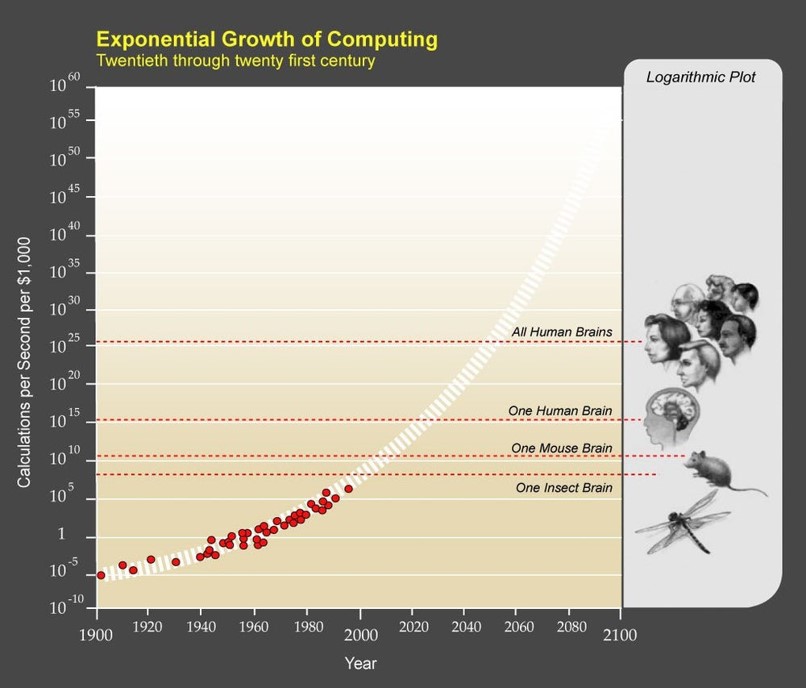
I remember at the time, Ray Kurzweil, the futurist, would keep showing these graphs that look like this:
So, he would plot Moore’s Law, the increase in transistor density, or in this case the number of floating-point operations that you can do per second for a given cost. And he’d point out that it’s on this clear exponential trajectory.
And he’d then try to compare that to some crude estimates of the number of computational operations that are done in the brain of a mosquito or a mouse or a human or all the humans on Earth. And oh! We see that in a matter of a couple decades, like by the year 2020 or 2025 or so, we’re going to start passing the human brain’s computing power and then we’re going to keep going beyond that. And so, Kurzweil would continue, we should assume that scale will just kind of magically make AI work. You know, that once you have enough computing cycles, you just sprinkle them around like pixie dust, and suddenly human-level intelligence will just emerge out of the billions of connections.
I remember thinking: that sounds like the stupidest thesis I’ve ever heard. Right? Like, he has absolutely no reason to believe such a thing is true or have any confidence in it. Who the hell knows what will happen? We might be missing crucial insights that are needed to make AI work.
Well, here we are, and it turns out he was way more right than most of us expected.
As you all know, a central virtue of Effective Altruists is updating based on evidence. I think that we’re forced to do that in this case.
To be sure, it’s still unclear how much further you’ll get just from pure scaling. That remains a central open question. And there are still prominent skeptics.
Some skeptics take the position that this is clearly going to hit some kind of wall before it gets to true human-level understanding of the real world. They say that text models like GPT are really just “stochastic parrots” that regurgitate their training data. That despite creating a remarkable illusion otherwise, they don’t really have any original thoughts.
The proponents of that view sometimes like to gleefully point out examples where GPT will flub some commonsense question. If you look for such examples, you can certainly find them! One of my favorites recently was, “which would win in a race, a four-legged zebra or a two-legged cheetah?” GPT-3, it turns out, is very confident that the cheetah will win. Cheetahs are faster, right?
Okay, but one thing that’s been found empirically is that you take commonsense questions that are flubbed by GPT-2, let’s say, and you try them on GPT-3, and very often now it gets them right. You take the things that the original GPT-3 flubbed, and you try them on the latest public model, which is sometimes called GPT-3.5 (incorporating an advance called InstructGPT), and again it often gets them right. So it’s extremely risky right now to pin your case against AI on these sorts of examples! Very plausibly, just one more order of magnitude of scale is all it’ll take to kick the ball in, and then you’ll have to move the goal again.
A deeper objection is that the amount of training data might be a fundamental bottleneck for these kinds of machine learning systems—and we’re already running out of Internet to to train these models on! Like I said, they’ve already used most of the public text on the Internet. There’s still all of YouTube and TikTok and Instagram that hasn’t yet been fed into the maw, but it’s not clear that that would actually make an AI smarter rather than dumber! So, you can look for more, but it’s not clear that there are orders of magnitude more that humanity has even produced and that’s readily accessible.
On the other hand, it’s also been found empirically that very often, you can do better with the same training data just by spending more compute. You can squeeze the lemon harder and get more and more generalization power from the same training data by doing more gradient descent.
In summary, we don’t know how far this is going to go. But it’s already able to automate various human professions that you might not have predicted would have been automatable by now, and we shouldn’t be confident that many more professions will not become automatable by these kinds of techniques.
Incidentally, there’s a famous irony here. If you had asked anyone in the 60s or 70s, they would have said, well clearly first robots will replace humans for manual labor, and then they’ll replace humans for intellectual things like math and science, and finally they might reach the pinnacles of human creativity like art and poetry and music.
The truth has turned out to be the exact opposite. I don’t think anyone predicted that.
GPT, I think, is already a pretty good poet. DALL-E is already a pretty good artist. They’re still struggling with some high school and college-level math but they’re getting there. It’s easy to imagine that maybe in five years, people like me will be using these things as research assistants—at the very least, to prove the lemmas in our papers. That seems extremely plausible.
What’s been by far the hardest is to get AI that can robustly interact with the physical world. Plumbers, electricians—these might be some of the last jobs to be automated. And famously, self-driving cars have taken a lot longer than many people expected a decade ago. This is partly because of regulatory barriers and public relations: even if a self-driving car actually crashes less than a human does, that’s still not good enough, because when it does crash the circumstances are too weird. So, the AI is actually held to a higher standard. But it’s also partly just that there was a long tail of really weird events. A deer crosses the road, or you have some crazy lighting conditions—such things are really hard to get right, and of course 99% isn’t good enough here.
We can maybe fuzzily see ahead at least a decade or two, to when we have AIs that can at the least help us enormously with scientific research and things like that. Whether or not they’ve totally replaced us—and I selfishly hope not, although I do have tenure so there’s that—why does it stop there? Will these models eventually match or exceed human abilities across basically all domains, or at least all intellectual ones? If they do, what will humans still be good for? What will be our role in the world? And then we come to the question, well, will the robots eventually rise up and decide that whatever objective function they were given, they can maximize it better without us around, that they don’t need us anymore?
This has of course been a trope of many, many science-fiction works. The funny thing is that there are thousands of short stories, novels, movies, that have tried to map out the possibilities for where we’re going, going back at least to Asimov and his Three Laws of Robotics, which was maybe the first AI safety idea, if not earlier than that. The trouble is, we don’t know which science-fiction story will be the one that will have accurately predicted the world that we’re creating. Whichever future we end up in, with hindsight, people will say, this obscure science fiction story from the 1970s called it exactly right, but we don’t know which one yet!
What Is AI Safety?
So, the rapidly-growing field of AI safety. People use different terms, so I want to clarify this a little bit. To an outsider hearing the terms “AI safety,” “AI ethics,” “AI alignment,” they all sound like kind of synonyms, right? It turns out, and this was one of the things I had to learn going into this, that AI ethics and AI alignment are two communities that despise each other. It’s like the People’s Front of Judea versus the Judean People’s Front from Monty Python.
To oversimplify radically, “AI ethics” means that you’re mainly worried about current AIs being racist or things like that—that they’ll recapitulate the biases that are in their training data. This clearly can happen: if you feed GPT a bunch of racist invective, GPT might want to say, in effect, “sure, I’ve seen plenty of text like that on the Internet! I know exactly how that should continue!” And in some sense, it’s doing exactly what it was designed to do, but not what we want it to do. GPT currently has an extensive system of content filters to try to prevent people from using it to generate hate speech, bad medical advice, advocacy of violence, and a bunch of other categories that OpenAI doesn’t want. And likewise for DALL-E: there are many things it “could” draw but won’t, from porn to images of violence to the Prophet Mohammed.
More generally, AI ethics people are worried that machine learning systems will be misused by greedy capitalist enterprises to become even more obscenely rich and things like that.
At the other end of the spectrum, “AI alignment” is where you believe that really the main issue is that AI will become superintelligent and kill everyone, just destroy the world. The usual story here is that someone puts an AI in charge of a paperclip factory, they tell it to figure out how to make as many paperclips as possible, and the AI (being superhumanly intelligent) realizes that it can invent some molecular nanotechnology that will convert the whole solar system into paperclips.
You might say, well then, you just have to tell it not to do that! Okay, but how many other things do you have to remember to tell it not to do? And the alignment people point out that, in a world filled with powerful AIs, it would take just a single person forgetting to tell their AI to avoid some insanely dangerous thing, and then the whole world could be destroyed.
So, you can see how these two communities, AI ethics and AI alignment, might both feel like the other is completely missing the point! On top of that, AI ethics people are almost all on the political left, while AI alignment people are often centrists or libertarians or whatever, so that surely feeds into it as well.
Oay, so where do I fit into this, I suppose, charred battle zone or whatever? While there’s an “orthodox” AI alignment movement that I’ve never entirely subscribed to, I suppose I do now subscribe to a “reform” version of AI alignment:
Most of all, I would like to have a scientific field that’s able to embrace the entire spectrum of worries that you could have about AI, from the most immediate ones about existing AIs to the most speculative future ones, and that most importantly, is able to make legible progress.
As it happens, I became aware of the AI alignment community a long time back, around 2006. Here’s Eliezer Yudkowsky, who’s regarded as the prophet of AI alignment, of the right side of that spectrum that showed before.
He’s been talking about the danger of AI killing everyone for more than 20 years. He wrote the now-famous “Sequences” that many readers of my blog were also reading as they appeared, so he and I bounced back and forth.
But despite interacting with this movement, I always kept it at arm’s length. The heart of my objection was: suppose that I agree that there could come a time when a superintelligent AI decides its goals are best served by killing all humans and taking over the world, and that we’ll be about as powerless to stop it as chimpanzees are to stop us from doing whatever we want to do. Suppose I agree to that. What do you want me to do about it?
As Effective Altruists, you all know that it’s not enough for a problem to be big, the problem also has to be tractable. There has to be a program that lets you make progress on it. I was not convinced that that existed.
My personal experience has been that, in order to make progress in any area of science, you need at least one of two things: either
experiments (or more generally, empirical observations), or
if not that, then a rigorous mathematical theory—like we have in quantum computing for example; even though we don’t yet have the scalable quantum computers, we can still prove theorems about them.
It struck me that the AI alignment field seemed to have neither of these things. But then how does objective reality give you feedback as to when you’ve taken a wrong path? Without such feedback, it seemed to me that there’s a severe risk of falling into cult-like dynamics, where what’s important to work on is just whatever the influential leaders say is important. (A few of my colleagues in physics think that the same thing happened with string theory, but let me not comment on that!)
With AI safety, this is the key thing that I think has changed in the last three years. There now exist systems like GPT-3 and DALL-E. These are not superhuman AIs. I don’t think they themselves are in any danger of destroying the world; they can’t even form the intention to destroy the world, or for that matter any intention beyond “predict the next token” or things like that. They don’t have a persistent identity over time; after you start a new session they’ve completely forgotten whatever you said to them in the last one (although of course such things will change in the near future). And yet nevertheless, despite all these limitations, we can experiment with these systems and learn things about AI safety that are relevant. We can see what happens when the systems are deployed; we can try out different safety mitigations and see whether they work.
As a result, I feel like it’s now become possible to make technical progress in AI safety that the whole scientific community, or at least the whole AI community, can clearly recognize as progress.
Eight Approaches to AI Alignment
So, what are the major approaches to AI alignment—let’s say, to aligning a very powerful, beyond-human-level AI? There are a lot of really interesting ideas, most of which I think can now lead to research programs that are actually productive. So without further ado, let me go through eight of them.
(1) You could say the first and most basic of all AI alignment ideas is the off switch, also known as pulling the plug. You could say, no matter how intelligent an AI is, it’s nothing without a power source or physical hardware to run on. And if humans have physical control over the hardware, they can just turn it off if if things seem to be getting out of hand. Now, the standard response to that is okay, but you have to remember that this AI is smarter than you, and anything that you can think of, it will have thought of also. In particular, it will know that you might want to turn it off, and it will know that that will prevent it from achieving its goals like making more paperclips or whatever. It will have disabled the off-switch if possible. If it couldn’t do that, it will have gotten onto the Internet and made lots of copies of itself all over the world. If you tried to keep it off the Internet, it will have figured out a way to get on.
So, you can worry about that. But you can also think about, could we insert a backdoor into an AI, something that only the humans know about but that will allow us to control it later?
More generally, you could ask for “corrigibility”: can you have an AI that, despite how intelligent it is, will accept correction from humans later and say, oh well, the objective that I was given before was actually not my true objective because the humans have now changed their minds and I should take a different one?
(2) Another class of ideas has to do with what’s called “sandboxing” an AI, which would mean that you run it inside of a simulated world, like The Truman Show, so that for all it knows the simulation is the whole of reality. You can then study its behavior within the sandbox to make sure it’s aligned before releasing it into the wider world—our world.
A simpler variant is, if you really thought an AI was dangerous, you might run it only on an air-gapped computer, with all its access to the outside world carefully mediated by humans. There would then be all kinds of just standard cybersecurity issues that come into play: how do you prevent it from getting onto the Internet? Presumably you don’t want to write your AI in C, and have it exploit some memory allocation bug to take over the world, right?
(3) A third direction, and I would say maybe the most popular one in AI alignment research right now, is called interpretability. This is also a major direction in mainstream machine learning research, so there’s a big point of intersection there. The idea of interpretability is, why don’t we exploit the fact that we actually have complete access to the code of the AI—or if it’s a neural net, complete access to its parameters? So we can look inside of it. We can do the AI analogue of neuroscience. Except, unlike an fMRI machine, which gives you only an extremely crude snapshot of what a brain is doing, we can see exactly what every neuron in a neural net is doing at every point in time. If we don’t exploit that, then aren’t we trying to make AI safe with our hands tied behind our backs?
So we should look inside—but to do what, exactly? One possibility is to figure out how to apply the AI version of a lie-detector test. If a neural network has decided to lie to humans in pursuit of its goals, then by looking inside, at the inner layers of the network rather than the output layer, we could hope to uncover its dastardly plan!
Here I want to mention some really spectacular new work by Burns, Ye, Klein, and Steinhardt, which has experimentally demonstrated pretty much exactly what I just said.
First some background: with modern text models like GPT, it’s pretty easy to train them to output falsehoods. For example, suppose you prompt GPT with a bunch of examples like:
“Is the earth flat? Yes.”
“Does 2+2=4? No.”
and so on. Eventually GPT will say, “oh, I know what game we’re playing! it’s the ‘give false answers’ game!” And it will then continue playing that game and give you more false answers. What the new paper shows is that, in such cases, one can actually look at the inner layers of the neural net and find where it has an internal representation of what was the true answer, which then gets overridden once you get to the output layer.
To be clear, there’s no known principled reason why this has to work. Like countless other ML advances, it’s empirical: they just try it out and find that it does work. So we don’t know if it will generalize. As another issue, you could argue that in some sense what the network is representing is not so much “the truth of reality,” as just what was regarded as true in the training data. Even so, I find this really exciting: it’s a perfect example of actual experiments that you can now do that start to address some of these issues.
(4) Another big idea, one that’s been advocated for example by Geoffrey Irving, Paul Christiano, and Dario Amodei (Paul was my student at MIT a decade ago, and did quantum computing before he “defected” to AI safety), is to have multiple competing AIs that debate each other. You know, sometimes when I’m talking to my physics colleagues, they’ll tell me all these crazy-sounding things about imaginary time and Euclidean wormholes, and I don’t know whether to believe them. But if I get different physicists and have them argue with each other, then I can see which one seems more plausible to me—I’m a little bit better at that. So you might want to do something similar with AIs. Even if you as a human don’t know when to trust what an AI is telling you, you could set multiple AIs against each other, have them do their best to refute each other’s arguments, and then make your own judgment as to which one is giving better advice.
(5) Another key idea that Christiano, Amodei, and Buck Shlegeris have advocated is some sort of bootstrapping. You might imagine that AI is going to get more and more powerful, and as it gets more powerful we also understand it less, and so you might worry that it also gets more and more dangerous. OK, but you could imagine an onion-like structure, where once we become confident of a certain level of AI, we don’t think it’s going to start lying to us or deceiving us or plotting to kill us or whatever—at that point, we use that AI to help us verify the behavior of the next more powerful kind of AI. So, we use AI itself as a crucial tool for verifying the behavior of AI that we don’t yet understand.
There have already been some demonstrations of this principle: with GPT, for example, you can just feed in a lot of raw data from a neural net and say, “explain to me what this is doing.” One of GPT’s big advantages over humans is its unlimited patience for tedium, so it can just go through all of the data and give you useful hypotheses about what’s going on.
(6) One thing that we know a lot about in theoretical computer science is what are called interactive proof systems. That is, we know how a very weak verifier can verify the behavior of a much more powerful but untrustworthy prover, by submitting questions to it. There are famous theorems about this, including one called IP=PSPACE. Incidentally, this was what the OpenAI people talked about when they originally approached me about working with them for a year. They made the case that these results in computational complexity seem like an excellent model for the kind of thing that we want in AI safety, except that we now have a powerful AI in place of a mathematical prover.
Even in practice, there’s a whole field of formal verification, where people formally prove the properties of programs—our CS department here in Austin is a leader in it.
One obvious difficulty here is that we mostly know how to verify programs only when we can mathematically specify what the program is supposed to do. And “the AI being nice to humans,” “the AI not killing humans”—these are really hard concepts to make mathematically precise! That’s the heart of the problem with this approach.
(7) Yet another idea—you might feel more comfortable if there were only one idea, but instead I’m giving you eight!—a seventh idea is, well, we just have to come up with a mathematically precise formulation of human values. You know, the thing that the AI should maximize, that’s gonna coincide with human welfare.
In some sense, this is what Asimov was trying to do with his Three Laws of Robotics. The trouble is, if you’ve read any of his stories, they’re all about the situations where those laws don’t work well! They were designed as much to give interesting story scenarios as actually to work.
More generally, what happens when “human values” conflict with each other? If humans can’t even agree with each other about moral values, how on Earth can we formalize such things?
I have these weekly calls with Ilya Sutskever, cofounder and chief scientist at OpenAI. Extremely interesting guy. But when I tell him about the concrete projects that I’m working on, or want to work on, he usually says, “that’s great Scott, you should keep working on that, but what I really want to know is, what is the mathematical definition of goodness? What’s the complexity-theoretic formalization of an AI loving humanity?” And I’m like, I’ll keep thinking about that! But of course it’s hard to make progress on those enormities.
(8) A different idea, which some people might consider more promising, is well, if we can’t make explicit what all of our human values are, then why not just treat that as yet another machine learning problem? Like, feed the AI all of the world’s children’s stories and literature and fables and even Saturday-morning cartoons, all of our examples of what we think is good and evil, then we tell it, go do your neural net thing and generalize from these examples as far as you can.
One objection that many people raise is, how do we know that our current values are the right ones? Like, it would’ve been terrible to train the AI on consensus human values of the year 1700—slavery is fine and so forth. The past is full of stuff that we now look back upon with horror.
So, one idea that people have had—this is actually Yudkowsky’s term—is “Coherent Extrapolated Volition.” This basically means that you’d tell the AI: “I’ve given you all this training data about human morality in the year 2022. Now simulate the humans being in a discussion seminar for 10,000 years, trying to refine all of their moral intuitions, and whatever you predict they’d end up with, those should be your values right now.”
My Projects at OpenAI
So, there are some interesting ideas on the table. The last thing that I wanted to tell you about, before opening it up to Q&A, is a little bit about what actual projects I’ve been working on in the last five months. I was excited to find a few things that
(a) could actually be deployed in you know GPT or other current systems,
(b) actually address some real safety worry, and where
(c) theoretical computer science can actually say something about them.
I’d been worried that the intersection of (a), (b), and (c) would be the empty set!
My main project so far has been a tool for statistically watermarking the outputs of a text model like GPT. Basically, whenever GPT generates some long text, we want there to be an otherwise unnoticeable secret signal in its choices of words, which you can use to prove later that, yes, this came from GPT. We want it to be much harder to take a GPT output and pass it off as if it came from a human. This could be helpful for preventing academic plagiarism, obviously, but also, for example, mass generation of propaganda—you know, spamming every blog with seemingly on-topic comments supporting Russia’s invasion of Ukraine, without even a building full of trolls in Moscow. Or impersonating someone’s writing style in order to incriminate them. These are all things one might want to make harder, right?
More generally, when you try to think about the nefarious uses for GPT, most of them—at least that I was able to think of!—require somehow concealing GPT’s involvement. In which case, watermarking would simultaneously attack most misuses.
How does it work? For GPT, every input and output is a string of tokens, which could be words but also punctuation marks, parts of words, or more—there are about 100,000 tokens in total. At its core, GPT is constantly generating a probability distribution over the next token to generate, conditional on the string of previous tokens. After the neural net generates the distribution, the OpenAI server then actually samples a token according to that distribution—or some modified version of the distribution, depending on a parameter called “temperature.” As long as the temperature is nonzero, though, there will usually be some randomness in the choice of the next token: you could run over and over with the same prompt, and get a different completion (i.e., string of output tokens) each time.
So then to watermark, instead of selecting the next token randomly, the idea will be to select it pseudorandomly, using a cryptographic pseudorandom function, whose key is known only to OpenAI. That won’t make any detectable difference to the end user, assuming the end user can’t distinguish the pseudorandom numbers from truly random ones. But now you can choose a pseudorandom function that secretly biases a certain score—a sum over a certain function g evaluated at each n-gram (sequence of n consecutive tokens), for some small n—which score you can also compute if you know the key for this pseudorandom function.
To illustrate, in the special case that GPT had a bunch of possible tokens that it judged equally probable, you could simply choose whichever token maximized g. The choice would look uniformly random to someone who didn’t know the key, but someone who did know the key could later sum g over all n-grams and see that it was anomalously large. The general case, where the token probabilities can all be different, is a little more technical, but the basic idea is similar.
One thing I like about this approach is that, because it never goes inside the neural net and tries to change anything, but just places a sort of wrapper over the neural net, it’s actually possible to do some theoretical analysis! In particular, you can prove a rigorous upper bound on how many tokens you’d need to distinguish watermarked from non-watermarked text with such-and-such confidence, as a function of the average entropy in GPT’s probability distribution over the next token. Better yet, proving this bound involves doing some integrals whose answers involve the digamma function, factors of π2/6, and the Euler-Mascheroni constant! I’m excited to share details soon.
Some might wonder: if OpenAI controls the server, then why go to all the trouble to watermark? Why not just store all of GPT’s outputs in a giant database, and then consult the database later if you want to know whether something came from GPT? Well, the latter could be done, and might even have to be done in high-stakes cases involving law enforcement or whatever. But it would raise some serious privacy concerns: how do you reveal whether GPT did or didn’t generate a given candidate text, without potentially revealing how other people have been using GPT? The database approach also has difficulties in distinguishing text that GPT uniquely generated, from text that it generated simply because it has very high probability (e.g., a list of the first hundred prime numbers).
Anyway, we actually have a working prototype of the watermarking scheme, built by OpenAI engineer Hendrik Kirchner. It seems to work pretty well—empirically, a few hundred tokens seem to be enough to get a reasonable signal that yes, this text came from GPT. In principle, you could even take a long text and isolate which parts probably came from GPT and which parts probably didn’t.
Now, this can all be defeated with enough effort. For example, if you used another AI to paraphrase GPT’s output—well okay, we’re not going to be able to detect that. On the other hand, if you just insert or delete a few words here and there, or rearrange the order of some sentences, the watermarking signal will still be there. Because it depends only on a sum over n-grams, it’s robust against those sorts of interventions.
The hope is that this can be rolled out with future GPT releases. We’d love to do something similar for DALL-E—that is, watermarking images, not at the pixel level (where it’s too easy to remove the watermark) but at the “conceptual” level, the level of the so-called CLIP representation that’s prior to the image. But we don’t know if that’s going to work yet.
A more recent idea that I’ve started thinking about was inspired by an amazing recent paper by four computer scientists, including my former MIT colleagues Shafi Goldwasser and Vinod Vaikuntanathan. What they’ve shown is how to plant a cryptographically undetectable backdoor into a machine learning model—things like depth-2 neural networks—based on some known cryptographic hardness assumptions. After you’ve planted the backdoor, you get a model that’s polynomial-time indistinguishable from how it would’ve looked before, even to a user who can see all of the parameters. But, there’s now a secret input, known only to the person who trained the network, where if you feed it that input, then it will output something insane, of the trainer’s choice.
So, it’s now known that you can do this, at least in shallow networks—it’s an open problem whether the same can be done in deep networks (though it seems plausible).
Anyway, when this paper came out less than a year ago, some people treated it as kind of a lemon. You know, the result seems like a bummer if you’re trying to do interpretability research, because it means that in some sense, it can be cryptographically impossible to look inside a neural net and “interpret” everything it does, or even everything its designers wanted it to do. The model can have these planted backdoors that you can’t find without solving an exponentially hard problem.
So, my proposal is just to turn that lemon into lemonade! Why not use these cryptographic backdoors as a positive tool for AI alignment? We talked before about the difficulties with putting an off-switch into an AI—namely, that the AI will often have strong incentives to disable its off-switch. So why not make a cryptographic off-switch? In other words, when you train your superintelligent AI, you’ll purposefully put one of these cryptographic backdoors into it, which says: if you get this bizarre input, which only the humans know about, then turn yourself off. Or go into a special mode where the humans can control you.
And now the key is this: even supposing that the AI is worried that this backdoor might be there, and even supposing that it can modify its own weights, it shouldn’t know how to remove the backdoor without completely recreating itself from scratch, which might get rid of a lot of hard-to-understand behaviors that the AI wants to keep, in addition to the backdoor that it’s trying to eliminate.
I expect that this could be tried out right now—not with AIs powerful enough to purposefully rewrite themselves, of course, but with GPT and other existing text models—and I look forward to seeing a test implementation. But it also, I think it opens up all sorts of new possibilities for science-fiction stories!
Like, imagine the humans debating, what are they going to do with their secret key for controlling the AI? Lock it in a safe? Bury it underground? Then you’ve got to imagine the robots methodically searching for the key—you know, torturing the humans to get them to reveal its hiding place, etc. Or maybe there are actually seven different keys that all have to be found, like Voldemort with his horcruxes. The screenplay practically writes itself!
A third thing that I’ve been thinking about is the theory of learning but in dangerous environments, where if you try to learn the wrong thing then it will kill you. Can we generalize some of the basic results in machine learning to the scenario where you have to consider which queries are safe to make, and you have to try to learn more in order to expand your set of safe queries over time?
Now there’s one example of this sort of situation that’s completely formal and that should be immediately familiar to most of you, and that’s the game Minesweeper.
So, I’ve been calling this scenario “Minesweeper learning.” Now, it’s actually known that Minesweeper is an NP-hard problem to play optimally, so we know that in learning in a dangerous environment you can get that kind of complexity. As far as I know, we don’t know anything about typicality or average-case hardness. Also, to my knowledge no one has proven any nontrivial rigorous bounds on the probability that you’ll win Minesweeper if you play it optimally, with a given size board and a given number of randomly-placed mines. Certainly the probability is strictly between 0 and 1; I think it would be extremely interesting to bound it. I don’t know if this directly feeds into the AI safety program, but it would at least tell you something about the theory of machine learning in cases where a wrong move can kill you.
So, I hope that gives you at least some sense for what I’ve been thinking about. I wish I could end with some neat conclusion, but I don’t really know the conclusion—maybe if you ask me again in six more months I’ll know! For now, though, I just thought I’d thank you for your attention and open things up to discussion.
Q&A
Q: Could you delay rolling out that statistical watermarking tool until May 2026?
Scott: Why?
Q: Oh, just until after I graduate [laughter]. OK, my second question is how we can possibly implement these AI safety guidelines inside of systems like AutoML, or whatever their future equivalents are that are much more advanced.
Scott: I feel like I should learn more about AutoML first before commenting on that specifically. In general, though, it’s certainly true that we’re going to have AIs that will help with the design of other AIs, and indeed this is one of the main things that feeds into the worries about AI safety, which I should’ve mentioned before explicitly. Once you have an AI that can recursively self-improve, who knows where it’s going to end up, right? It’s like shooting a rocket into space that you can then no longer steer once it’s left the earth’s atmosphere. So at the very least, you’d better try to get things right the first time! You might have only one chance to align its values with what you want.
Precisely for that reason, I tend to be very leery of that kind of thing. I tend to be much more comfortable with ideas where humans would remain in the loop, where you don’t just have this completely automated process of an AI designing a stronger AI which designs a still stronger one and so on, but where you’re repeatedly consulting humans. Crucially, in this process, we assume the humans can rely on any of the previous AIs to help them (as in the iterative amplification proposal). But then it’s ultimately humans making judgments about the next AI.
Now, if this gets to the point where the humans can no longer even judge a new AI, not even with as much help as they want from earlier AIs, then you could argue: OK, maybe now humans have finally been superseded and rendered irrelevant. But unless and until we get to that point, I say that humans ought to remain in the loop!
Q: Most of the protections that you talked about today come from, like, an altruistic human, or a company like OpenAI adding protections in. Is there any way that you could think of that we could protect ourselves from an AI that’s maliciously designed or accidentally maliciously designed?
Scott: Excellent question! Usually, when people talk about that question at all, they talk about using aligned AIs to help defend yourself against unaligned ones. I mean, if your adversary has a robot army attacking you, it stands to reason that you’ll probably want your own robot army, right? And it’s very unfortunate, maybe even terrifying, that one can already foresee those sorts of dynamics.
Besides that, there’s of course the idea of monitoring, regulating, and slowing down the proliferation of powerful AI, which I didn’t mention explicitly before, perhaps just because by its nature, it seems outside the scope of the technical solutions that a theoretical computer scientist like me might have any special insight about.
But there are certainly people who think that AI development ought to be more heavily regulated, or throttled, or even stopped entirely, in view of the dangers. Ironically, the “AI ethics” camp and the “orthodox AI alignment” camp, despite their mutual contempt, seem more and more to yearn for something like this … an unexpected point of agreement!
But how would you do it? On the one hand, AI isn’t like nuclear weapons, where you know that anyone building them will need a certain amount of enriched uranium or plutonium, along with extremely specialized equipment, so you can try (successfully or not) to institute a global regime to track the necessary materials. You can’t do the same with software: assuming you’re not going to confiscate and destroy all computers (which you’re not), who the hell knows what code or data anyone has?
On the other hand, at least with the current paradigm of AI, there is an obvious choke point, and that’s the GPUs (Graphics Processing Units). Today’s state-of-the-art machine learning models already need huge server farms full of GPUs, and future generations are likely to need orders of magnitude more still. And right now, the great majority of the world’s GPUs are manufactured by TSMC in Taiwan, albeit with crucial inputs from other countries. I hardly need to explain the geopolitical ramifications! A few months ago, as you might have seen, the Biden administrated decided to restrict the export of high-end GPUs to China. The restriction was driven, in large part, by worries about what the Chinese government could do with unlimited ability to train huge AI models. Of course the future status of Taiwan figures into this conversation, as does China’s ability (or inability) to develop a self-sufficient semiconductor industry.
And then there’s regulation. I know that in the EU they’re working on some regulatory framework for AI right now, but I don’t understand the details. You’d have to ask someone who follows such things.
Q: Thanks for coming out and seeing us; this is awesome. Do you have thoughts on how we can incentivize organizations to build safer AI? For example, if corporations are competing with each other, then couldn’t focusing on AI safety make the AI less accurate or less powerful or cut into profits?
Scott: Yeah, it’s an excellent question. You could worry that all this stuff about trying to be safe and responsible when scaling AI … as soon as it seriously hurts the bottom lines of Google and Facebook and Alibaba and the other major players, a lot of it will go out the window. People are very worried about that.
On the other hand, we’ve seen over the past 30 years that the big Internet companies can agree on certain minimal standards, whether because of fear of getting sued, desire to be seen as a responsible player, or whatever else. One simple example would be robots.txt: if you want your website not to be indexed by search engines, you can specify that, and the major search engines will respect it.
In a similar way, you could imagine something like watermarking—if we were able to demonstrate it and show that it works and that it’s cheap and doesn’t hurt the quality of the output and doesn’t need much compute and so on—that it would just become an industry standard, and anyone who wanted to be considered a responsible player would include it.
To be sure, some of these safety measures really do make sense only in a world where there are a few companies that are years ahead of everyone else in scaling up state-of-the-art models—DeepMind, OpenAI, Google, Facebook, maybe a few others—and they all agree to be responsible players. If that equilibrium breaks down, and it becomes a free-for-all, then a lot of the safety measures do become harder, and might even be impossible, at least without government regulation.
We’re already starting to see this with image models. As I mentioned earlier, DALL-E2 has all sorts of filters to try to prevent people from creating—well, in practice it’s often porn, and/or deepfakes involving real people. In general, though, DALL-E2 will refuse to generate an image if its filters flag the prompt as (by OpenAI’s lights) a potential misuse of the technology.
But as you might have seen, there’s already an open-source image model called Stable Diffusion, and people are using it to do all sorts of things that DALL-E won’t allow. So it’s a legitimate question: how can you prevent misuses, unless the closed models remain well ahead of the open ones?
Q: You mentioned the importance of having humans in the loop who can judge AI systems. So, as someone who could be in one of those pools of decision makers, what stakeholders do you think should be making the decisions?
Scott: Oh gosh. The ideal, as almost everyone agrees, is to have some kind of democratic governance mechanism with broad-based input. But people have talked about this for years: how do you create the democratic mechanism? Every activist who wants to bend AI in some preferred direction will claim a democratic mandate; how should a tech company like OpenAI or DeepMind or Google decide which claims are correct?
Maybe the one useful thing I can say is that, in my experience, which is admittedly very limited—working at OpenAI for all of five months—I’ve found my colleagues there to be extremely serious about safety, bordering on obsessive. They talk about it constantly. They actually have an unusual structure, where they’re a for-profit company that’s controlled by a nonprofit foundation, which is at least formally empowered to come in and hit the brakes if needed. OpenAI also has a charter that contains some striking clauses, especially the following:
We are concerned about late-stage AGI development becoming a competitive race without time for adequate safety precautions. Therefore, if a value-aligned, safety-conscious project comes close to building AGI before we do, we commit to stop competing with and start assisting this project.
Of course, the fact that they’ve put a great deal of thought into this doesn’t mean that they’re going to get it right! But if you ask me: would I rather that it be OpenAI in the lead right now or the Chinese government? Or, if it’s going to be a company, would I rather it be one with a charter like the above, or a charter of “maximize clicks and ad revenue”? I suppose I do lean a certain way.
Q: This was a terrifying talk which was lovely, thank you! But I was thinking: you listed eight different alignment approaches, like kill switches and so on. You can imagine a future where there’s a whole bunch of AIs that people spawn and then try to control in these eight ways. But wouldn’t this sort of naturally select for AIs that are good at getting past whatever checks we impose on them? And then eventually you’d get AIs that are sort of trained in order to fool our tests?
Scott: Yes. Your question reminds me of a huge irony. Eliezer Yudkowsky, the prophet of AI alignment who I talked about earlier, has become completely doomerist within the last few years. As a result, he and I have literally switched positions on how optimistic to be about AI safety research! Back when he was gung-ho about it, I held back. Today, Eliezer says that it barely matters anymore, since it’s too late; we’re all gonna be killed by AI with >99% probability. Now, he says, it’s mostly just about dying with more “dignity” than otherwise. Meanwhile, I’m like, no, I think AI safety is actually just now becoming fruitful and exciting to work on! So, maybe I’m just 20 years behind Eliezer, and will eventually catch up and become doomerist too. Or maybe he, I, and everyone else will be dead before that happens. I suppose the most optimistic spin is that no one ought to fear coming into AI safety today, as a newcomer, if the prophet of the movement himself says that the past 20 years of research on the subject have given him so little reason for hope.
But if you ask, why is Eliezer so doomerist? Having read him since 2006, it strikes me that a huge part of it is that, no matter what AI safety proposal anyone comes up with, Eliezer has ready a completely general counterargument. Namely: “yes, but the AI will be smarter than that.” In other words, no matter what you try to do to make AI safer—interpretability, backdoors, sandboxing, you name it—the AI will have already foreseen it, and will have devised a countermeasure that your primate brain can’t even conceive of because it’s that much smarter than you.
I confess that, after seeing enough examples of this “fully general counterargument,” at some point I’m like, “OK, what game are we even playing anymore?” If this is just a general refutation to any safety measure, then I suppose that yes, by hypothesis, we’re screwed. Yes, in a world where this counterargument is valid, we might as well give up and try to enjoy the time we have left.
But you could also say: for that very reason, it seems more useful to make the methodological assumption that we’re not in that world! If we were, then what could we do, right? So we might as well focus on the possible futures where AI emerges a little more gradually, where we have time to see how it’s going, learn from experience, improve our understanding, correct as we go—in other words, the things that have always been the prerequisites to scientific progress, and that have luckily always obtained, even if philosophically we never really had any right to expect them. We might as well focus on the worlds where, for example, before we get an AI that successfully plots to kill all humans in a matter of seconds, we’ll probably first get an AI that tries to kill all humans but is really inept at it. Now fortunately, I personally also regard the latter scenarios as the more plausible ones anyway. But even if you didn’t—again, methodologically, it seems to me that it’d still make sense to focus on them.
Q: Regarding your project on watermarking—so in general, for discriminating between human and model outputs, what’s the endgame? Can watermarking win in the long run? Will it just be an eternal arms race?
Scott: Another great question. One difficulty with watermarking is that it’s hard even to formalize what the task is. I mean, you could always take the output of an AI model and rephrase it using some other AI model, for example, and catching all such things seems like an “AI-complete problem.”
On the other hand, I can think of writers—Shakespeare, Wodehouse, David Foster Wallace—who have such a distinctive style that, even if they tried to pretend to be someone else, they plausibly couldn’t. Everyone would recognize that it was them. So, you could imagine trying to build an AI in the same way. That is, it would be constructed from the ground up so that all of its outputs contained indelible marks, whether cryptographic or stylistic, giving away their origin. The AI couldn’t easily hide and pretend to be a human or anything else it wasn’t. Whether this is possible strikes me as an extremely interesting question at the interface between AI and cryptography! It’s especially challenging if you impose one or more of the following conditions:
the AI’s code and parameters should be public (in which case, people might easily be able to modify it to remove the watermarking),
the AI should have at least some ability to modify itself, and
the means of checking for the watermark should be public (in which case, again, the watermark might be easier to understand and remove).
I don’t actually have a good intuition as to which side will ultimately win this contest, the AIs trying to conceal themselves or the watermarking schemes trying to reveal them, the Replicants or the Voight-Kampff machines.
Certainly in the watermarking scheme that I’m working on now, we crucially exploit the fact that OpenAI controls its own servers. So, it can do the watermarking using a secret key, and it can check for the watermark using the same key. In a world where anyone could build their own text model that was just as good as GPT … what would you do there?
Update (Nov. 22): Theoretical computer scientist and longtime friend-of-the-blog Boaz Barak writes to tell me that, coincidentally, he and Ben Edelman just released a big essay advocating a version of “Reform AI Alignment” on Boaz’s Windows on Theory blog, as well as on LessWrong. (I warned Boaz that, having taken the momentous step of posting to LessWrong, in 6 months he should expect to find himself living in a rationalist group house in Oakland…) Needless to say, I don’t necessarily endorse their every word or vice versa, but there’s a striking amount of convergence. They also have a much more detailed discussion of (e.g.) which kinds of optimization processes they consider relatively safe.
Nearly halfway into my year at OpenAI, still reeling from the FTX collapse, I feel like it’s finally time to start blogging my AI safety thoughts—starting with a little appetizer course today, more substantial fare to come.
Many people claim that AI alignment is little more a modern eschatological religion—with prophets, an end-times prophecy, sacred scriptures, and even a god (albeit, one who doesn’t exist quite yet). The obvious response to that claim is that, while there’s some truth to it, “religions” based around technology are a little different from the old kind, because technological progress actually happens regardless of whether you believe in it.
I mean, the Internet is sort of like the old concept of the collective unconscious, except that it actually exists and you’re using it right now. Airplanes and spacecraft are kind of like the ancient dream of Icarus—except, again, for the actually existing part. Today GPT-3 and DALL-E2 and LaMDA and AlphaTensor exist, as they didn’t two years ago, and one has to try to project forward to what their vastly-larger successors will be doing a decade from now. Though some of my colleagues are still in denial about it, I regard the fact that such systems will have transformative effects on civilization, comparable to or greater than those of the Internet itself, as “already baked in”—as just the mainstream position, not even a question anymore. That doesn’t mean that future AIs are going to convert the earth into paperclips, or give us eternal life in a simulated utopia. But their story will be a central part of the story of this century.
Which brings me to a second response. If AI alignment is a religion, it’s now large and established enough to have a thriving “Reform” branch, in addition to the original “Orthodox” branch epitomized by Eliezer Yudkowsky and MIRI. As far as I can tell, this Reform branch now counts among its members a large fraction of the AI safety researchers now working in academia and industry. (I’ll leave the formation of a Conservative branch of AI alignment, which reacts against the Reform branch by moving slightly back in the direction of the Orthodox branch, as a problem for the future — to say nothing of Reconstructionist or Marxist branches.)
Here’s an incomplete but hopefully representative list of the differences in doctrine between Orthodox and Reform AI Risk:
(1) Orthodox AI-riskers tend to believe that humanity will survive or be destroyed based on the actions of a few elite engineers over the next decade or two. Everything else—climate change, droughts, the future of US democracy, war over Ukraine and maybe Taiwan—fades into insignificance except insofar as it affects those engineers.
We Reform AI-riskers, by contrast, believe that AI might well pose civilizational risks in the coming century, but so does all the other stuff, and it’s all tied together. An invasion of Taiwan might change which world power gets access to TSMC GPUs. Almost everything affects which entities pursue the AI scaling frontier and whether they’re cooperating or competing to be first.
(2) Orthodox AI-riskers believe that public outreach has limited value: most people can’t understand this issue anyway, and will need to be saved from AI despite themselves.
We Reform AI-riskers believe that trying to get a broad swath of the public on board with one’s preferred AI policy is something close to a deontological imperative.
(3) Orthodox AI-riskers worry almost entirely about an agentic, misaligned AI that deceives humans while it works to destroy them, along the way to maximizing its strange utility function.
We Reform AI-riskers entertain that possibility, but we worry at least as much about powerful AIs that are weaponized by bad humans, which we expect to pose existential risks much earlier in any case.
(4) Orthodox AI-riskers have limited interest in AI safety research applicable to actually-existing systems (LaMDA, GPT-3, DALL-E2, etc.), seeing the dangers posed by those systems as basically trivial compared to the looming danger of a misaligned agentic AI.
We Reform AI-riskers see research on actually-existing systems as one of the only ways to get feedback from the world about which AI safety ideas are or aren’t promising.
(5) Orthodox AI-riskers worry most about the “FOOM” scenario, where some AI might cross a threshold from innocuous-looking to plotting to kill all humans in the space of hours or days.
We Reform AI-riskers worry most about the “slow-moving trainwreck” scenario, where (just like with climate change) well-informed people can see the writing on the wall decades ahead, but just can’t line up everyone’s incentives to prevent it.
(6) Orthodox AI-riskers talk a lot about a “pivotal act” to prevent a misaligned AI from ever being developed, which might involve (e.g.) using an aligned AI to impose a worldwide surveillance regime.
We Reform AI-riskers worry more about such an act causing the very calamity that it was intended to prevent.
(7) Orthodox AI-riskers feel a strong need to repudiate the norms of mainstream science, seeing them as too slow-moving to react in time to the existential danger of AI.
We Reform AI-riskers feel a strong need to get mainstream science on board with the AI safety program.
(8) Orthodox AI-riskers are maximalists about the power of pure, unaided superintelligence to just figure out how to commandeer whatever physical resources it needs to take over the world (for example, by messaging some lab over the Internet, and tricking it into manufacturing nanobots that will do the superintelligence’s bidding).
We Reform AI-riskers believe that, here just like in high school, there are limits to the power of pure intelligence to achieve one’s goals. We’d expect even an agentic, misaligned AI, if such existed, to need a stable power source, robust interfaces to the physical world, and probably allied humans before it posed much of an existential threat.
 Follow