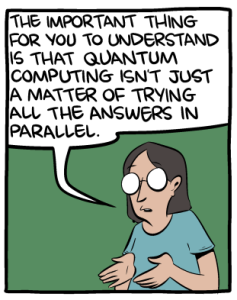
The Blog of Scott Aaronson If you take nothing else from this blog: quantum computers won't solve hard problems instantly by just trying all solutions in parallel.
Also, next pandemic, let's approve the vaccines faster!
Check out this statement on “The Cost of Knowledge” released today, which (besides your humble blogger) has been signed by Ingrid Daubechies (President of the International Mathematical Union), Timothy Gowers, Terence Tao, László Lovász, and 29 others. The statement carefully explains the rationale for the current Elsevier boycott, and answers common questions like “why single out Elsevier?” and “what comes next?”
Also check out Timothy Gowers’ blog post announcing the statement. The post includes a hilarious report by investment firm Exane Paribas, explaining that the current boycott has caused Reed Elsevier’s stock price to fall, but presenting that as a great investment opportunity, since they fully expect the price to rebound once this boycott fails like all the previous ones. I ask you: does that not want to make you boycott Elsevier, for no other reason than to see the people who follow Exane Paribas’ cynical advice lose their money?
In related news, the boycott petition now has 4600+ signatures and counting. If you’ve already signed, great! If you haven’t, why not?
Update (Feb. 9): There’s now a great editorial by Gareth Cook in the Boston Globe supporting the Elsevier boycott (and analogizing it to both the Tahrir Square uprising and the Boston Tea Party!).
If you’re in academia and haven’t done so yet, please take a moment to sign this online petition organized by Tyler Neylon, and pledge that you won’t publish, referee, or do editorial work for any Elsevier journals. I’ve been boycotting Elsevier (and most other commercial journal publishers—Elsevier is merely the worst) since 2004, when I first learned about their rapacious pricing policies. I couldn’t possibly be happier with my choice: unlike most idealistic principles, this one gets you out of onerous work rather than committing you to it! Sure, Elsevier is huge and we’re tiny, but the fight against them is finally gathering steam (possibly because of Elsevier’s support for the “Research Works Act”), years after the case against them became inarguable. Since their entire business model depends on our donating free labor to them, all it will take to bring them down is for enough of us to decide we’re through being had. We can actually win this one … Yes We Can.
For more information, see this wonderful recent post by Fields medalist and Shtetl-Optimized commenter Timothy Gowers, entitled “Elsevier — my part in its downfall.” (Added: also check out this great post by Aram Harrow.) You might also enjoy a parody piece I wrote years ago, trying to imagine how Elsevier’s “squeeze those dupes for all they’ve got” business model would work in any other industry.
A year ago, in a post entitled Anti-Complexitism, I tried to grapple with the strange phenomenon—one we’ve seenin force this past week—of anonymous commenters getting angry about the mere fact of announcements, on theoretical computer science blogs, of progress on longstanding open problems in theoretical computer science. When I post something about global warming, Osama Bin Laden, or (of course) the interpretation of quantum mechanics, I expect a groundswell of anger … but a lowering of the matrix-multiplication exponent ω? Huh? What was that about?
Well, in this case, some commenters were upset about attribution issues (which hopefully we can put behind us now, everyone agreeing about the importance of both Stothers’ and Vassilevska Williams’ contributions), while others honestly but mistakenly believed that a small improvement to ω isn’t a big deal (I tried to explain why they’re wrong here). What interests me in this post is the commenters who went further, positing the existence of a powerful “clique” of complexity bloggers that’s doing something reprehensible by “hyping” progress in complexity theory, or by exceeding some quota (what, exactly?) on the use of the word “breakthrough.”
One of the sharpest responses to that paranoid worldview came (ironically) from a wonderful anonymous comment on my Anti-Complexitism post, which I recommend everyone read. Here was my favorite paragraph:
The final criticism [by the anti-complexites] seems to be: complexity theory makes too much noise which people in other areas do not like. I really don’t understand this one, I mean what is wrong with people in an area being excited about their area? Is that wrong? And where do we make those noise? On complexity blogs! If you don’t like complexity theorists being excited about their area why are you reading these blogs? The metaphor would be an outsider going to a wedding and asking the people in the wedding with a very serious tone: “why is everyone happy here?”
Scott, you are missing the larger socio-economical context: it’s not about excitement. It’s about researchers competing for scarce resources, primarily funding. The work involved in funding acquisition is generally loathed, and directly reduces the time scientists have for research and teaching. If some researchers ramp up their hype-level vis-a-vis the rest of the community, as the complexity community is believed to be doing (what with all them Goedel awards?), they are forcing (or are seen as forcing) the rest either to accept a lower level of funding with all the concomitant disadvantages, or invest more time in hype themselves. In other words, hypers are defecting in the prisoners dilemma type game scientists are playing, the objective of which is to minimise the labour involved in funding acquisition.
This is similar to teeth-whitening: in the past, it was perfectly possible to be considered attractive with natural, slightly yellowish teeth. Then some defected by bleaching, then more and more, and today natural teeth are socially hardly acceptable, certainly not if you want to be good-looking. Is that progress?
I posted a response on Lance and Bill’s blog, but then decided it was important enough to repost here. So:
Dear Anonymous 2:47,
Let me see whether I understand you correctly. On the view you propose, other scientists shouldn’t have praised (say) Carl Sagan for getting millions of people around the world excited about science. Rather, they should have despised him, for using hype to divert scarce funding dollars from their own fields to the fields Sagan favored (like astronomy, or Sagan’s preferred parts of astronomy). Sagan forced all those other scientists to accept a terrible choice: either accept reduced funding, or else sink to Sagan’s level, and perform the loathed task of communicating their own excitement about their own fields to the public.
Actually, there were other scientists who drew essentially that conclusion. As an example, Sagan was famously denied membership in the National Academy of Sciences, apparently because of a few vocal NAS members who were jealous and resentful of Sagan’s outreach activities. The view we’re now being asked to accept is that those NAS members are the ones who emerge from the story the moral victors.
So let me thank you, Anonymous 2:47: it’s rare for anyone to explain the motivation behind angry TCS blog comments with that much candor.
Now that the real motivation has (apparently) crawled out from underneath its rock, I can examine it and refute it. The central point is simply that science isn’t a Prisoner’s-Dilemma-type game. What you describe as the “socially optimal equilibrium,” where no scientists need to be bothered to communicate their excitement about their fields, is not socially optimal at all—neither from the public’s standpoint nor from science’s.
At the crudest level, science funding is not a fixed-size pie. For example, when Congress was debating the cancellation of the Superconducting Supercollider, a few physicists from other fields eagerly jumped on the anti-SSC bandwagon, hoping that the SSC money might then get diverted to their own fields. Ultimately, of course, the SSC was cancelled, and none of the money ever found its way to other areas of physics.
So, if you see people using blogs to talk about research results that excite them, then instead of resenting it, consider starting your own blog to talk about the research results that excite YOU. If your blog is well-written and interesting, I’ll even add you to my blogroll, game-theoretic funding considerations be damned. Just go to WordPress.com—it’s free, and it takes only a few minutes to set one up.
Five years ago, not long after the founding of Shtetl-Optimized, I blogged about Alex Halderman: my best friend since seventh grade at Newtown Junior High School, now a famous security researcher and a computer science professor at the University of Michigan, and someone whose exploits seem to be worrying at least one government as much as Julian Assange’s.
In the past, Alex has demonstrated the futility of copy-protection schemes for music CDs, helped force the state of California to change its standards for electronic voting machines, and led a spectacular attack against an Internet voting pilot in Washington DC. But Alex’s latest project is probably his most important and politically-riskiest yet. Alex, Hari Prasad of India, and Rop Gonggrijp of the Netherlands demonstrated massive security problems with electronic voting machines in India (which are used by about 400 million people in each election, making them the most widely-used voting system on earth). As a result of this work, Hari was arrested in his home and jailed by the Indian authorities, who threatened not to release him until he revealed the source of the voting machine that he, Alex, and Rop had analyzed. After finally being released by a sympathetic judge, Hari flew to the United States, where he received the Electronic Frontier Foundation’s 2010 Pioneer Award. I had the honor of meeting Hari at MIT during his and Alex’s subsequent US lecture tour.
But the story continues. Earlier this week, after flying into India to give a talk at the International Conference on Information Systems Security (ICISS’2010) in Gandhinagar, Alex and Rop were detained at the New Delhi airport and threatened with deportation from India. No explanation was given, even though the story became front-page news in India. Finally, after refusing to board planes out of New Delhi without being given a reason in writing for their deportation, Alex and Rop were allowed to enter India, but only on the condition that they did so as “tourists.” In particular, they were banned from presenting their research on electronic voting machines, and the relevant conference session was cancelled.
To those in the Indian government responsible for the harassment of Alex Halderman and Rop Gonggrijp and (more seriously) the imprisonment of Hari Prasad: shame on you! And to Alex, Hari, and Rop: let the well-wishes of this blog be like a small, nerdy wind beneath your wings.
WARNING: This post makes (what turned out in retrospect to be) advanced use of sarcasm, irony, and absurdism. Indeed, even after I added a disclaimer explaining the sarcasm, many commenters still responded as if I actually favored gutting the National Science Foundation. (Unless, of course, those commenters were also being sarcastic—in which case, touche!)
The confusion is completely my fault. When I write a post, I have in my mind a reader who’s read this blog for a while, and knows that obviously I don’t favor gutting the fraction of a percentage of the Federal budget devoted to the progress of human understanding and American leadership thereof; obviously the NSF wastes plenty of money, but if it didn’t, then it would be doing a terrible job, because research is all about trying stuff that has a good chance of failure; obviously if you were seriously looking for waste, you could find orders of magnitude more of it in the military and elsewhere. So then the only remaining question is: how can we best have fun with a disgusting and contemptible situation? I forgot how many people come to this blog not having any idea who I am or why I’m writing—and for that, I sincerely apologize.
Now, if you’d like a sarcasm-detection challenge, I did leave lots of hints in the following post that I didn’t actually agree with Congressman Smith. See how many of them you can find!
As some of you may have heard, the incoming Republican majority in Congress has a new initiative called YouCut, which lets ordinary Americans like me propose government programs for termination. So imagine how excited I was to learn that YouCut’s first target—yes, its first target—was that notoriously bloated white elephant, the National Science Foundation. Admittedly, I’ve already tried to save NSF from some wasteful expenditures, in my occasional role as an NSF panel member. But this is my first chance to join in as a plain US citizen.
In a video explaining the new initiative, Congressman Adrian Smith concedes that the NSF supports “worthy research in the hard sciences,” but then gives two examples of NSF grants that strike him as wasteful: one involving collaboration among soccer players, the other involving modeling the sound of breaking objects. This article gives some more detail about the projects in question.
While I can’t wait to participate, I have a few questions before I start:
Exactly which sciences count as “hard”? Once the pitchforks are raised, how far do we go? Is math fair game? What about economics, cosmology, evolutionary biology?
Has there ever been a research project that couldn’t be described in such a way as to sound absurd? (“Even in the middle of a war, university academics in Chicago are spending taxpayer dollars in a quixotic attempt to smash teeny-tiny uranium atoms underneath a football field…”)
Years ago, several commenters on my and Lance’s blogs eloquently argued that science funding isn’t a traditional left vs. right issue, that Republicans are at least as friendly to science as Democrats, and that viewing the modern GOP as the “party of ignorance” is inaccurate, simplistic, and offensive. Would any of those commenters kindly help us understand what’s going on?
Let me end this post with a request: I want all of my readers to visit the YouCut page, and propose that quantum computing and theoretical computer science research be completely eliminated. Here’s my own CAREER Award; go ahead and cite it by number as a particularly egregious example of government waste.
See, I’m hungry for the honor (not to mention the free publicity) of seeing my own favorite research topics attacked on the floor of the House. As we all know, it’s child’s play to make fun of theoretical computer science: its abstruseness, its obvious irrelevance to national goals—however infinitesimal the cost is compared to (say) corn subsidies or defense contracts for stuff the military doesn’t want, however gargantuan the payoffs of such research have been in the past. So what are Reps. Eric Cantor and Adrian Smith waiting for? I dare them to do it!
Obviously, though, before the House Republicans end American participation in theoretical computer science, they’ll want to familiarize themselves with what our tiny little field actually is. To that end, let me humbly offer the links on the sidebar to the right as one place to get started.
Update (12/18): When a friend read this post, his first reaction was that the sarcasm would be lost on most readers. I didn’t believe him. See, I exist in a frame of reference wherein, when the mob shows up at your house with torches, you don’t argue with them. Instead you say: “Oh, so you’re the ones here to burn me? Then please, let’s get started! There’s plenty of flammable fat around my torso area. Do you prefer rare, medium, or well done?” That way, at least history will record you as having gone down with your middle finger proudly aloft, rather than cowering in a corner. However, it’s now obvious that my friend was right. So, for the literal-minded: I think reacting to our country’s debt crisis by looking for NSF grants to ridicule is a really terrible idea, for reasons that are so self-evident I’ll simply provide some blank space for you to fill them in yourself: _______________________________. And, having devoted my whole career to quantum computing and theoretical computer science research, I don’t wish to see them eliminated. On the other hand, if science in United States were going to be dismantled (which, despite the efforts of some politicians, I don’t think it will be), then I’d consider it an honor for theoretical computer science to be the first in the crosshairs.
As those of you in American academia have probably heard by now, this week the National Research Council finally released its 2005 rankings of American PhD programs, only five years behind schedule. This time, the rankings have been made 80% more scientific by the addition of error bars. Among the startling findings:
In electrical and computer engineering, UCLA and Purdue are ahead of Carnegie Mellon.
In computer science, UNC Chapel Hill is ahead of the University of Washington.
In statistics, Iowa State is ahead of Berkeley.
However, before you base any major decisions on these findings, you should know that a few … irregularities have emerged in the data used to generate them.
According to the NRC data set, 0% of graduates of the University of Washington’s Computer Science and Engineering Department had “academic plans” for 2001-2005. (In reality, 40% of their graduates took faculty positions during that period.) NRC also reports that UW CSE has 91 faculty (the real number is about 40). Most of the illusory “faculty,” it turned out, were industrial colleagues who don’t supervise students, and who thereby drastically and artificially brought down the average number of students supervised. See here and here for more from UW itself.
According to the NRC, 0% of MIT electrical engineering faculty engage in interdisciplinary work. NRC also reports that 24.62% of MIT computer science PhDs found academic employment; the actual number is twice that (49%).
The more foreign PhD students a department had, the higher it scored. This had the strange effect that the top departments were punished for managing to recruit more domestic students, who are the ones in much shorter supply these days.
The complicated regression analysis used to generate the scoring formula led to the percentage of female faculty in a given department actually counting against that department’s reputation score (!).
Ever since the NRC data were released from the parallel universe in which they were gathered, bloggers have been having a field day with them—see for example Dave Bacon and Peter Woit, and especially Sariel Har-Peled’s Computer Science Deranker (which ranks CS departments by a combined formula, consisting of 0% the NRC scores and 100% a random permutation of departments).
Yet despite the fact that many MIT departments (for some reason not CS) took a drubbing, I actually heard some of my colleagues defend the rankings, on the following grounds:
A committee of good people put a lot of hard work into generating them.
The NRC is a prestigious body that can’t be dismissed out of hand.
Now that the rankings are out, everyone should just be quiet and deal with them.
But while the Forces of Doofosity usually win, my guess is that they’re going to lose this round. Deans and department heads—and even the Computing Research Association—have been livid enough about the NRC rankings that they’ve denounced them with unusual candor, and the rankings have already been thoroughly eviscerated elsewhere on the web.
Look: if I really needed to know what (say) the best-regarded PhD programs in computer science were, I could post my question to a site like MathOverflow—and in the half hour before the question was closed for being off-topic, I’d get vastly more reliable answers than the ones the NRC took fifteen years and more than four million dollars to generate.
So the interesting questions here have nothing to do with the “rankings” themselves, and everything to do with the process and organization that produced them. How does Charlotte Kuh, study director of the NRC’s Assessment of Research Doctorate Programs, defend the study against what now looks like overwhelming evidence of Three-Stooges-level incompetence? How will the NRC recover from this massive embarrassment, and in what form should it continue to exist?
The NRC, as I had to look up, is an outfit jointly overseen by the National Academy of Sciences (NAS), the National Academy of Engineering (NAE), and the Institute of Medicine (IOM). Which reminded me of the celebrated story about Richard Feynman resigning his membership in the NAS. When asked why, Feynman explained that, when he was in high school, there was an “honor club” whose only significant activity was debating who was worthy of joining the honor club. After years in the NAS, he decided it was no different.
Now that I write that, though, an alternative explanation for the hilarious problems with the NRC study occurs to me. The alternative theory was inspired by this striking sentence from an Inside Higher Ed article:
When one of the reporters on a telephone briefing about the rankings asked Ostriker [the chairman of the NRC project committee] and his fellow panelists if any of them would “defend the rankings,” none did so.
So, were these joke rankings an elaborate ruse by the NRC, meant to discredit the whole idea of a strict linear order on departments and universities? If so, then I applaud the NRC for its deviousness and ingenuity in performing a much-needed public service.
Several people asked me to comment on an entry by Hartmut Neven in the Google Research Blog, about using D-Wave’s “quantum” computers for image recognition.
I said nothing: what is there to say? Didn’t I already spend enough time on this subject for 10400 lifetimes? I want to create, explore, discover things that no one expected—not be some talking-head playing his assigned role in a script, a blogger-pundit who journalists know they can rely on to say “f(X)” whenever X happens. Even if f(X) is true. Why can’t I just tell the world what f is and be done with it?
Then more people asked me to comment.
I set the matter aside. I worked on the complexity problem that’s currently obsessing me. I met with students, sent recommendation letters, answered emails, went ice-skating with my girlfriend.
Then more people asked me to comment.
And I thought: yes, I believe it’s vital for scientists to communicate with the broader public, not just a few colleagues. And yes, it’s important for scientists to offer a skeptical perspective on the news—since otherwise, they implicitly cede the field to those making dubious and unsubstantiated claims. And yes, blogging is a wonderful tool for scientists to connect directly with anyone in the world who’s curious about their work. But isn’t there some statute of limitations on a given story? When does it end? And why me?
Then more people asked me to comment—so I wrote the following only-slightly-fictionalized exchange.
Skeptic: Let me see if I understand correctly. After three years, you still haven’t demonstrated two-qubit entanglement in a superconducting device (as the group at Yale appears to have done recently)? You still haven’t explained how your “quantum computer” demos actually exploit any quantum effects? While some of your employees are authoring or coauthoring perfectly-reasonable papers on various QC topics, those papers still bear essentially zero relation to your marketing hype? The academic physicists working on superconducting QC—who have no interest in being scooped—still pay almost no attention to you? So, what exactly has changed since the last ten iterations? Why are we still talking?
D-Wave: Then you must not have read our latest press release! Your questions are all obsolete, because now we’re recruiting thousands of volunteers over the Internet to study the power of adiabatic quantum computing!
Onlooker: Hmm, an interesting counterargument! D-Wave might not be using quantum mechanics, but they are using the Internet! And their new project even has a cool code-name: “AQUA@home”! So, skeptic, how do you respond to that?
Skeptic (distractedly): You know, when I was eight years old, and dreamed of building starships and artificial intelligences in my basement, my first order of business was always to invent code-names—not just for the projects themselves, but for every little subcomponent of them. The second order of business was to think through the marketing aspects. What should the robot look like? What recreational facilities should be available on the starship, and what color should it be painted? It really, genuinely felt like I was making concrete progress toward realizing my plans. Sure, the engine and control system still needed to be built, but at least I had code-names and “design specs”! How many others had even gotten that far?
D-Wave: Who cares? This isn’t some children’s game. Keep in mind that we’re delivering a product—serving our customers, by solving the 4-by-4 Sudoku puzzles they rely on to keep their businesses running.
Skeptic: We’ve been through this how many times? A pigeon can probably be trained to solve 4-by-4 Sudokus. So the only relevant questions concern the details of how you solve them. For example, how do you encode a problem instance? How much of the work is done in the encoding procedure itself? What evidence do you have for quantum coherence at intermediate points of the computation? Can you measure an entanglement witness, to give people confidence that you’re doing something other than classical simulated annealing?
Onlooker: Hmm, those do seem like important questions…
D-Wave: But they’re based on outdated premises! Today, we’re pleased to announce that, using what might be a quantum computer, and might also be a noisy, probabilistic classical computer, we can solve 5-by-5 Sudoku puzzles!
Onlooker: Whoa, awesome! So we’re back to square one then. As long as D-Wave’s demos only involved 4-by-4 Sudokus, the skeptic’s arguments almost had me persuaded. But 5-by-5? I don’t know what to think anymore. Skeptic, where are you? What’s your reaction to this latest development?
Skeptic: …
D-Wave: That silence you hear is the sound of the skeptic’s worldview crashing all around him! But we haven’t even played our top card yet. Today, we’re positively ecstatic to announce that we’ve entered into an official-sounding partnership with GOOGLE, Inc. (or anyway, with someone who works at Google Research). Together, we’re harnessing the power of quantum adiabatic optimization to create the next generation of car-recognition systems!
Onlooker:WOW! This debate is over, then. I confess: D-Wave on its own did seem a bit flaky to me. But Google is the company born without sin. Everything they do, have done, and will ever do is perfect by definition—from building the search engine that changed the world, to running mail servers that only fail for an insignificant 0.001% of users, to keeping the Chinese people safe from lies. And, as Google is infallible, so too its 20,000 diverse employees—who are encouraged to spend 20% of their time on high-risk, exploratory projects—have nevertheless failed to come up with a single idea that didn’t pan out. Skeptic, show your face! Will you admit that, through grit, moxie, old-fashioned Canadian inventiveness, and the transformative power of the Internet, D-Wave has finally achieved what the naysayers said was impossible—namely, getting someone from Google Research to coauthor a paper with them?
Skeptic: Yes. I concede! D-Wave wins, and I hereby retire as skeptic. In particular, the next time D-Wave announces something, there’s no need to ask me for my reaction. I’ll be busy tending to my own project, codenamed ARGHH@home, which consists of banging my head against a brick wall.
In a New York Times column that exemplifies the highest instincts of science journalism, Dennis Overbye writes about two physicists’ idea that creating a Higgs boson is so abhorrent to the universe that backwards-in-time causal influences have conspired to prevent humans from seeing one—first by causing Congress to cancel the Superconducting Supercollider in 1993, and more recently by causing the faulty electrical connections that have delayed the startup of the LHC. (For reactions, see pretty much any science blog. Peter Woit writes that, with the exception of a defense by Sean Carroll, “pretty much all of [the blog chatter] has been unremittingly hostile, when not convinced that these papers must be some sort of joke.”)
One of the originators of the theory, Holger Bech Nielsen, sounded familiar, so I looked him up. It turns out I once heard him lecture about a plan to predict the specific masses and coupling constants of the Standard Model, by starting from the assumption that the laws of physics were “chosen randomly” (from which distribution was never exactly clear). It struck me at the time that we had a shnood among shnoods here, a leader in the field of aggressively-wrong physics.
However, I didn’t know at the time about Nielsen and his collaborator Masao Ninomiya’s universe-conspiring-to-stop-the-LHC proposal. Mulling over the new theory, I realized that it has the ring of truth about it. Specifically, assuming (as I do) that Nielsen and Nanomiya are correct, their theory can explain an bigger deeper mystery than why we haven’t yet seen a Higgs boson: namely, why haven’t I blogged for a month? Why, when there’s plenty to blog about … when I just spent two weeks at the Kavli Institute in Santa Barbara for their special semester on quantum computing, when I’m now at Schloss Dagstuhl, Germany, for an exciting, lower-bound-packed workshop on algebraic methods in computational complexity?
Clearly, the universe itself must have decided last month that this blog was so abhorrent to it, it would employ quantum postselection effects to force me to procrastinate whenever I would otherwise have posted something. An obvious corollary is that, if I do manage to post something nevertheless, it will bring about the immediate end of the universe.
The beautiful thing about science is that theories of this kind can be tested by observation. So:
Yesterday DJ Strouse, a student in MIT’s quantum computing summer school, pointed me to A Mathematician’s Lament by Paul Lockhart, the most blistering indictment of K-12 “math” education I’ve ever encountered.
Lockhart says pretty much everything I’ve wanted to say about this subject since the age of twelve, and does so with the thunderous rage of an Old Testament prophet. If you like math, and more so if you think you don’t like math, I implore you to read his essay with every atom of my being.
Which is not to say I don’t have a few quibbles:
1. I think Lockhart gives too much credit to the school system when he portrays the bureaucratization, hollowing-out, and general doofusication of knowledge as unique to math. In my experience, science, literature, and other fields are often butchered with quite as much gusto. Not until grad school, for example, had I sufficiently recovered from eleventh-grade English to give Shakespeare another try (or from Phys Ed do push-ups).
2. Lockhart doesn’t discuss the many ways motivated students can and do end up learning what math is, despite the best efforts of the school system to prevent it. These side-channels include the web, the books of Martin Gardner, recreational programming, and math competitions and camps. Obviously it’s no defense of an execrable system to point out how some people learn in spite of it—but these omissions make the overall picture too depressing even for me (which is really saying something).
3. In describing math purely as a soul-uplifting pursuit of beautiful patterns, Lockhart leaves open the question of why, in that case, it’s been in bed with science and technology throughout its history—not merely for the education bureaucrats but for Archimedes, Newton, and Gauss. (Of course, like most relationships, this one is not without its sniping feuds.) Personally I have no problem with teachers who want to recognize and celebrate that aspect of math, provided the students respond to it. “So you say you want theorems that are not only beautiful, but also inspired by physics or economics or cryptography? Line up then, because here comes a heaping helping of them…”
4. Lockhart doesn’t address an interesting problem that’s arisen in my own teaching over the last few years. Namely, what happens when you try to teach as he advocates—with history and philosophy and challenging puzzles and arguments about the definitions and improvisation and digressions—but the students want more structure and drill and routine? Should you deny it to them? (For myself, I concluded that brains come in different types, and that it would be presumptuous to assume a teaching style that wouldn’t work for me can’t possibly work for anyone else. Still, before beginning a traditional rote drill session, it’s probably a good idea for all parties involved to agree on a safe-word.)
In the end, Lockhart’s lament is subversive, angry, and radical … but if you know anything about math and anything about K-12 “education” (at least in the United States), I defy you to read it and find a single sentence that isn’t permeated, suffused, soaked, and encrusted with truth.
Update (April 4): I just finished reading Postmodern Pooh by Frederick Crews—a hilarious spoof of modern literary criticism, by someone who was the chair of Berkeley’s English department and understands the theories he’s ridiculing as well as anyone. I actually found Crews’ fake Marxist, feminist, and deconstructionist exegeses of Winnie the Pooh far more persuasive than the “serious” scholarship he “reverently” quotes. Crews seems to be breathing life into straw opponents here: making the obscurantist literary theories much more sensible and interesting than they really are, in order to give himself some challenge knocking them down. (The real fun comes when his intentionally goofy arguments start working on you—when you yourself can no longer read innocent passages about Eeyore, Piglet, and Tigger without seeing the simmering sexual innuendo and class struggle.) For anyone who likes the sort of books I discuss in this post, I recommend Postmodern Pooh in the strongest terms.
Several commenters on my last post asked why I’d waste time with Atlas Shrugged, given its evident flaws. The reason is simple: because when there’s so little literature that gets emotional about rationality, you’re tempted to take what you can. Throughout history, the weapons of art—poetry, literature, movies—have been deployed mercilessly against scientists, engineers, and anyone else so naïve or simplistic as to think there are “right” and “wrong” answers. Other times, a work of literature will praise “scientists,” but the science itself will be cringeworthy—and worse yet, the juvenile humor at the core of how science works will be absent, replaced by a wooden earnestness more in line with the writer’s preconceptions. Occasionally, though, what you might call the “satiric rationalist impulse” (if you were writing a PhD thesis about it) has found superb expression in literature. So in this post, I’d like to celebrate a few literary works that exemplify what appealed to me about Ayn Rand as a teenager—but do so without Rand’s shrill libertarianism, suspicion of modern science, or deification of Nietszchean quasi-rapist supermen.At the head of the list is the Dialogue Concerning the Two Chief World Systems by Galileo Galilei. I submit that Galileo’s greatest contribution here was not his account of how it could be possible for the Earth to go around the Sun even though we don’t feel the Earth’s motion. For that achievement was far surpassed by his creation of Simplicio: the amiable doofus (standing in for scholastic astronomers) who answers Salviati’s patient explanations with pompous Latin phrases and quotations from Aristotle. Apparently the main reason Galileo was hauled before the Inquisition was not his scientific arguments, which the Church assumed most people wouldn’t understand or care about anyway. Rather, Pope Urban VIII was outraged that Galileo put his (the Pope’s) own arguments about the limits of empirical thinking into the mouth of Simplicio.I find it interesting that Galileo’s dialogues are almost never assigned in high schools, despite being not merely among the most influential works of all time, but also uproariously funny. Why is that? After 400 years, is the parody still too barbed for some people’s taste?
Next on the list is Huckleberry Finn. Unlike Galileo’s dialogues, this one is assigned in American high schools. But the final chapters—the ones where Tom Sawyer proposes increasingly elaborate and fanciful schemes to rescue Jim, rejecting as insufferably naïve Huck’s idea of simply going to the shed and freeing him—tend to be downplayed or denigrated as comic fluff that detracts from the novel’s Deep Important Message. (It’s fun to imagine critics scratching their heads in bewilderment: what could Twain have been trying to say in the final chapters? Surely he wasn’t questioning the value of obfuscating the obvious?)
As far as I know, the only person ever to win a Nobel Prize in Literature for writing that was explicitly anti-obscurantist was Bertrand Russell. (Orwell might have gotten one had he lived longer; maybe a case could also be made for Churchill.) In retrospect, Russell’s clarity seems to have been a serious mistake: had he learned to write as cryptically as his student Wittgenstein, his reputation today would’ve been vastly greater. Alas, more recent “public rationalists”—such as Carl Sagan, Isaac Asimov, Richard Feynman, Steven Pinker, and Richard Dawkins—have repeated Russell’s mistake of boringly saying what they mean, and for that reason, have failed to produce any serious literature.
Any list of the world’s great anti-pomposity literature has to include Sokal’s Social Text hoax. But since the amount of ink already spilled about that illustrious hoax can only be explained using noncommutative (and hence nonlinear) chaos theory, let me address postmodernism using a more recent and less conventional choice: an interview with Priya Venkatesan conducted by The Dartmouth Review. For those with better things to do than follow academic blogs, Venkatesan is a former instructor at Dartmouth College who’s announced that she’s suing the students in her freshman writing seminar for harassment because they (1) argued with her ideas, (2) asked too many impertinent questions about French critical theory and deconstructionism, (3) didn’t accord her sufficient respect as someone with both a Masters and a PhD, and (4) submitted poor teaching evaluations. I know, it sounds like something some right-wing commentator would make up—which is why reading Venkatesan at length, in her own words, is so fascinating. The reason I put this interview on my list is not Venkatesan herself (eloquent though she is), but her interviewer, Tyler Brace. Brace seems acutely aware of his historical responsibility in interviewing this real-life Simplicio: the polite, faux-naïve questions give Venkatesan ample rope to hang not only herself, but (in my opinion) an entire academic subculture that made her possible.
My last entrant into the snarky rationalist canon is the recent poem Storm by Tim Minchin (see here for the YouTube version). It far surpasses my own feeble attempt at this sort of poetry: When I Heard the Learn’d Poet, which I wrote in 11th-grade English.
Look, there’s an obvious paradox in the idea of “rationalist literature.” Almost by definition, people who like rationality are going to want to write dry, methodical arguments, rather than novels or poems that bypass the neocortex and directly engage the emotions. But the consequence is that they’ll tend to cede the emotional field without contest to the woo merchants. If you want to defend yourself against obscurantist sharks, you need to enter the dark waters where the sharks live. That’s why, in my view, the rare efforts to do that—to right the historical imbalance, to sing Modus Ponens from the rooftops—are actually worth something. If you know of other good literature in this category, let me know in the comments section.