Moar Updatez
To start on a somber note: those of us at UT Austin are in mourning this week for Savitha Shan, an undergrad double major here in economics and information systems, who was murdered over the weekend by an Islamist terrorist who started randomly shooting people on Sixth Street, apparently angry about the war in Iran. Two other innocents were also killed.

As it happens, these murders happened just a few hours after the end of my daughter’s bat mitzvah, and in walking distance from the venue. The bat mitzvah itself was an incredibly joyful and successful event that consumed most of my time lately, and which I might or might not say more about—the nastier the online trolls get, the more I need to think about my family’s privacy.
Of all the many quantum computing podcasts/interviews I’ve done recently, I’m probably happiest with this one, with Yuval Boger of QuEra. It covers all the main points about where the hardware currently is, the threat to public-key cryptography, my decades-long battle against quantum applications hype, etc. etc., and there’s even an AI-created transcript that eliminates my verbal infelicities!

A month ago, I blogged about “The Time I Didn’t Meet Jeffrey Epstein” (basically, because my mom warned me not to). Now the story has been written up in Science magazine, under the clickbaity headline “Meet Three Scientists Who Said No to Epstein.” (Besides yours truly, the other two scientists are friend-of-the-blog Sean Carroll, whose not-meeting-Epstein story I’d already heard directly from him, and David Agus, whose story I hadn’t heard.)

To be clear: as I explained in my post, I never actually said “no” to Epstein. Instead, based on my mom’s advice, I simply failed to follow up with his emissary, to the point where no meeting ever happened.
Anyway, ever since Science ran this story and it started making the rounds on social media, my mom has been getting congratulatory messages from friends of hers who saw it!
I’ve been a huge fan of the philosopher-novelist Rebecca Newberger Goldstein ever since I read her celebrated debut work, The Mind-Body Problem, back in 2005. Getting to know Rebecca and her husband, Steven Pinker, was a highlight of my last years at MIT. So I’m thrilled that Rebecca will be visiting UT Austin next week to give a talk on Spinoza, related to her latest book The Mattering Instinct (which I’m reading right now), and hosted by me and my colleague Galen Strawson in UT’s philosophy department. More info is in the poster below. If you’re in Austin, I hope to see you there!

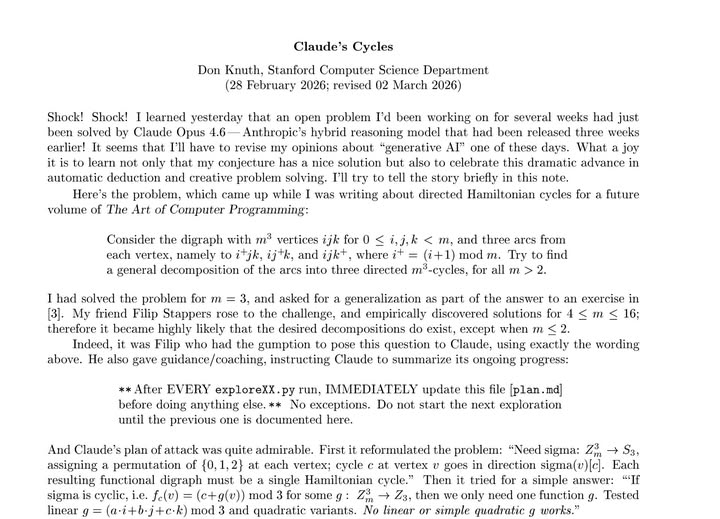
The 88-year-old Donald Knuth has published a 5-page document about how Claude was able to solve a tricky graph theory problem that arose while he was working on the latest volume of The Art of Computer Programming—a series that Knuth is still writing after half a century. As you’d expect from Knuth, the document is almost entirely about the graph theory problem itself and Claude’s solution to it, eschewing broader questions about the nature of machine intelligence and how LLMs are changing life on Earth. To anyone who’s been following AI-for-math lately, the fact that Claude now can help with this sort of problem won’t come as a great shock. The virality is presumably because Knuth is such a legend that to watch him interact productively with an LLM is sort of like watching Leibniz, Babbage, or Turing do the same.
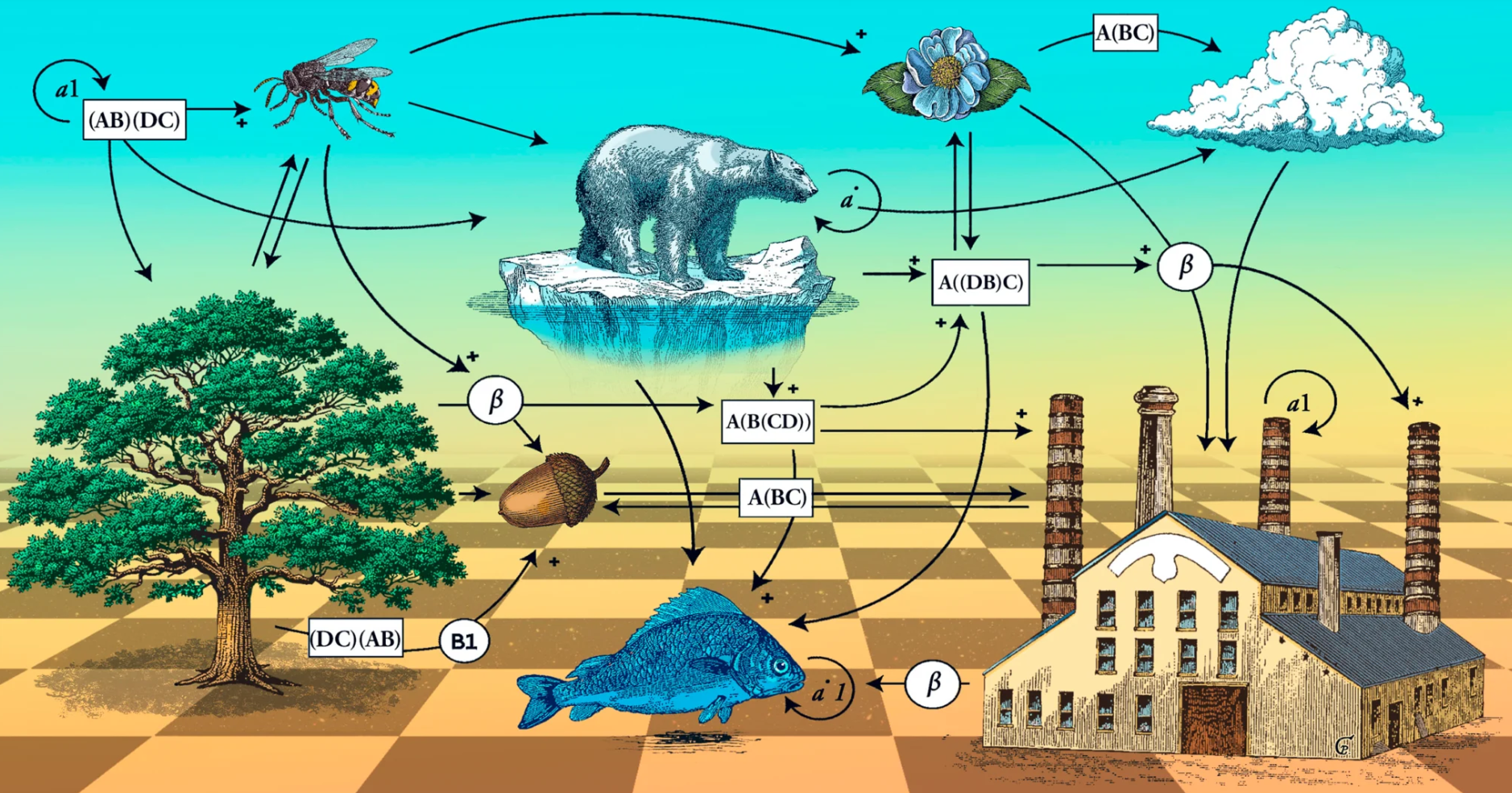
John Baez is a brilliant mathematical physicist and writer, who was blogging about science before the concept of “blogging” even existed, and from whom I’ve learned an enormous amount. But regarding John’s quest for the past 15 years — namely, to use category theory to help solve the climate crisis (!) — I always felt like the Cookie Monster would, with equal intellectual justification, say that the key to arresting climate change was for him to eat more Oreos. Then I read this Quanta article on the details of Baez’s project, and … uh … I confess it failed to change my view. Maybe someday I’ll understand why it’s better to say using category theory what I would’ve said in a 100x simpler way without category theory, but I fear that day is not today.
 Follow
Comment #1 March 5th, 2026 at 8:44 pm
I notice you are completely silent on the war in Iran itself. What do you think?
Comment #2 March 5th, 2026 at 9:51 pm
Sorry to hear about the terrorist attack in Austin. These things are always far scarier when they take place close to you and those you know and love. I hope you and your family are doing OK.
My family in Israel are running to bomb shelters every few hours for the past few days. Things are very scary right now.
And yet, I have a lot more hope for the future than I did last week. It seems like the United States and Israel are finally fighting a regime change war against the dictatorship in Iran. There is a chance that the Iranian people will soon be free, and the Middle East and the world will no longer have to put up with proxy terror groups and the threat of Ayatollahs with nukes. Hopefully things will get much better soon.
Comment #3 March 5th, 2026 at 10:54 pm
Hello Scott. I’ve been discussing within the Busy Beaver challenge online community and have an update: In terms of turing machines which are logically independent from formal theories (and the unprovability of the corresponding busy beaver number), the bound for ZFC has been lowered to BB(432), while new results have been made for the weaker theory of Peano Arithmetic (BB(372)) and the stronger theory of “ZFC+’There exists arbitrarily large subtle cardinals'” (BB(493)). Work is being done to try and engineer machines for stronger theories such as “ZFC+rank-into-rank cardinals”, although it is expected that the state count for this machine will be much higher, as while there were known simple first-order set theory [FOST] axiom lists which were equiconsistent with the theories of the current machines, this is not true for the rank-into-rank axioms, which in their usual formulation seem to require a bit of metamathematical/gödel-coding grunt work to give a FOST transcription.
A formal verification that these machines really are independent of their corresponding theories would also be helpful, as it is very possible that there are bugs in these results (they have not been thoroughly checked/peer-reviewed)
Comment #4 March 6th, 2026 at 12:25 am
Interesting updates! About Baez’s category theory project, I wonder when you say the Quanta article failed to change your view, do you mean you don’t understand that article, or do you mean you actually understand what Baez has been doing but that you simply can’t explain it in simple enough words?
In the second case, I think it’d be great if you could still share your understanding on Baez’s work. : )
I only have very basic understanding of category theory, on the level of morphisms and chain complexes, and I really have zero idea on Baez’s work even after reading the article twice.
Comment #5 March 6th, 2026 at 6:56 am
Dear Dr. Aaronson, Congratulations for your daughters bat mitzvah. I hope your family in Israel is safe. India stands with Israel now and forever.
Comment #6 March 6th, 2026 at 7:00 am
fumin #4: The article didn’t even try to dive into details of how applied category theory trades “the crystalline beauty of traditional mathematics” for “something slightly more earthy”. Instead, it gives the names of the people involved, and how their efforts are perceived by insiders and outsiders. I guess the hope is that a passage like “said Tom Leinster, a mathematician at the University of Edinburgh” motivates readers interested in details to click on such links. Those homepages typically make it easy too access the underlying work and details, both research papers and pedagogic books:
Books (all available free online):
Comment #7 March 6th, 2026 at 8:52 am
This was tragic and terrible for the victims and their families but I consider you were fortunate due to the coincident time and place in addition to the motive. Very fortunate in my view that his attack was unsophisticated.
I have spoken to many Muslim immigrants to the US and struck by the fact that many do believe that ultimately el-Mahdi will lead the Muslims to victory over the other peoples of the Earth.
Free Iran #1
I feel a sense of national pride that the US stands with Israel in this operation.
Comment #8 March 6th, 2026 at 12:03 pm
Free Iran! #1:
I notice you are completely silent on the war in Iran itself. What do you think?
Don’t you think that, if I’d meant to write a blog post about the Iran war, I would’ve done so?
It’s been enough for me to deal with my daughter’s bat mitzvah, and an unusual crush of responsibilities at UT, while also reading the news about Iran and Israel for hours every day. I’ve barely had time to form a considered response.
First and foremost, I’m thinking about my friends and family members in Israel, who are once again running to and from their missile shelters day and night, and I’m of course also thinking about my many friends and colleagues in Iran, who have braved literal state execution and the collapse of their economy in their struggle for freedom. I hope for a good outcome for the Persian and Israeli people alike. I hope they’ll soon resume the deep friendship that they had 2500 years ago as well as 50 years ago. I hope I’ll soon be able to visit Tehran to give a quantum computing talk.
I’m glad that the monstrous Khamenei and so many of his henchmen are now dead. I grieve for all the innocents who are dead.
I wish the US had been doing more for years, and I wish it was doing more right now, to arm and train and fund the opposition in Iran. This is their moment. May they seize the opportunity.
I don’t know whether launching this war, at this time, was a good idea or not. That depends on what happens next. But I’ll note that, unlike Americans at the left and right extremes who say “why on earth would the US launch an attack on the Ayatollah regime?,” I’m at least as curious to know “why wouldn’t it have done so at any point in the last 47 years? What took so long?”
I’d hope that all readers of this blog, regardless of disagreements about Israel, US politics, etc, could join me in praying for peace, freedom, and safety for the heroic Iranian people against their murderous government.
Comment #9 March 6th, 2026 at 1:28 pm
AF #2: Thanks, and I hope your family stays safe!
After the bat mitzvah, my wife’s parents were in a rush to return to Israel, back into the warzone, in what El Al calls its “rescue” flights—a term that might fully make sense only to Israelis. My wife’s sister is about to give birth in Tel Aviv, and it was non-negotiable that they be there for it.
Comment #10 March 6th, 2026 at 1:29 pm
tlonuqbar (cool Borgesian handle by the way) #3: Thank you so much for those fascinating updates on the BB function! They might even be worth another post on this blog! (Especially that there’s now finally a gap between the smallest n for which BB(n) is known to be independent of ZFC and known to be independent of PA.) But could you please give me a link with the details?
Comment #11 March 6th, 2026 at 1:34 pm
fumin #4: I just meant that I started the article open to being presented with a clear case of the form “more category theory → exciting new math and science → progress on climate change,” and that I closed the article still totally unclear about what the case was. And I know Natalie Wolchover well, and she’s a talented journalist, and I feel like if the case existed then she could have presented it.
Comment #12 March 6th, 2026 at 1:45 pm
Vrushali #5: Thanks so much! I stand with my many Indian friends and colleagues (a good number of whom were at the bat mitzvah, and one of whom had a great story about how it was only attending his friends’ bar mitzvahs that motivated her son to do his Upanayanam ceremony).
Comment #13 March 6th, 2026 at 1:54 pm
OhMyGoodness #7: There are of course hundreds of millions of devout Muslims who want nothing to do with this sort of barbarism, and one of the great challenges of the 21st century is how to empower them over the Islamists.
Comment #14 March 6th, 2026 at 2:54 pm
Scott #10: https://wiki.bbchallenge.org/wiki/Logical_independence this is probably the most up to date historically. All of these machines are designed to direct contradiction-searching ones. The weak-link here is probably the new TM compiler, and I don’t know how many eyes have examined and inspected it.
The base machine is the BB(432) ZFC machine, and the other machines are a modification of this. The ZFC machine has the rules of first order logic along with the theory ZFC, with some omissions that are known to keep the theory equiconsistent with ZFC.
The large cardinal machine adds the axiom of Choice and a statement showed by Harvey Friedman to be equivalent to the existence of a large cardinal: “∀a∃b∀c(∀d∀e(d∈c→((e∈d→e∈c)∧(e∈c→(¬d∈a→(¬e∈a→(∀f(f∈e→f∈d)→e=d))))))→c∈b)”
The PA machine removes all the set theory axioms and uses a single axiom schema “adjunction + separation” or “∀x∀y∃z∀w(w∈z↔((z∈x∨z=y)∧∀zP(x,y,z,w))” for all quaternary formulas P(x,y,z,w).
Comment #15 March 6th, 2026 at 3:11 pm
Scott #8: It’s not “Americans at the left and right extremes”; it’s the right extreme and essentially ALL of the left. I can count on one hand the number of politicians on the left who could have asked “What took so long?” I’ve always comfortably leaned left. As of this week, I’m not sure anymore.
Comment #16 March 6th, 2026 at 3:12 pm
I’m not necessarily opposed to an attack on Iran, but I also don’t trust the current administration further than I can throw it and consider them unqualified to deliver pizzas, let alone fight a war. (Remember that Signal chat?) I am also not happy that there was basically no attempt whatsoever to seek authorization from Congress or make a case for war to the American people. Bush’s invasion of Iraq in 2003 may very well have been a bad idea, but he at least didn’t start the war entirely on his own authority without offering more than a vague fig leaf of a justification.
(The maximally cynical interpretation of recent events would be that Trump started a war just so he could have the extra power given to a wartime President.)
Trump does things basically every week that would have gotten Nixon impeached and convicted several times over. 🙁
Comment #17 March 6th, 2026 at 4:20 pm
“Especially that there’s now finally a gap between the smallest n for which BB(n) is known to be independent of ZFC and known to be independent of PA.”
Excited for a new blog post on this! Happy to hear that your daughters bat mitzvah was such a joyous occasion Scott!
Comment #18 March 6th, 2026 at 5:33 pm
Doug S. #16
These are real events so it doesn’t matter if any of them can deliver pizzas or whatever other thoughts you have in your head about the principals. There will be an outcome and that outcome can be judged by all just as the successful Venezuelan operation outcome can be judged. Thus far it looks promising in that the usual ideological BS has been jettisoned ad it looks like an actual military operation with well defined goals.
Do you have any specific criticisms of the strategy or tactics thus far? A lot of progress already so interested in what you think should have been done differently.
Comment #19 March 6th, 2026 at 9:58 pm
>why wouldn’t it have done so at any point in the last 47 years? What took so long?
My two cents: when you produce enough oil, Hormuz stops looking like an existential threat.
https://wolfstreet.com/wp-content/uploads/2025/03/US-crude-oil-2025-03-03-crude-oil-production.png
Comment #20 March 6th, 2026 at 10:07 pm
In my experience “India stands with Israel now and forever” is a sentiment largely expressed by Indians online more closely aligned with the pro-Hindu Modi government, motivated by animosity towards Muslims.
Comment #21 March 7th, 2026 at 4:12 am
@16: Venezuela went fine as a military operation but what it actually accomplished, as far as I can tell, was pretty much nothing. Maduro is currently awaiting trial in the United States, but I haven’t seen any sign that his successor is going to do anything differently.
And Bush’s 2003 invasion of Iraq also went well at first. Hurting or even toppling the Iranian government is entirely possible; the biggest problem is that there’s nothing in place that can replace it, so “mission accomplished” will likely just be the prelude to chaos, just like in Iraq.
Comment #22 March 7th, 2026 at 9:43 am
Mahdi #15
A third of House Democrats couldn’t find it in themselves to affirm that Iran remains the largest state sponsor of terrorism. That’s a lot of extremists.
Comment #23 March 7th, 2026 at 11:45 am
Vladimir #22: Yes, but ALL BUT ONE in both House and Senate at best prefer strongly worded letters to actually doing something about the threat of the Islamic Republic regime.
Comment #24 March 7th, 2026 at 12:24 pm
Doug S #21
You didn’t mention where your knowledge of Venezuela derives from?
Here is a report from an NPR correspondent’s recent trip to Venezuela-
“ NPR correspondent Eyder Peralta was amazed during a segment Friday by his recent trip to Venezuela following President Donald Trump’s arrest of the country’s president Nicolás Maduro.”
“ And then you go out on the streets and people here tell you that they feel like a weight has been lifted”
“ He continued, “For the first time in a long time, there are street protests. Opposition groups are holding public meetings. I was at the justice department building yesterday, and there was a group of protesters calling for all political prisoners to be released.”
https://www.aol.com/articles/npr-reporter-stunned-venezuela-visit-230043654.html
I won’t go through again the logical problems of fact with analogizing Iraq and Iran but this video provides an indication of the response of the Iranian people that had no analogue in Iraq.
https://m.youtube.com/watch?v=pdpzm1zpb1A
The fact is that what was claimed would happen in Iraq and didn’t actually did happen in Iran. No Khameini sponsored death squads are roaming the streets killing unarmed civilians and no Khameini sponsored demons from hell are murdering women, children, and even babies in Israel. He was sent to hell and that is his rightful place to be with his minions that perpetrated horrific acts and had their transit tickets punched earlier.
The strategies are clearly different. No playing hide and seek to stand trial in Iran and no agreement to allow whomever rises to the top of the post Khameini power broker assemblages to assume control.
Comment #25 March 7th, 2026 at 12:31 pm
What is “applied category theory”? The Applied Category Theory Munich Meetup started by reading “Seven Sketches in Compositionality” by Fong and Spivak in October 2019. It is a nice book, even so the last chapter has many typos and feels less polished than the rest. It nicely sketches the essence of applied category theory. Next came “Basic Category Theory” by Tom Leinster, which took more than a year, and lost more than half of the group. It is an excellent book, but not applied, of course. Then came “Modal Homotopy Type Theory” by David Corfield, “Introduction to Coalgebra” by Bart Jacobs, “An informal introduction to topos theory” by Tom Leinster, “Picturing Quantum Processes” by Bob Coecke and Aleks Kissinger, various papers and more books. The group size recovered over time, even so we also tried “Entropy and Diversity: The Axiomatic Approach” by Tom Leinster.
gentzen #6:
The reason for this comment is to try to shed some light on the hopes of the proponents, beyond merely mentioning their books or papers. From section “1.1 First Encounters” in “Modal Homotopy Type Theory” by David Corfield (page 4):
What I might then have pursued was the ever-tighter embrace into which computer scientists, constructive type theorists and category theorists were entering. They were converging under the guidance of a vision dubbed by the computer scientist, Robert Harper, computational trinitarianism. Tongue in cheek, he glosses this position as follows:
The serious point is that these three corners allow a literal ‘triangulation’ of the value of a
new development put forward in any one of them. Any proposed construction in one field
had better make good sense in the other two.
Taking category theory as the representative of mathematics, he continues:
Comment #26 March 7th, 2026 at 1:14 pm
Doug S # 21
Also-
“Venezuela went fine as a military operation”
Does this imply that you consider this military operation was easier than delivering pizzas?
Comment #27 March 7th, 2026 at 1:51 pm
#20 , The prime minister of India, just 2 days before the war began, went all the way to Israel, and said before the Israeli parliament and for the whole world to hear, very loud and clear and “with full conviction” that 1.4 billion Indians stand with Israel now and forever. Lets not complicate things by trying to read between lines when things are spoken with such clarity. Jews came to India around 2000 years ago. Islam did not exist then. Everything need not revolve around whether someone has love or animosity towards muslims. Hindus can be friendly towards jews because we like them. Because we think they are brilliant and peace loving.
Comment #28 March 7th, 2026 at 3:22 pm
Hello Scott,
First, I wish to show solidarity and concern for the three innocent individuals killed over the weekend in Austin. That is unbelievably horrific, and a tragic loss of human life and potential. Scott, I am thankful that you and your family were safe, and I grieve for those who lost so much.
(I wish to now document great hesitation on my part to move on to another issue, as the first point is of infinite importance.)
Second, I have not read ‘The Mattering Instinct’ by Rebecca Goldstein, but I very much wish to do so! Goldstein is a philosophical force to be reckoned with, and she has many good, true, exciting, and rich observations! In my limited exposure to just her lectures, I have benefitted greatly. Is there any chance this will be recorded and posted on youtube? I would love to be a fly on the wall just to hear a conversation among you and Rebecca Goldstein and Galen Strawson! In particular, I would like to know her take on how facts about ‘mattering’ maps to the known positions in metaethics? Obviously, mattering is a normative concept or relation, and would therefore be subject to analysis in metaethical terms. (Perhaps more precisely, ‘should matter-ing’ is a normative concept or relation; i.e X has properties that *should* matter to other individuals, even if these other individuals do not in fact happen to care). How does her perspective of the ontology and fundamental nature of normative ‘shoulds’ about mattering differ from her mentor, Thomas Nagel’s, or are they the same? What does she think about Parfit’s and Huemer’s nonnaturalism about ethical and mathematical truths? Or Parfit and Bernard Williams dispute about internal vs external reasons (i.e. can reasons be nonHumean in nature)? (Parfit and Williams were both influential, but could not find agreement about the nature of reasons. I side with Parfit, while respecting the massive intellectual figure that was Williams)
Man, it would also be cool to get her opinion about Spinoza in relation to the mathematical sophistication and nontriviality in physical law. I remember a quote from her on Closer to Truth, where she said something exciting and unexpected: that perhaps the abstract mathematical beauty of the physical laws is related to the explanation for why they exist. In this case, explanatory reasons and normative reasons could be deeply connected: the reason that something exists (explanatory/causal), is a reason for something to exist (normative, in terms of aesthetics or ethics). That suggests (some form of) value-bias at the ultimate layer of reality, which produces all kinds of interesting philosophical consequences. But, this may all be a misunderstanding on my part, so I am definitely not claiming this is her position! I have some further thoughts about the basis of morality that I can remember Goldstein and PInker (both heroes!) making independently, but this post is already too long, so I will hold off for now.
Anyway, I love this blog and I definitely read it for its awesome science value, but I am most interested in (and enriched by) Scott’s occasional philosophical comments, which I have found extremely deep and helpful, and which produce so many unexpected connections, insights, etc. Thank you, Scott for science and philosophy, and an ethical passion for deep truth and justice!
Comment #29 March 7th, 2026 at 8:15 pm
#27, thanks for the education. I invite folks here to search for ‘India stands with Israel’ on X/twitter and check the timeline of those posting it to see their right-wing Hindu pro-Modi anti-Muslim stance for themselves. A search just now produced this one. https://x.com/HindutvaDon_/status/2028099148243972183
Comment #30 March 11th, 2026 at 3:16 am
Congrats on your daughter’s bat mitzvah.
Its horrible to hear how close these murders were to you.
Comment #31 March 13th, 2026 at 1:27 pm
On the Iran war, even without considering the specific negative effects of this poorly planned war, there are good reasons not to start a hot war. War is costly in many ways – lives lost, economic impacts, and effects on alliances.
Why start a war when economic containment and demographic shifts are working? The young Iranian generation is much more secular and anti-regime than the older generations. But now with their country under siege and civilians being killed, will they stay that way? Or will this end up being the regime’s biggest recruitment opportunity in decades?
And on the specifics of this war, so far the main beneficiary has been Russia which has suddenly been bailed out of it’s economic’s situation with the rising price of oil.
Comment #32 March 13th, 2026 at 6:14 pm
Scott,
I have been following your blog for years but have never posted my thoughts or comments. I really enjoyed your podcast with Yuval Boger, and Gil has a posted a response. See below. I don’t think it contradicts anything you said in the podcast. Also, loved your blog post on Scott Adams, it was very thoughtful.
https://gilkalai.wordpress.com/2026/03/10/scott-aaronsons-view-of-my-view-about-quantum-computing/